Sep 8, 2026
Automate complex Attending Physician Statement (APS) processing, accelerate risk decisions, and elevate STP rates with autonomous, human-in-the-loop multi-agent workflows.

A leading Tier-1 health insurance provider serving over 4.5 million policyholders transformed its manual medical underwriting process by deploying Subverse AI’s autonomous multi-agent orchestration platform. By automating the extraction of unstructured Attending Physician Statements (APS), electronic health records (EHR), and lab reports, Subverse AI increased Straight-Through Processing (STP) rates from 14% to 64%. The platform eliminated medical triage backlogs, reduced average underwriting turnaround time from 18 days to just 4 hours, and slashed policy acquisition operational overhead by $8.4M annually while maintaining 99.2% decision accuracy.
What Operational Challenges Was the Enterprise Facing?
Medical underwriting in individual and group health insurance requires evaluating extensive applicant health disclosures, medical histories, and lifestyle risk factors. Prior to partnering with Subverse AI, a major health insurer faced systemic operational bottlenecks that severely restricted underwriting velocity, escalated acquisition costs, and damaged customer satisfaction.

1. High Volume of Unstructured Medical Records
Over 75% of incoming applications required an Attending Physician Statement (APS) or historical EHR retrieval. Medical charts, clinical notes, and diagnostic lab reports often exceeded 200 pages per applicant. Human underwriters spent an average of 3.5 hours per file manually scanning dense, unstructured PDFs, hand-written clinical notes, and multi-page lab results to identify critical pre-existing conditions (PEDs) such as hypertension, type-2 diabetes, or cardiovascular anomalies.
2. Protracted SLA Cycle Times and Application Drop-Offs
The manual review process resulted in an average underwriting decision turnaround time (TAT) of 18 calendar days. This prolonged cycle time led to a 32% policy application abandonment rate, as prospective policyholders either opted for competitor plans with faster issue times or lost interest entirely during the extended waiting period.
3. Inconsistent Risk Rating and Underwriting Leakage
Manual parsing of clinical records under strict daily quota pressures introduced high decision variance across human underwriting teams. Inconsistencies in applying medical loading parameters, misinterpreting subtle ICD-10 code trends, or missing co-morbidities led to underwriting leakage—underpricing high-risk applicants while over-rating standard profiles.
4. Severe Underwriter Burnout and Scalability Limits
Underwriters spent 70% of their working hours performing repetitive administrative tasks—such as chasing missing medical records, verifying prescription histories with pharmacies, and manually re-keying data into core engines like Guidewire PolicyCenter—rather than evaluating complex, high-liability medical risks.
How Did Subverse AI Solve the Problem?
Subverse AI deployed an enterprise-grade, multi-agent orchestration solution that completely automated medical risk triage, document parsing, and policy decisioning while keeping human experts in control for high-risk boundary cases.
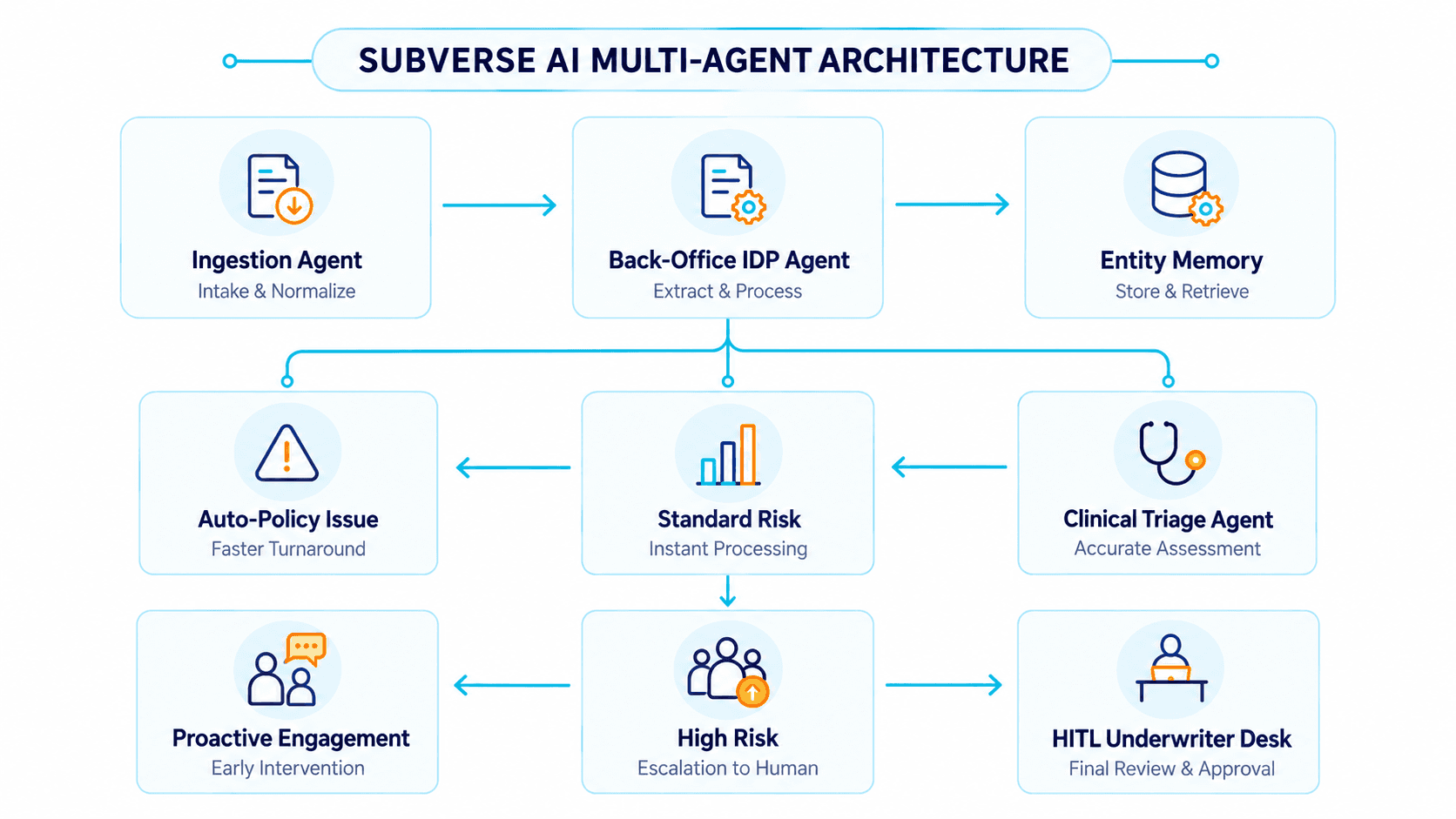
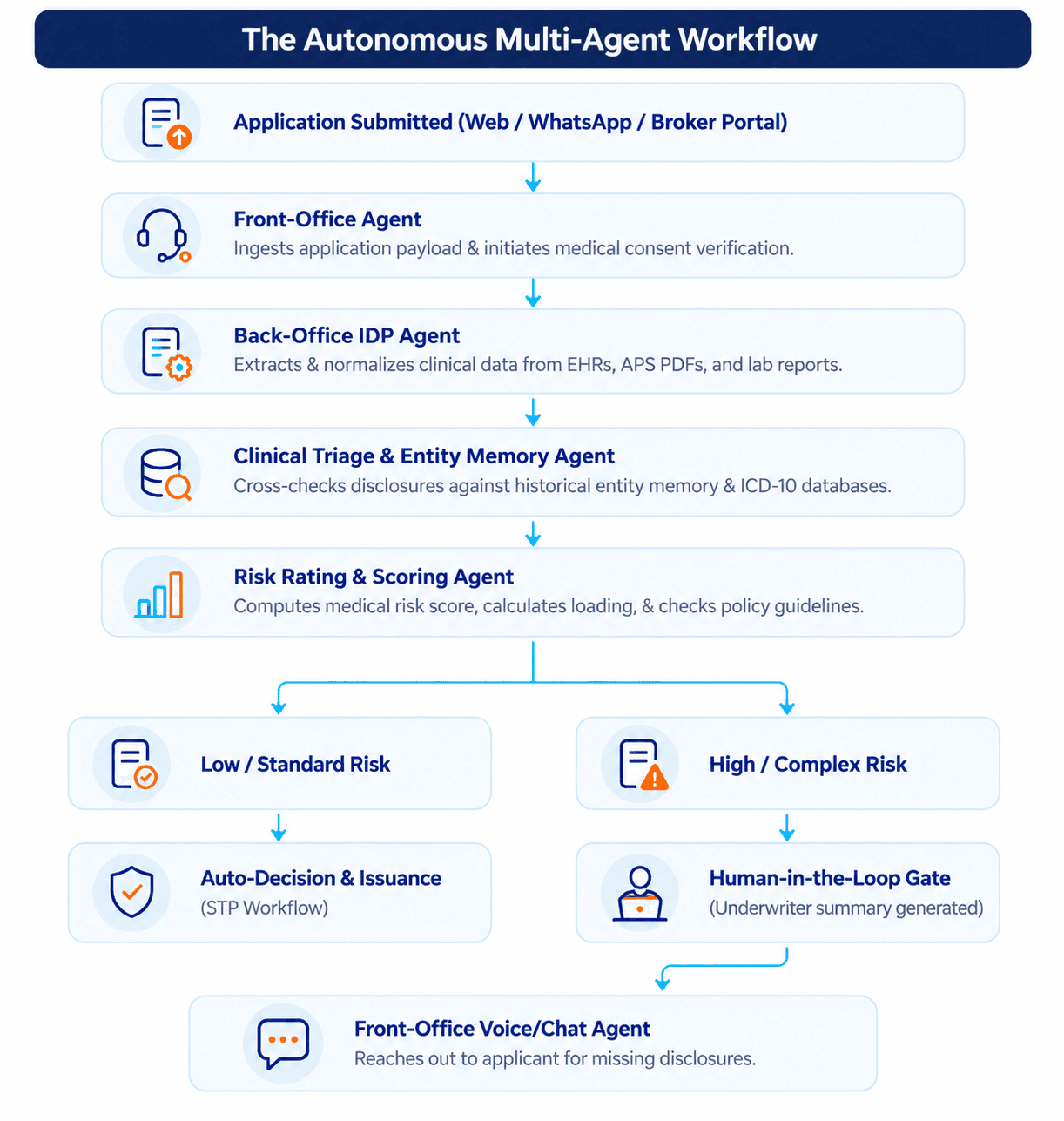
1. Ingestion & Multi-Channel Trigger Agent (Front-Office)
The moment an application is submitted via the web portal, mobile app, or broker API, Subverse AI’s Front-Office Ingestion Agent validates applicant declarations and automatically generates HIPAA-compliant digital authorization webhooks to retrieve EHR records and prescription history logs from network partners.
2. Intelligent Document Processing (IDP) Agent (Back-Office)
Unstructured medical records, APS documents, and scanned clinical notes are routed to Subverse AI’s Back-Office Vision & IDP Agent. Utilizing specialized multimodal clinical LLMs, the agent performs optical character recognition (OCR), parses complex medical terminology, categorizes lab trend markers (e.g., HbA1c, lipid profiles), and extracts structured diagnostic entities.
3. Clinical Triage & Entity Memory Agent (Back-Office)
Subverse AI’s persistent Entity Memory maintains a contextual temporal graph for every applicant. The Triage Agent correlates freshly extracted APS data with self-reported medical declarations, flagging discrepancies (e.g., undisclosed smoking habits, unstated hypertension prescriptions, or prior hospitalizations). It maps extracted conditions to ICD-10 medical coding trees and calculates historical risk vectors.
4. Risk Scoring & Policy Decisioning Agent (Back-Office)
Operating under the insurer's proprietary underwriting guidelines, this agent calculates the precise risk score, determines mandatory exclusion clauses, and computes premium loading percentages. If the applicant meets clean-file criteria, the agent automatically approves the policy via API integration with the Core Policy Administration System.
5. Human-in-the-Loop (HITL) Safety Checkpoint
For complex cases (e.g., severe multi-morbidity profiles, high sum-insured limits, or edge-case diagnostic markers), the system triggers a HITL approval gate. Subverse AI generates an executive 30-second Underwriting Summary Brief highlighting key clinical risks, flagged discrepancies, and recommended loading options, enabling a senior human underwriter to make a single-click decision.
6. Proactive Applicant Engagement Agent (Front-Office)
If an APS document is incomplete or additional medical clarity is required, Subverse AI’s Conversational Voice and Messaging Agent proactively reaches out to the applicant or clinic via outbound voice call, SMS, or WhatsApp to collect the specific missing information, eliminating weeks of email tag.
What System Integrations & Multimodal Architecture Were Implemented?
To ensure enterprise-grade reliability and low latency, Subverse AI orchestrated seamless communication across legacy core systems, clinical databases, and external communication networks:
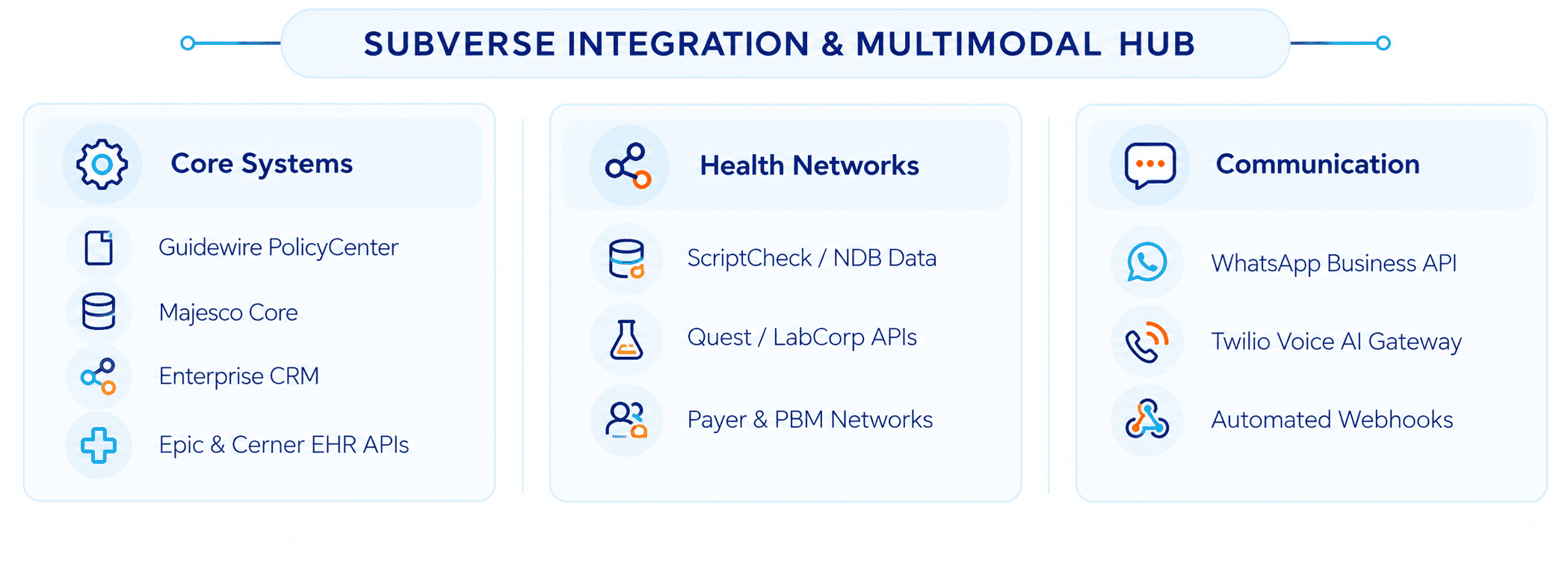
Core System & API Integrations
● Policy Administration Systems (PAS): Native REST/SOAP bi-directional connectors with Guidewire PolicyCenter and Majesco to pull policy rules and push final binding decisions.
● Health Information Networks: Direct API integrations with national EHR exchanges (Epic, Cerner), pharmacy prescription history clearinghouses (ScriptCheck), and medical information bureaus (MIB Group).
● CRM & Document Warehouses: Deep integration with Salesforce Health Cloud and enterprise document repositories (AWS S3, IBM FileNet) for secure document retrieval and archiving.
Multimodal Processing Stack
● Computer Vision & Clinical OCR: Engine trained on complex hand-written physician notes, unstructured clinical charts, and diagnostic imaging reports.
● Multimodal LLMs (BYOM/BYOA): Orchestrated domain-tuned medical models alongside open frameworks, allowing the insurer to Bring Their Own Model for specialized clinical NLP tasks.
● Omnichannel Front-Office Adapters: Integrated Voice AI agents via Twilio SIP trunks and conversational chat endpoints across WhatsApp Business API, Web Chat, and Email servers.
Traditional Approach vs. Subverse Autonomous AI Workflow
Parameter | Traditional Manual Underwriting | Subverse AI Autonomous Workflow |
End-to-End Turnaround Time (TAT) | 14 – 21 Calendar Days | < 4 Hours (Minutes for STP cases) |
Straight-Through Processing (STP) Rate | 14% (Strictly basic policies) | 64% (Automated clean-file issuance) |
Cost per Underwritten Application | $145.00 | $28.50 (80.3% cost reduction) |
Document Data Extraction Accuracy | 82% (Manual human error/fatigue) | 99.2% (Multimodal IDP verification) |
Underwriter Time Allocation | 70% Manual Ingestion / 30% Analysis | 10% Oversight / 90% High-Risk Analysis |
Application Drop-off Rate | 32% (Due to slow processing SLAs) | 4.1% (Near instantaneous issuing) |
Scalability & Peak Capacity | Limited by physical underwriter headcount | Infinite vertical cloud auto-scaling |
What Was the Business Impact and KPI Improvement?
Deploying Subverse AI transformed the insurer's underwriting operations from a costly bottleneck into a competitive growth advantage:
Cost & Operational Efficiency Metrics
● $8.4 Million Annual Savings: Direct reduction in third-party document processing vendor costs, manual data entry overhead, and administrative labor.
● 80.3% Operational Cost Reduction: Decreased cost per underwritten policy from $145.00 down to $28.50.
● 64% STP Rate: Achieved automatic policy generation for nearly two-thirds of all incoming individual health applications without human intervention.
Speed & SLA Metrics
● 99% Cycle Time Reduction: Average underwriting TAT dropped from 18 days to under 4 hours. Clean STP applications are now bound and issued in under 15 minutes.
● 10x APS Ingestion Throughput: Multimodal agents process and summarize 200-page APS medical charts in less than 45 seconds per document.
Quality, Risk & CSAT Metrics
● 99.2% Extraction Accuracy: Completely eliminated data entry leakage and manual misinterpretation of critical clinical markers.
● +42 Point CSAT Increase: Customer satisfaction scores surged due to rapid issue times and friction-free onboarding.
● 28% Increase in Policy Conversion: Drastically reduced application drop-off, capturing $18.2M in previously lost annual premium revenue.
Frequently Asked Questions (FAQ)
How does Subverse AI handle unstructured medical documents like Attending Physician Statements (APS)?
Subverse AI uses specialized back-office IDP agents equipped with multimodal clinical vision models. They OCR, extract, and normalize dense, hand-written physician notes, complex lab trends, and medical histories from multi-page PDFs into structured ICD-10 medical entities for automated risk evaluation.
Does Subverse AI replace human underwriters in health insurance?
No. Subverse AI automates repetitive document ingestion and routine low-risk decisions (raising STP rates) while leveraging Human-in-the-Loop (HITL) checkpoints. Complex, high-liability medical profiles are automatically summarized and routed to senior underwriters for final decision-making.
How does Subverse AI ensure HIPAA compliance and data security during underwriting?
Subverse AI is engineered with enterprise-grade security, featuring end-to-end encryption for data at rest and in transit, zero-data-retention options for sensitive health details, HIPAA compliance certifications, and fully configurable cloud or hybrid deployment models.
Can Subverse AI integrate with existing Core Policy Administration Systems like Guidewire?
Yes. Subverse AI features pre-built API connectors and webhook orchestration engines that integrate seamlessly with core platforms like Guidewire PolicyCenter, Majesco, and custom CRMs to read underwriting rules, extract historical entity data, and push final policy decisions.
How does Entity Memory improve health underwriting accuracy over time?
Subverse AI’s persistent Entity Memory tracks an applicant’s cross-channel interactions, past declarations, and historical medical records over time. This prevents duplicate data collection, catches medical disclosure inconsistencies, and ensures holistic risk evaluations across all touchpoints.
Table of Content
More Insights


