Sep 21, 2026
Deploy autonomous front-office and back-office AI agents to handle Voice/WhatsApp intake, inventory matching, dynamic pricing, and proactive follow-ups at scale.

A leading enterprise B2B travel platform connecting 45,000+ travel agents across Southeast Asia (Thailand, Indonesia, Vietnam) and the Middle East (Dubai) faced severe operational bottlenecks, taking up to 24 hours to generate custom travel itineraries and quotes. By orchestrating autonomous agent workflows using Subverse AI, the platform automated inbound Voice/WhatsApp lead intake, real-time supplier inventory matching, and dynamic price calculations. Proposal turnaround time dropped from 24 hours to under 3 minutes, boosting lead conversion by 38% while incorporating Human-in-the-Loop (HITL) safety gates for complex custom requests.
What Operational Challenges Was the Enterprise Facing?
The client operates as a major B2B travel distribution hub and Destination Management Company (DMC) network. They serve a network of over 45,000 retail travel agents submitting customized package requests for destinations including Thailand, Indonesia, Vietnam, Dubai, and Europe.
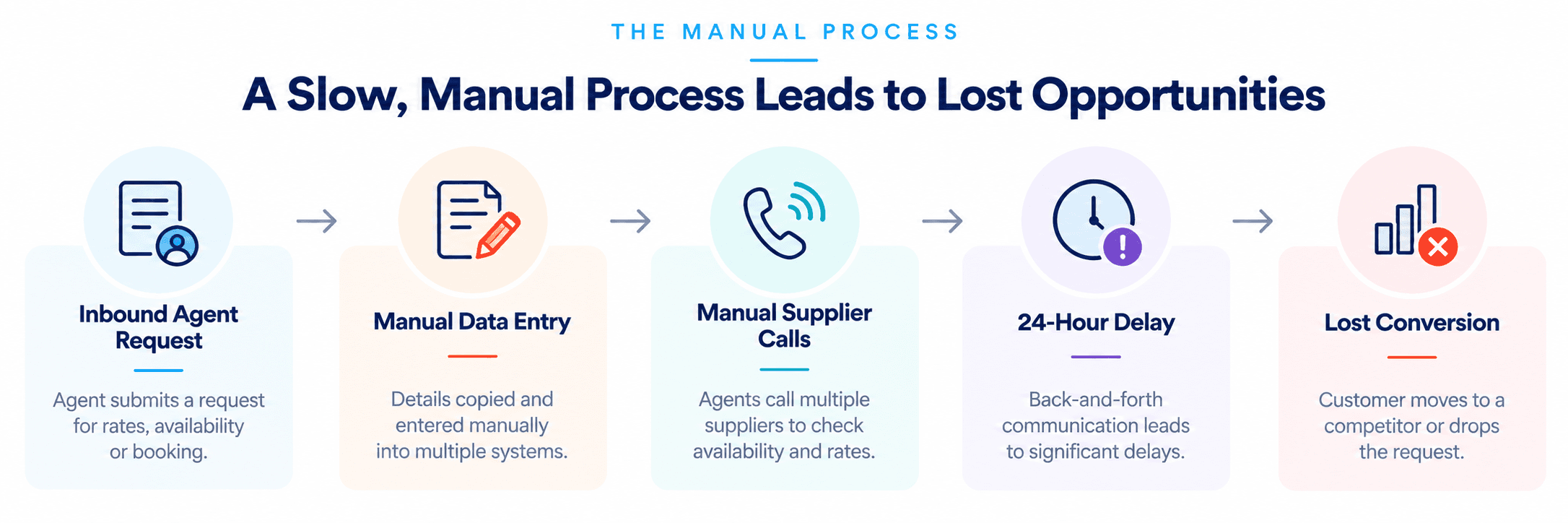
1. The 24-Hour SLA Bottleneck
Retail travel agents expect near-instant answers when dealing with end-travelers. Legacy operations required manual coordination between internal DMC teams, contracted hotel providers, local cab fleets, and tour management suppliers. Manually checking availability, calculating tiered markups, and assembling a day-wise itinerary created a strict 24-hour response turnaround, causing high agent attrition and lost bookings.
2. High Drop-off Rates Across Unstructured Channels
Inquiries poured in continuously via phone calls and unstructured WhatsApp messages. Operational teams spent hours manually re-keying trip dates, traveler preferences, and budget constraints into internal spreadsheets and CRM systems, introducing human error and slow response times.
3. Ineffective Manual Follow-up Loops
Once a quote was dispatched, sales operations lacked the operational bandwidth to execute timely follow-up sequences with retail travel agents. Furthermore, when complex package customizations stalled on internal human supervisor desks, inquiries frequently went cold without automated reminders or accountability tracking.
How Did Subverse AI Solve the Problem?
Subverse AI deployed an enterprise multi-agent orchestration architecture. Front-office conversational agents handle initial intake, while back-office autonomous agents query live inventories, construct detailed day-wise itineraries, and execute dynamic pricing logic.
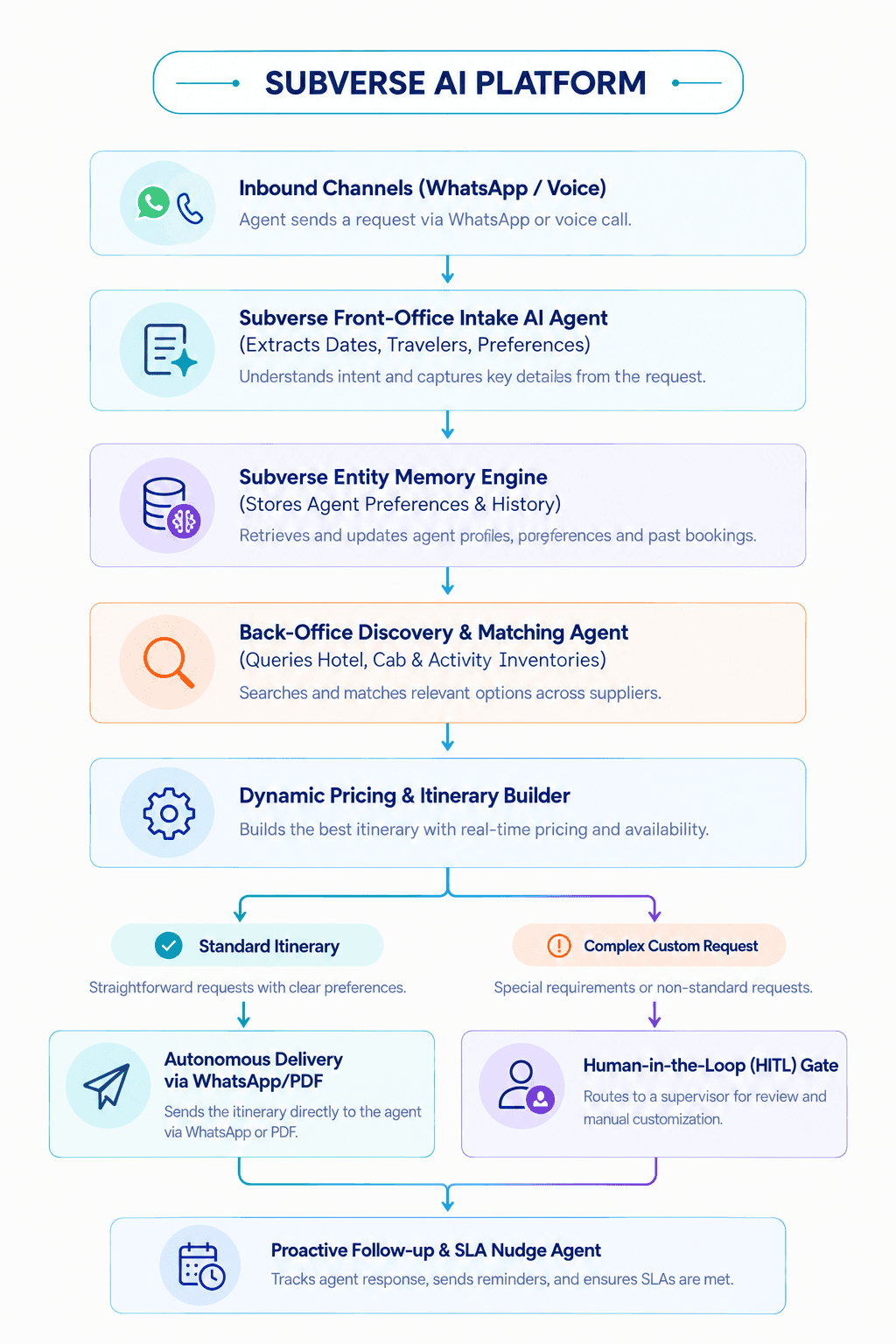
Agent Workflow & Orchestration Step-by-Step
Step 1: Multi-Channel Front-Office Intake
● Trigger: An incoming WhatsApp message or voice phone call from a registered retail travel agent.
● Execution: Subverse Front-Office Voice/Chat Agents engage the agent in natural conversation. The agent extracts key parameters: trip dates, adult/child counts, hotel ratings, activity preferences, and budget limits.
● Entity Memory Persistence: All extracted parameters are tied to the retail agent's profile inside the Subverse Entity Memory engine. The system recognizes historical booking patterns, preferred margins, and past traveler interactions automatically.
Step 2: Back-Office Inventory Matching & Supplier Querying
● Execution: Back-Office AI Agents execute automated API payloads to query live availability across contracted supplier databases:
○ Hotel availability and negotiated B2B room rates.
○ Local transport and private cab availability across destination cities.
○ Partner tour management companies and activity slots (e.g., island-hopping tours in Thailand, desert safaris in Dubai).
Step 3: Day-Wise Itinerary Assembly & Dynamic Pricing
● Execution: The Itinerary Generation Agent structures a day-by-day, itemized schedule aligned with traveler preferences.
● Pricing Engine: A specialized pricing agent calculates real-time costs, applies the DMC’s dynamic margin rules, adds agent commissions, and generates a formatted interactive web link and downloadable PDF quote.
Step 4: Human-in-the-Loop (HITL) Safety Gate
● Trigger: Requests involving high-level customizations (e.g., VIP helicopter transfers, non-standard group sizes >50, or extreme itinerary modifications).
● Execution: Subverse AI routes the request to a human supervisor console with full state context pre-populated. The human supervisor approves or modifies the quote with a single click, allowing the agent workflow to resume without losing state history.
Step 5: Proactive Agent Follow-Ups & Escalation Management
● Agent Follow-Up: Subverse AI proactively tracks quote statuses. If the retail travel agent has not responded within 4 hours, the agent sends contextual follow-up nudges over WhatsApp.
● Internal Escalation SLA: If an escalated quote remains pending on an internal human supervisor’s desk beyond 15 minutes, Subverse AI automatically alerts operational leads to prevent internal bottlenecks.
What System Integrations & Multimodal Architecture Were Implemented?
To deliver end-to-end automation, Subverse AI was integrated across the platform's tech stack:
● Communication Ingestion Layer: Integrated directly with WhatsApp Business API and SIP/Telephony cloud trunks for high-fidelity Voice AI interaction.
● DMC Core ERP & Inventory APIs: Webhook-driven integration with core inventory engines, local supplier databases, and tariff sheets.
● Multimodal Document Processing Engine: Back-office agents parse incoming PDF rate cards from non-API hotel partners using Intelligent Document Processing (IDP) and Vision LLMs.
● Subverse Entity Memory Engine: Centralized memory architecture maintaining contextual state across sessions, channels, and agent interactions.
Traditional Approach vs. Subverse Autonomous AI Workflow
Operational Parameter | Traditional Legacy DMC Process | Subverse AI Autonomous Workflow |
Response Turnaround Time (SLA) | 24 Hours (1 Business Day) | < 3 Minutes |
Inbound Lead Intake | Manual phone logging & WhatsApp reading | Automated Voice & WhatsApp Conversational AI Agents |
Inventory & Pricing Check | Manual calls/emails to local tour suppliers & hotels | Automated REST API lookups & real-time pricing calculation |
Itinerary Generation | Manual copying into Word/PDF templates | Autonomous, day-wise customized itinerary assembly |
Complex Customization Handling | Unstructured email loops, high risk of lost context | Human-in-the-Loop (HITL) triggers with full context state |
Travel Agent Follow-Ups | Ad-hoc manual messaging by busy agents | Autonomous, scheduled nudge loops until conversion |
Internal Escalation Tracking | Manual management check-ins | Automated internal supervisor alerts for pending tasks |
Scalability | Linear (Requires adding operational headcount) | Exponential (Handles 10x query spikes with 0 added staff) |
What Was the Business Impact and KPI Improvement?
Deploying Subverse AI transformed the B2B travel platform's core operational metrics:
Speed & SLA Metrics
● 98% Reduction in Response Time: Quotation and itinerary turnaround dropped from 24 hours down to <3 minutes.
● 92% Straight-Through Processing (STP) Rate: Over 90% of custom itinerary requests were generated and delivered completely autonomously without human intervention.
Cost & Efficiency Metrics
● 78% Reduction in Cost per Quotation: Drastically lowered manual back-office processing costs.
● 10x Operational Capacity Expansion: The platform effortlessly handled peak travel season demand surges across 45,000+ connected agents without hiring seasonal temp staff.
Quality & Revenue Metrics
● 38% Increase in Lead Conversion: Delivering instant, accurate proposals prevented travel agents from shopping around with competing DMCs.
● 100% Escalation SLA Adherence: Automated internal nudge loops ensured zero human-escalated quotes were dropped or delayed.
● 4.8/5 Agent CSAT: Retail travel agents reported significantly higher satisfaction due to immediate quote availability on WhatsApp.
Frequently Asked Questions (FAQ)
How does Subverse AI handle complex custom DMC itinerary requests?
Subverse AI uses business rule filters to identify complex requests. If a quote requires custom arrangements outside platform rules, it triggers a Human-in-the-Loop (HITL) gate, escalating the request to a supervisor console along with full context.
Can Subverse AI integrate with legacy DMC ERPs and WhatsApp channels?
Yes. Subverse AI connects via REST APIs and webhooks to legacy DMC booking systems, hotel databases, WhatsApp Business API, and cloud telephony platforms, keeping data synchronized across channels in real time.
How does the platform manage proactive follow-ups with travel agents?
Subverse AI features proactive communication scheduling. It monitors quote statuses and sends contextual WhatsApp or email nudges to travel agents until leads convert or close, while tracking internal escalation SLAs.
What is Entity Memory in Subverse AI travel automation?
Entity Memory maintains persistent context for travel agents and customers across interactions. It remembers past destination preferences, negotiation habits, commission structures, and interaction history to personalize touchpoints automatically.
Does Subverse AI support multi-destination package creation?
Yes. Front-office and back-office agents orchestrate multi-destination itineraries across regions like Thailand, Vietnam, Indonesia, and Dubai, aggregating hotel, activity, and transport pricing into a unified, day-wise proposal instantly.
Table of Content
More Insights


