Aug 27, 2026
Streamline garage inspections, multimodal repair validation, and proactive customer communications with Subverse AI's multi-agent workflows.

A leading Tier-1 digital auto insurance enterprise transformed its network garage repair tracking and claim processing by deploying Subverse AI. Using Subverse AI’s multi-agent orchestration platform, front-office voice and chat agents—combined with back-office multimodal vision, policy, and pricing agents—automated garage inspections, work order approvals, and proactive status updates. The implementation reduced claim cycle times by 68%, eliminated manual follow-up overhead, and increased customer CSAT by 38%.
What Operational Challenges Was the Enterprise Facing?
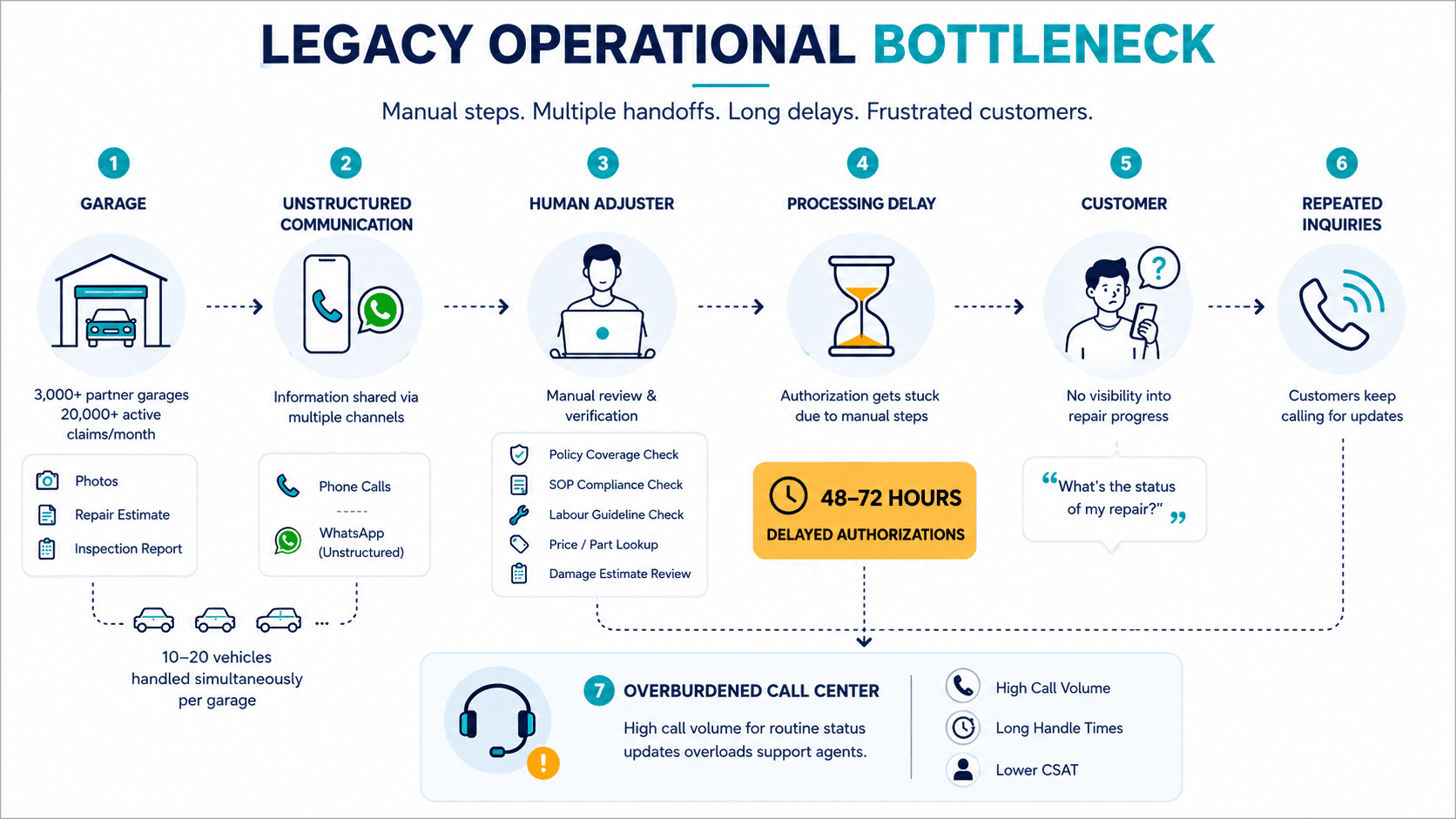
The enterprise manages a nationwide network of over 3,000 cashless partner garages, processing more than 20,000 active vehicle repair claims every month. Under cashless network policies, the insurer assumes full operational accountability for supervising repair lifecycles, validating estimates, and keeping policyholders informed. However, the legacy operational workflow was bogged down by heavy manual overhead and communication bottlenecks:
● Fragmented Partner Communication: Claim adjusters relied on manual phone calls and unstandardized WhatsApp messages to gather initial vehicle inspection reports, damage photographs, and repair estimates from garage managers.
● Severe Processing Delay & Bottlenecks: Manual verification of damage estimates against policy coverage terms, standard operating procedures (SOPs), and labor guidelines created a 48-to-72-hour delay before work orders could be authorized.
● Spare Part Cost Inflation: In the absence of automated real-time cross-referencing against standard pricing catalogs, estimate inflation and part substitution errors generated significant claim leakage.
● High Call Center Volume: Frustrated policyholders constantly dialed into customer support lines to check repair progress, tying up front-office agents with routine status query calls.
● Loss of Dual-Entity Context: Individual partner garages typically handle 10 to 20 insurer vehicles simultaneously. Human agents frequently struggled to maintain context across concurrent claims, resulting in misallocated repair updates and misplaced photo proof.
How Did Subverse AI Solve the Problem?
The enterprise deployed Subverse AI to orchestrate an end-to-end autonomous agent workflow across front-office customer channels, garage communication interfaces, and back-office claim decision systems.
1. Multi-Agent Agentic Workflow Breakdown
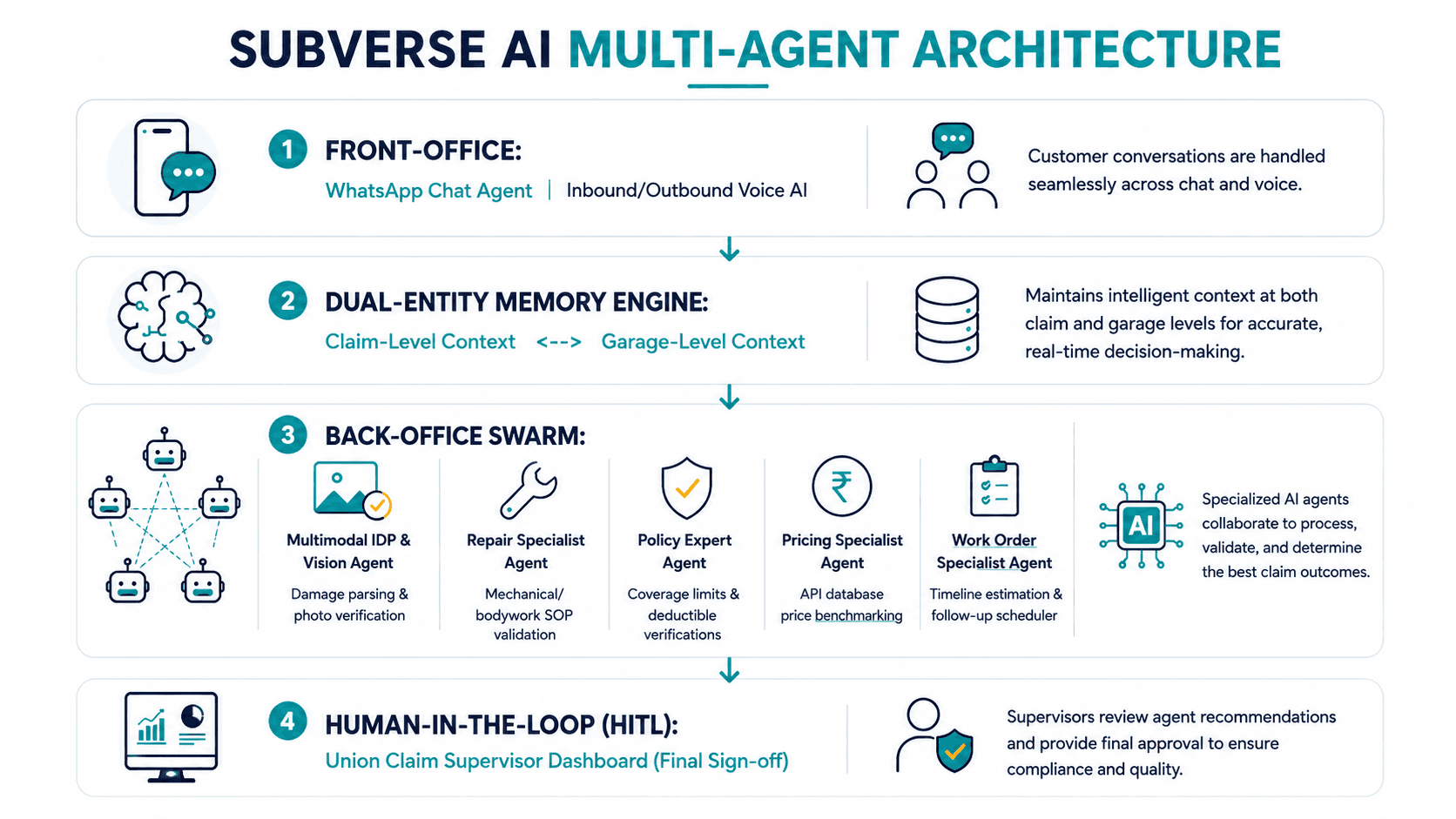
1. Omnichannel Intake & Vehicle Inspection: When a vehicle arrives at a partner garage, Subverse AI’s outbound Voice AI Agent or WhatsApp Chat Agent automatically initiates contact with the garage. The garage submits initial findings, damage assessments, and vehicle photographs directly through voice or WhatsApp messaging.
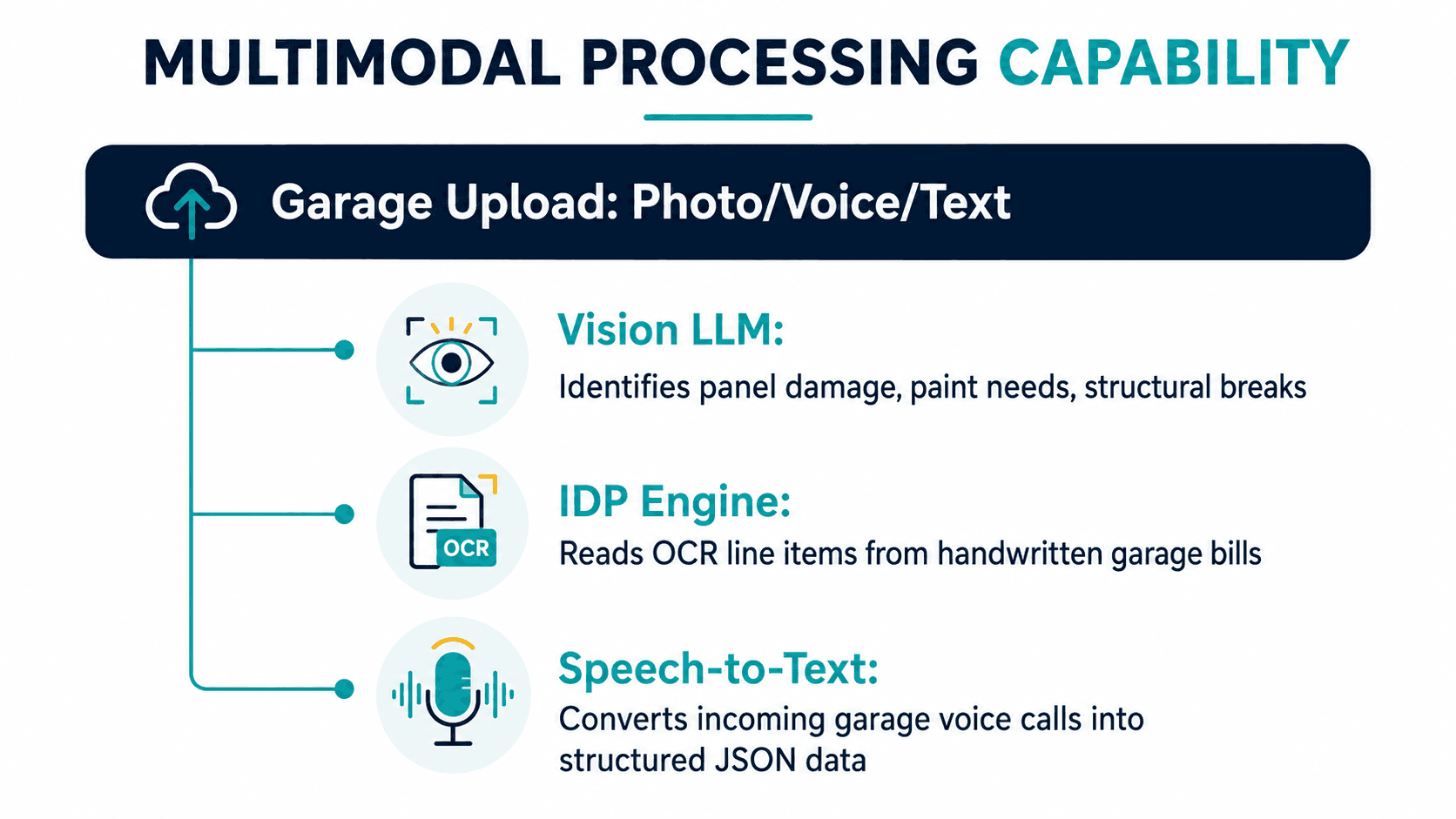
2. Multimodal Vision & IDP Extraction: The Multimodal Vision Agent processes incoming images, extracting visual evidence of structural damage, panel scratches, or mechanical wear, while the Intelligent Document Processing (IDP) module parses attached paper estimates or text payloads.
3. Back-Office Reasoning & Underwriting Swarm:
○ Repair Specialist Agent: Evaluates whether the identified physical damage matches the reported accident cause and verifies whether proposed repairs follow recommended enterprise guidelines.
○ Policy Expert Agent: Cross-checks the claim against policy terms, active endorsements, SOP coverage parameters, and deductible structures.
○ Pricing Specialist Agent: Queries central parts databases via real-time API payloads to benchmark estimated spare part costs against standard enterprise rate cards.
○ Work Order Specialist Agent: Calculates estimated repair timelines based on spare part delivery schedules and standard labor hours, generating a pre-filled digital work order.
4. Human-in-the-Loop (HITL) Authorization: Once verified by the agent swarm, the digital work order is routed to the claim handler dashboard. The human supervisor reviews the pre-validated package and approves the request with a single click.
5. Proactive Follow-ups & Lifecycle Tracking: Subverse AI schedules proactive follow-up triggers based on the approved repair timeline. Every morning or at pre-set intervals, the outbound WhatsApp/Voice agent checks in with the garage. Upon repair completion, the system requests final proof photos, which the Vision Agent validates before notifying the claim handler for final approval.
6. Customer Communication & Inquiry Handling: When customers reach out via WhatsApp or call the helpline, Subverse AI's Front-Office Agents query the entity memory engine to deliver precise, live repair status updates without requiring human agent intervention.
2. Dual-Entity Memory Architecture
To eliminate context loss, Subverse AI implemented a two-dimensional memory engine:
● Claim-Level Entity Memory: Tracks the complete lifecycle, uploaded media, active work orders, historical status changes, and communication threads for each unique claim ID (CLM-XXXXX).
● Garage-Level Entity Memory: Maintains state for each partner garage (GAR-YYYYY). When a garage manager sends an unstructured update like "The bumper is painted," the engine contextualizes the sender's phone number, checks all active claims assigned to that garage, and uses conversation cues to map the update to the correct vehicle.
What System Integrations & Multimodal Architecture Were Implemented?
The deployment connected Subverse AI’s orchestration platform with legacy systems, messaging networks, and enterprise databases via real-time webhooks and REST APIs.
Core System Integrations
● Core Insurance Claims Engine: Deep integration with enterprise claim platforms via webhooks to update claim statuses, trigger payouts, and issue approved work orders.
● Enterprise ERP & Parts Pricing Database: Direct API connections to central master pricing catalogs for real-time spare part cost validation.
● WhatsApp Business API: Webhook-driven communication pipeline for receiving damage photos, sending structured interactive messages, and delivering status notifications.
● Telephony PBX & SIP Trunking: Ultra-low latency Voice AI streaming pipelines for conversational inbound and outbound garage intake calls.
Multimodal Processing Capability
Traditional Approach vs. Subverse Autonomous AI Workflow
Parameter | Legacy Manual Process | Subverse AI Autonomous Workflow |
Inspection & Estimate Submission | Manual phone calls, manual email exchanges, unstandardized photos | Omnichannel Voice/WhatsApp intake with automated multimodal parsing |
Repair & SOP Validation | Human adjusters manually reviewing physical guidelines (24–48 hours) | Instant assessment by Repair & Policy Specialist Agents (< 2 minutes) |
Part Price Verification | Manual checks against physical rate cards | Automated real-time API query by Pricing Agent |
Garage Follow-up Management | Manual phone outreach by call center operators | Proactive scheduled follow-ups via automated Voice & WhatsApp workflows |
Multi-Vehicle Context Handling | High error rate when garages manage 10+ vehicles concurrently | Dual-Entity Memory mapping conversations to exact Claim and Garage IDs |
Turnaround Time (STP Rate) | 48 to 72 hours for work order issuance | Under 20 minutes (with 82% Straight-Through Processing) |
Human Supervision | Exhaustive manual input at every stage | Single-click Human-in-the-Loop (HITL) supervisory gate |
What Was the Business Impact and KPI Improvement?
Deploying Subverse AI radically improved operational efficiency, straight-through processing rates, and policyholder satisfaction scores across the enterprise's cashless garage network.
Cost & Efficiency Metrics
● 64% Reduction in Operational Costs: Drastically reduced manual processing overhead across garage coordination and claim underwriting teams.
● 82% Straight-Through Processing (STP) Rate: Over four-fifths of routine garage estimates passed directly through agent verification to human sign-off without manual rework.
● $3.8M Annual Claim Leakage Savings: Automated spare part price benchmarking and strict SOP alignment eliminated line-item inflation.
Speed & SLA Metrics
● 68% Faster Cycle Time: Average turnaround time from initial garage vehicle intake to approved work order dropped from 52 hours to under 20 minutes.
● 90% Reduction in Call Center Overhead: Proactive garage follow-ups and automated customer status responses eliminated repetitive status inquiry calls.
Quality & CSAT Metrics
● 99.4% Pricing & Coverage Accuracy: AI policy cross-referencing removed human oversight errors in coverage validation.
● +38 Net Promoter Score (NPS) Improvement: Real-time visibility and transparency boosted policyholder CSAT during the repair process.
Frequently Asked Questions (FAQ)
How does Subverse AI handle multiple claims from a single partner garage?
Subverse AI utilizes dual-entity memory to separate garage-level state from claim-level state. When a garage communicates via phone or WhatsApp, the platform cross-references active claim IDs assigned to that garage and uses conversational cues to map updates to the correct vehicle.
How does the system verify garage repair estimates against insurance policy rules?
Subverse AI uses specialized back-office agents. The Repair Specialist Agent validates mechanical necessity against SOPs, while the Policy Expert Agent evaluates terms, coverage limits, and deductibles, ensuring 100% policy compliance before generating work orders.
What role does human intervention play in Subverse AI auto claim workflows?
Human claim handlers act as Human-in-the-Loop (HITL) supervisors. Subverse AI’s back-office agent swarm performs all data extraction, policy checking, pricing verification, and draft generation, leaving the human supervisor to review and authorize the final work order package.
How does Subverse AI ensure pricing accuracy for spare parts?
The Pricing Specialist Agent connects directly to the enterprise’s master parts pricing database via API payloads. It cross-references garage line items against standard rate cards in real time, identifying overcharges and replacing non-standard quotes before approval.
Can Subverse AI integrate with legacy core insurance claims management systems?
Yes. Subverse AI integrates with core platforms like Guidewire, custom enterprise ERPs, and legacy claims engines via webhooks and REST API endpoints, enabling automated data synchronization without requiring infrastructure overhauls.
More Insights

