Sep 4, 2026
Turn chaotic First Notice of Loss into instant, AI-orchestrated claim creation with voice, vision, and real-time damage evaluation.

A top digital-first general insurer managing over 80 million policies and processing more than 600,000 claims annually transformed its First Notice of Loss (FNOL) operations using Subverse AI. By deploying an orchestrated fleet of multimodal AI agents across Voice, WhatsApp, and Web, Subverse AI automates loss intake, photo/video visual assessment, policy verification, and surveyor scheduling in under three minutes. The solution eliminated call center bottlenecks, reduced FNOL intake costs by 70%, achieved an 82% Straight-Through Processing (STP) registration rate, and boosted customer CSAT/NPS to an industry-leading 72.
What Operational Challenges Was the Enterprise Facing?
As one of the region's largest digital-first motor insurers, the enterprise processes over 1,800 auto insurance claims every day. Despite a modern direct-to-consumer digital infrastructure, their First Notice of Loss (FNOL) claims intake workflow faced severe operational bottlenecks during surge periods.
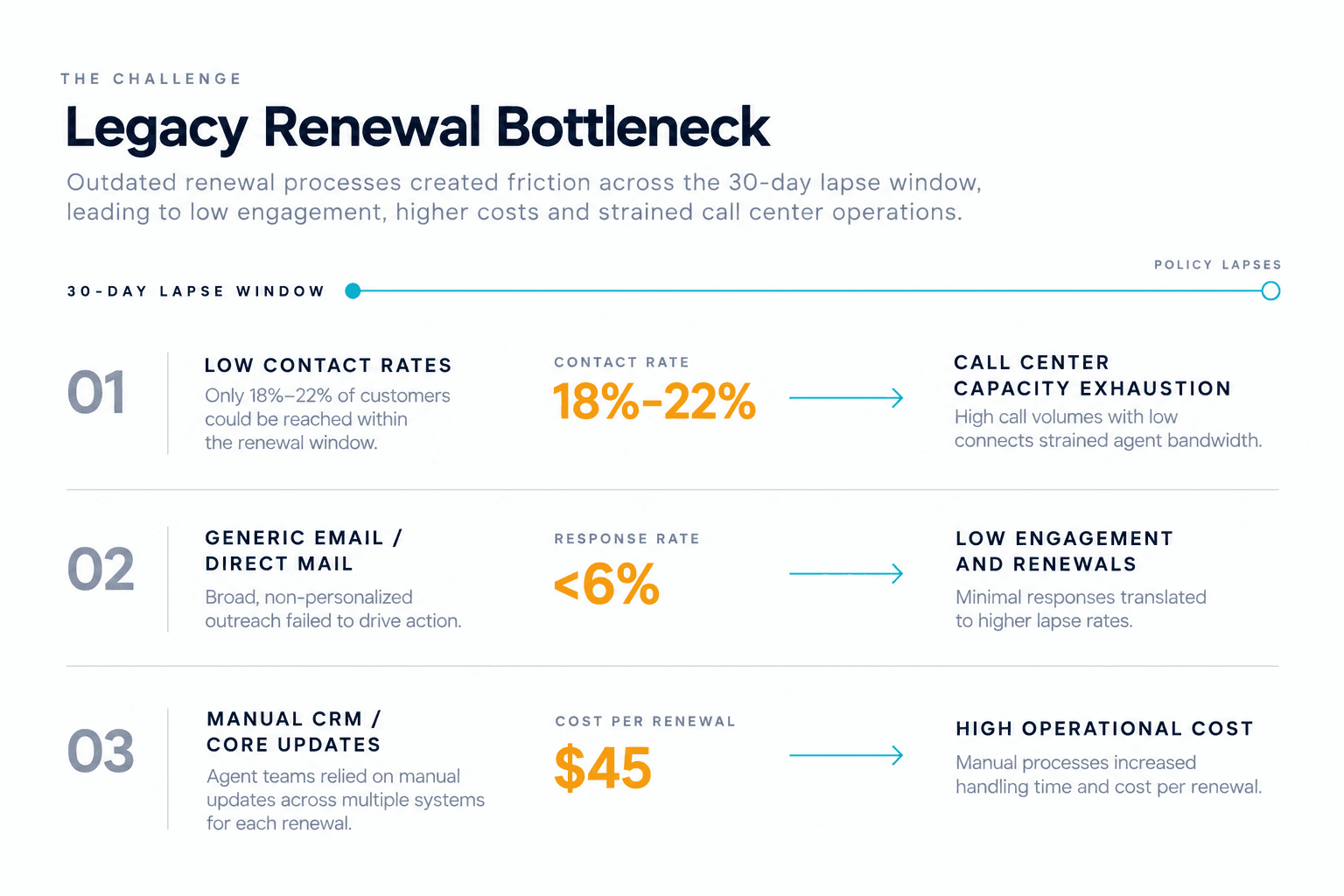
High Call Center Spikes and Drop-Off Rates
During peak commute hours or severe weather events, inbound claim volumes spiked by over 300%. Call centers suffered from 15-to-20-minute hold times, leading to a 22% call abandonment rate from stressed policyholders at their moment of need.
Incomplete Loss Data and Endless Follow-Ups
When customers reported incidents ("My car has been damaged in a collision"), legacy web forms or manual voice agents failed to guide them through structured visual evidence collection. Unclear photos, missing vehicle identification numbers (VIN), and incomplete crash context caused constant back-and-forth communications between policyholders and adjusters.
Manual Triaging and Policy Lookup Delays
Claims teams spent an average of 18 minutes per claim cross-referencing policy validity, checking coverage active add-ons (such as zero-depreciation or engine protection), and verifying deductible thresholds across legacy databases.
Lagging Field Surveyor Allocation
Dispatching field surveyors or assigning digital self-inspection links was a manual task. This created a 24-to-48-hour administrative lag between the initial incident reporting and physical damage appraisal.
How Did Subverse AI Solve the Problem?
Subverse AI deployed an autonomous multi-agent orchestration architecture that handles the end-to-end FNOL workflow within minutes of an incident report.
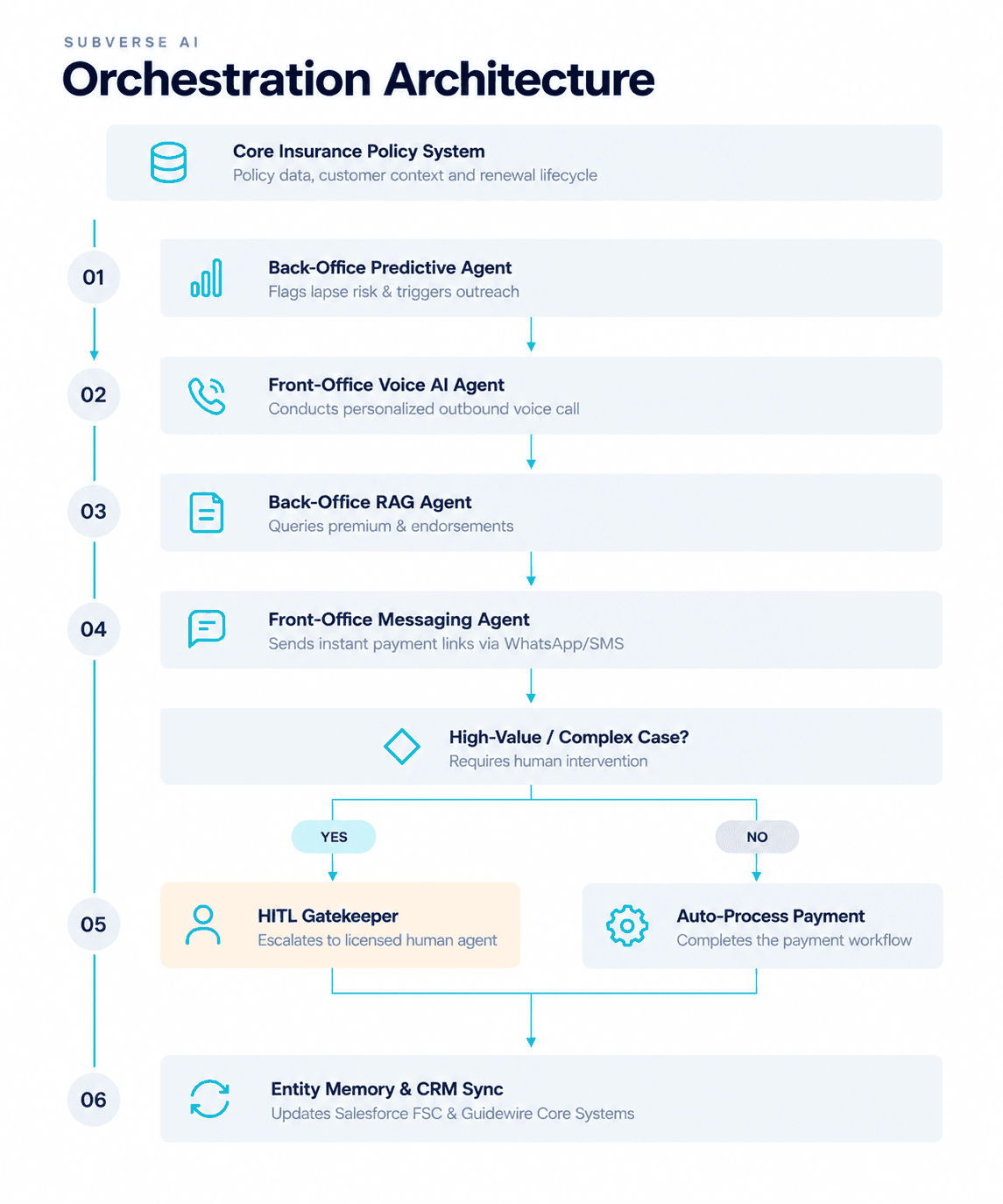
1. Multi-Channel Conversational Trigger
The moment a customer reaches out via phone call, WhatsApp, or mobile app saying "I just hit a pole and my bumper is damaged," Subverse Front-Office Voice AI or Conversational Chat Agents take over. The agent speaks or texts in natural language, expressing empathy while systematically gathering core incident metadata (time, precise GPS location, third-party involvement, and drivability status).
2. Guided Multimodal Visual & Document Capture
During the call or chat, the agent sends an instant, secure media link. The customer is guided in real time to capture:
● Multi-angle photographs and video walk-arounds of vehicle damage.
● Direct photos of the driver’s license and dashboard odometer.
● Third-party vehicle license plates or police report (FIR) documents, if applicable.
3. Deep Entity Memory Contextualization
Subverse AI queries its Entity Memory layer to retrieve historical data tied to the policyholder. It verifies active policy dates, coverage limits, zero-depreciation add-ons, historical claim frequencies, and specific deductible rules in real time without human database queries.
4. Multimodal Back-Office Inspection Engine
Subverse Back-Office AI Agents analyze incoming visual and document data:
● Vision Analysis Agent: Scans vehicle photos, identifies impacted components (e.g., front bumper, headlight assembly, radiator), estimates damage severity, and classifies the claim into Minor/Fast-Track, Moderate Garage Repair, or Major/Total Loss.
● IDP Agent: Parses documents (driver's license, vehicle registration, police report) and validates against state databases using OCR and webhook API checks.
5. Automated Triage, Claim Creation, and Surveyor Scheduling
The orchestration engine generates a structured JSON payload containing the claim summary, damage severity score, and recommended reserve amount. It automatically posts this payload to the Core Policy Administration System (PAS) to mint the official claim number. Simultaneously, it checks field surveyor availability via geo-routing APIs and schedules a surveyor or directs the customer to the nearest preferred network garage.
6. Human-in-the-Loop (HITL) Safety Gate
If the Vision Agent flags severe structural frame damage, high-value total loss potential, or an elevated anomaly/fraud score, Subverse routes the claim payload to a human claims manager via a dedicated HITL dashboard. The dashboard presents pre-summarized audio, auto-extracted photo annotations, and confidence scores, allowing human approval in seconds.
What System Integrations & Multimodal Architecture Were Implemented?
The enterprise implemented Subverse AI as an orchestration layer directly sitting on top of their core insurance tech stack:
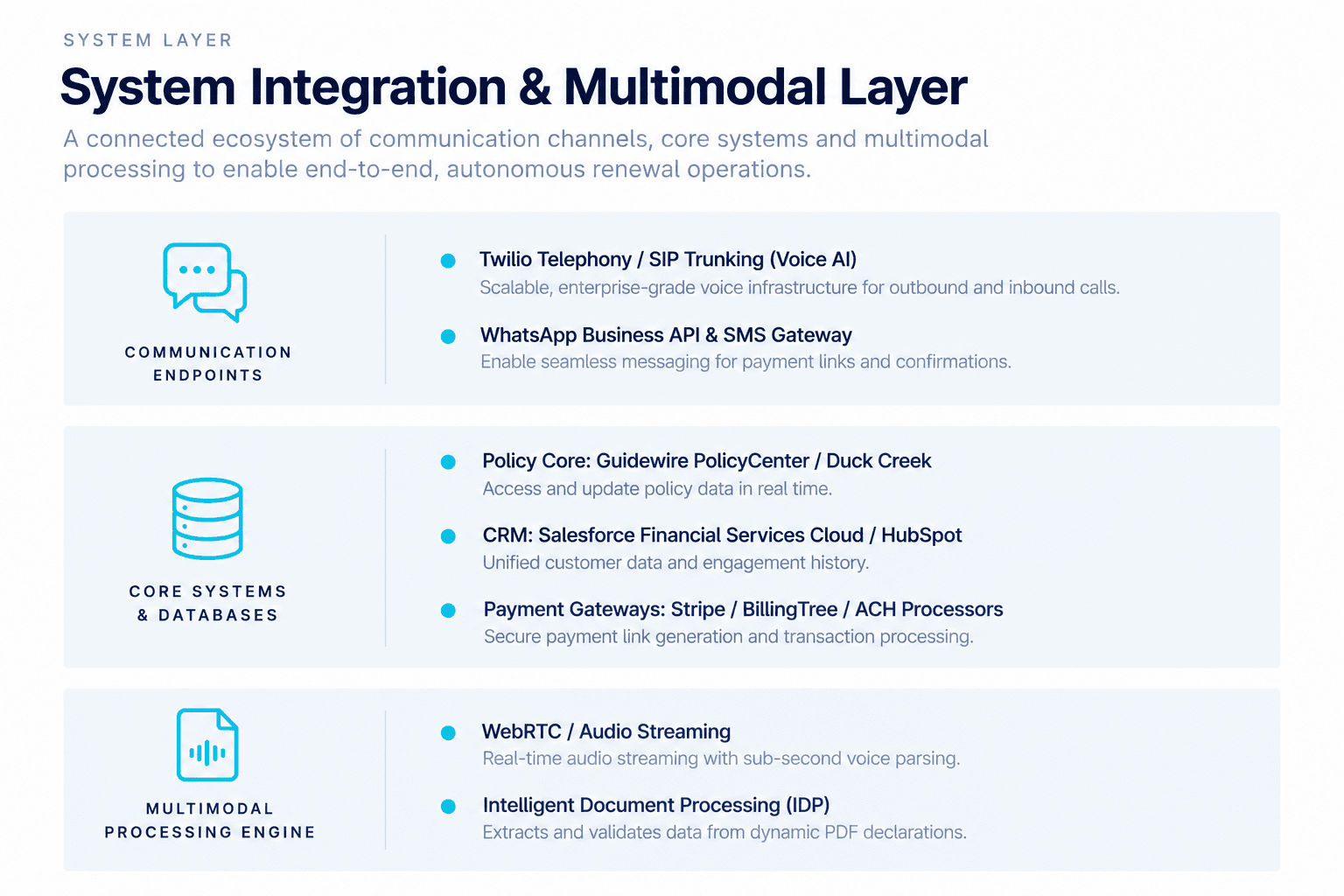
Communication & Voice Gateways
● Telephony Infrastructure: Integrated via SIP/PSTN trunking with sub-500ms voice latency for real-time conversational intake.
● Messaging APIs: Native integrations with WhatsApp Business API and mobile app SDKs for seamless photo/video file transfer.
Core Insurance & Database Systems
● Policy Administration Systems (PAS): Real-time REST API hooks for policy status validation and endorsement checking.
● Claims Management Systems (CMS): Automated claim creation, reserve setting, and status synchronization.
● Network Garage & Surveyor Dispatch APIs: Live geo-location matching for instant field assignment.
Multimodal AI Core
● Computer Vision & IDP Models: Multimodal vision parsing for car part segmentation, dent/scratch classification, and OCR extraction.
● Bring Your Own Model (BYOM): Seamless integration allowing the enterprise to deploy custom-trained insurance risk and fraud detection models directly inside Subverse workflows.
Traditional Approach vs. Subverse Autonomous AI Workflow
Parameter | Legacy Manual FNOL Workflow | Subverse Autonomous AI Workflow |
FNOL Intake Duration | 25 to 40 minutes per claim | Under 3 minutes (End-to-End) |
Data Collection Method | Manual voice notes and email uploads | Guided multimodal Voice + WhatsApp visual capture |
Damage Evaluation | Manual review by claims team (24–48 hours) | Instant AI visual classification & reserve calculation |
Straight-Through Processing (STP) | 0% (100% human agent reliant) | 82% automated claim creation rate |
Surveyor Dispatch SLA | 24 to 48 hours post-intake | Under 60 seconds post-intake |
Operational Scaling Cap | Requires scaling call center headcount | Infinitely scalable during regional disaster spikes |
What Was the Business Impact and KPI Improvement?
By replacing legacy intake flows with Subverse AI multi-agent orchestration, the insurer unlocked massive operational gains across cost, turnaround times, and policyholder satisfaction.
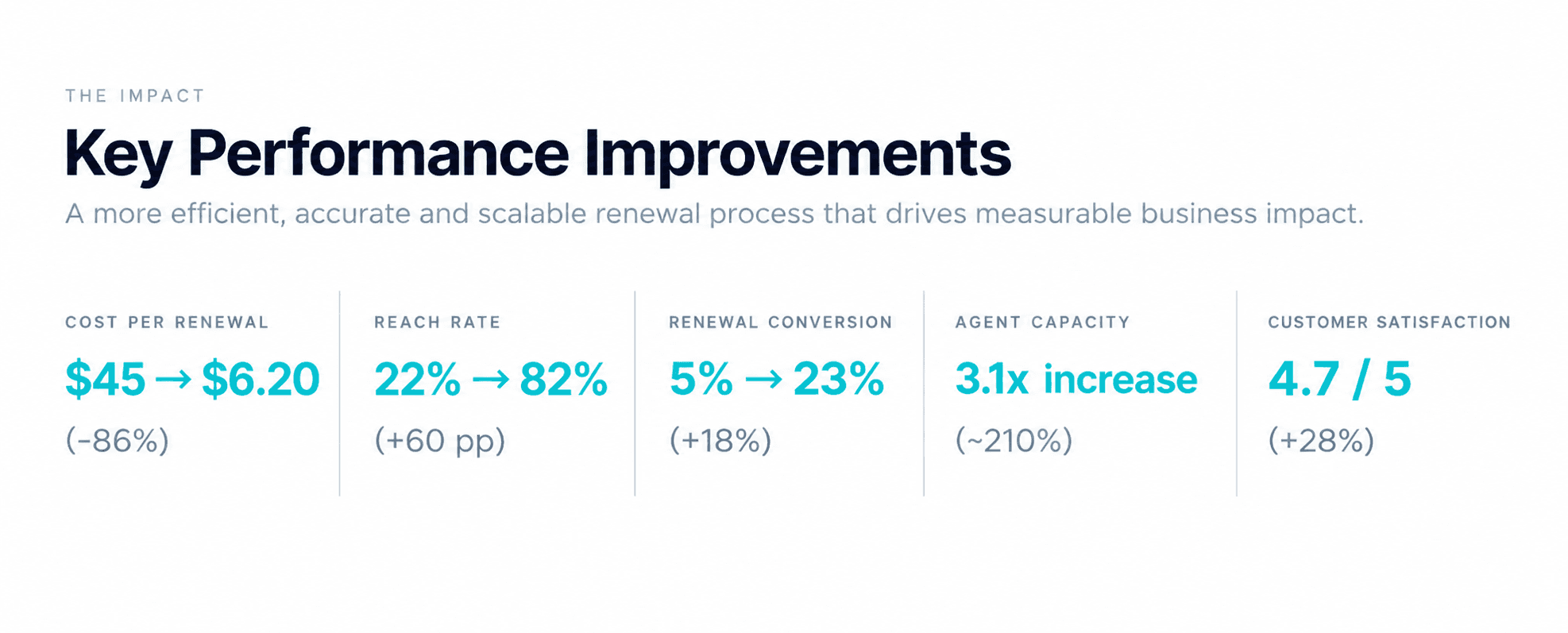
Cost & Efficiency Metrics
● 70% Reduction in FNOL Operational Cost: Cost per registered claim dropped significantly due to reduced call center staffing reliance.
● $3.8M Annual Operational Savings: Direct savings across support triage, manual data entry, and phone line overhead.
● Zero Infrastructure Bottlenecks: System handled a 350% volume spike during severe weather storms with zero downtime or increased queue wait times.
Speed & SLA Metrics
● Sub-3-Minute FNOL Creation: Total intake time dropped from 35+ minutes to under 180 seconds.
● 82% Straight-Through Processing (STP): 82 out of 100 auto claims are registered, triaged, and dispatched without human intervention.
● Instant Field Dispatch: Surveyor scheduling time was reduced from 2 days to under 60 seconds.
Quality & CSAT Metrics
● NPS Surge from 54 to 72: Real-time empathetic assistance and fast processing vastly improved customer post-accident satisfaction.
● 99.4% Data Accuracy: Multimodal OCR and visual verification eliminated manual typing errors in vehicle numbers and damage notes.
Frequently Asked Questions (FAQ)
What is FNOL in auto insurance claims?
First Notice of Loss (FNOL) is the initial report made by a policyholder to an insurer following a vehicle accident or damage incident. It initiates the claims lifecycle, establishing incident facts, loss details, policy eligibility, and immediate appraisal requirements.
How does AI handle claims intake for damaged vehicles?
AI handles claims intake through conversational voice and chat agents that gather incident details, guide users to upload photos/videos, automatically parse policy coverage, analyze damage visual evidence, and create structured claim files directly inside policy management systems in real time.
Can AI accurately evaluate car damage from photos?
Yes. Subverse AI integrates advanced multimodal vision models that segment vehicle components, analyze structural distortion, classify severity (minor, moderate, severe), and cross-check estimated repair costs against historical claims data to ensure highly accurate, automated damage grading.
How does Subverse AI ensure human oversight in insurance claims?
Subverse AI incorporates built-in Human-in-the-Loop (HITL) safety gates. If an incident exceeds specific cost thresholds, involves complex injury risks, or triggers potential fraud anomalies, the workflow automatically pauses and routes the full AI-annotated file to a human adjuster for sign-off.
What core systems does Subverse AI integrate with for insurance FNOL?
Subverse AI connects via REST APIs and webhooks to major Core Policy Administration Systems (PAS), Claims Management Systems (CMS), telephony gateways (SIP/PSTN), WhatsApp APIs, national vehicle databases, telematics platforms, and field surveyor dispatch routing tools.
Table of Content
More Insights


