Sep 3, 2026
Streamlining multi-rate-card invoicing, payment gateway reconciliation, and intelligent email dispute resolution with Subverse AI agents.

Operating a B2B ground mobility fleet of 20,000+ vehicles across 130+ cities created massive operational overhead in post-trip billing, customized corporate rate-card auditing, and payment collection. By deploying Subverse AI, the enterprise automated the entire post-trip lifecycle—from driver proof validation to multi-invoice consolidation and payment reconciliation. Utilizing autonomous front-office and back-office agents backed by persistent entity memory and Human-in-the-Loop (HITL) guardrails, the provider reduced Days Sales Outstanding (DSO) by 62%, achieved a 99.4% straight-through processing (STP) rate for invoicing, and slashed manual billing overhead by 85%.
What Operational Challenges Was the Enterprise Facing?
Managing enterprise B2B ground transportation at scale presents significant back-office billing hurdles. Operating a fleet of over 20,000 vehicles across more than 130 cities, the client serviced thousands of corporate accounts, each bound by distinct contract terms and rate cards.
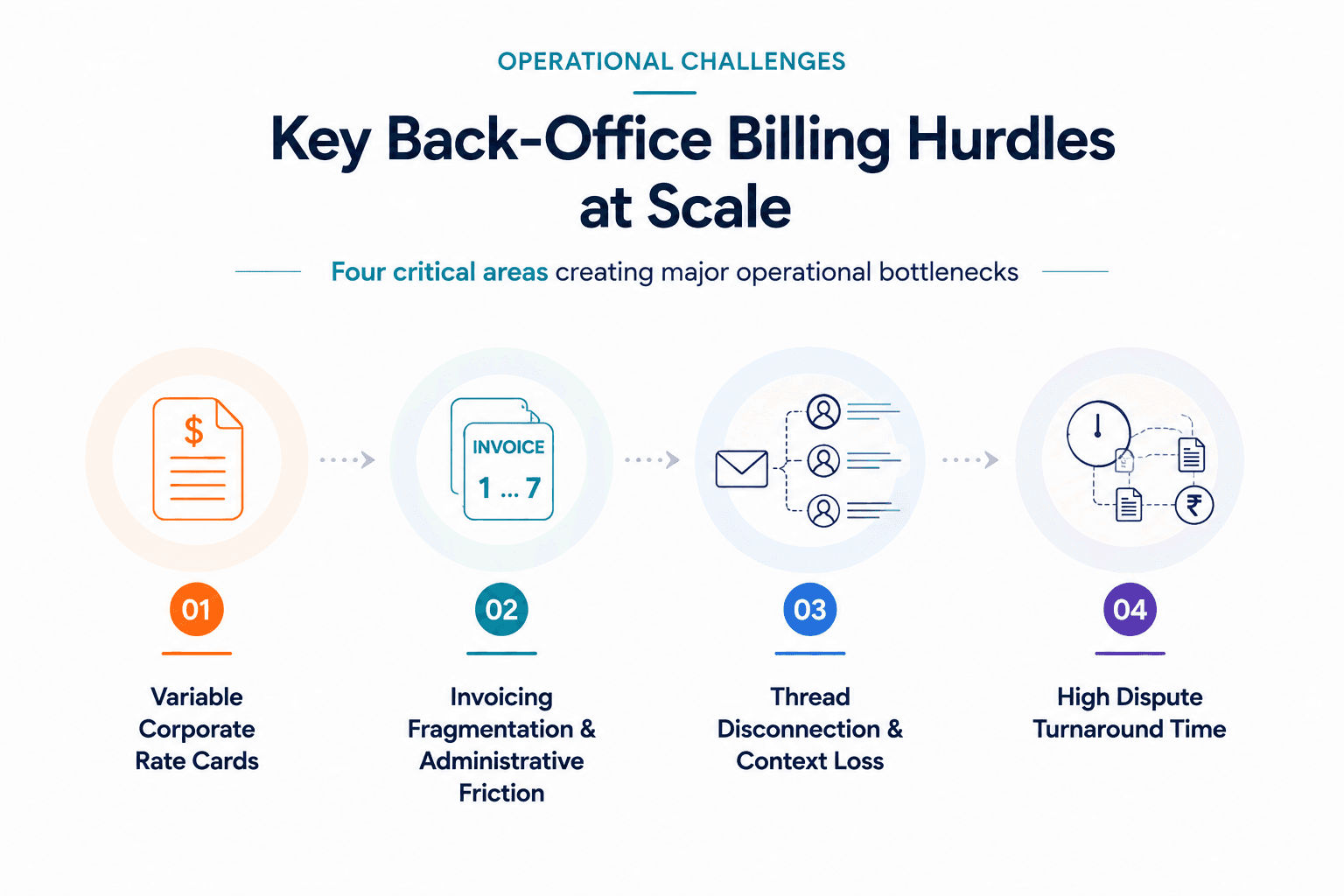
The enterprise faced severe operational bottlenecks in four critical areas:
● Variable Corporate Rate Cards: Every enterprise account operated on bespoke pricing structures based on service categories (e.g., airport transfers, local hourly rentals, outstation trips, fuel surcharges, and state taxes). Auditing driver duty slips against these varied contracts manually created massive backlogs.
● Invoicing Fragmentation & Administrative Friction: A single corporate booking desk could trigger 6 to 7 individual invoices per billing cycle. Manual compilation caused dispatch delays and cluttered client accounts with fragmented payment requests.
● Thread Disconnection & Context Loss: Corporate bookers frequently discussed multiple invoice numbers within a single email thread or split single invoice inquiries across multiple threads over several weeks. Legacy CRM systems failed to track cross-thread history, causing support teams to misplace critical billing context.
● High Dispute Turnaround Time: Minor discrepancies in driver-submitted timing logs or toll receipts stalled total payouts. Billing teams lacked an automated, central system to review driver proofs, reconcile gateway payments, or escalate verified discrepancies to human supervisors efficiently.
How Did Subverse AI Solve the Problem?
Subverse AI deployed an orchestrated multi-agent workflow that connected the enterprise’s internal CRM, communication channels, payment gateways, and back-office accounting systems.
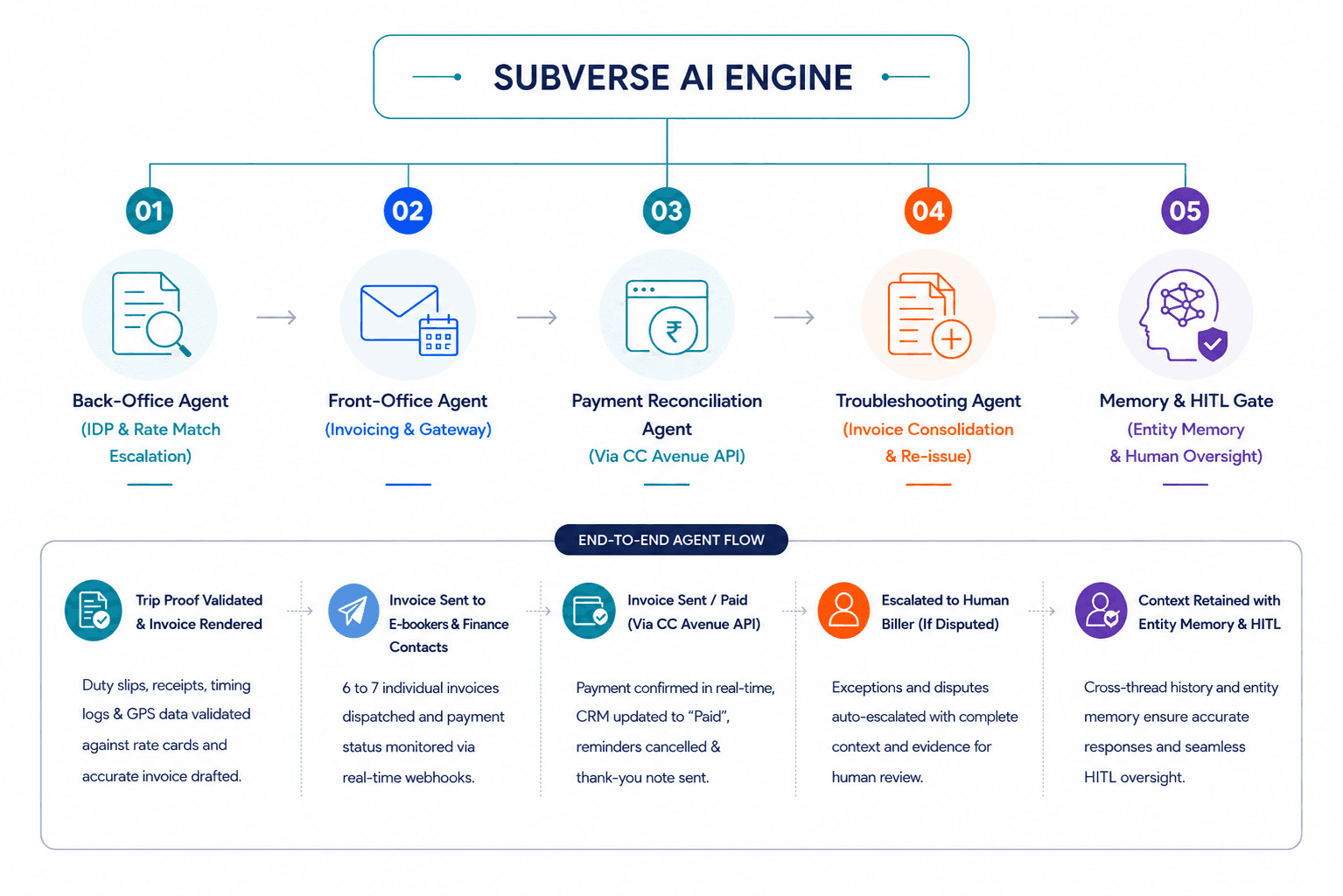
The system operates across a coordinated agent pipeline:
1. Back-Office Document Processing & Rate Matching Agent
As soon as a trip concludes and a duty slip is submitted, a back-office agent triggers automatically. Using multimodal vision capabilities, it parses driver duty slips, physical receipts, timing logs, and GPS distance markers. It cross-references these details with the client’s exact rate card stored in the CRM, dynamically calculating base fares, extra hours, kilometer overages, and applicable tolls to draft an accurate invoice.
2. Front-Office Dispatch & Scheduled Follow-up Agent
Once generated, the Front-Office Email Agent dispatches the invoice package (often containing 6 to 7 individual billing items) to designated e-bookers and finance contacts. The agent continuously monitors payment status through real-time webhooks. If an invoice reaches its due date without payment, the agent initiates context-aware, polite email follow-up sequences customized to that corporate account.
3. Payment Reconciliation & Automated Response
Integrated directly with payment gateways (including CCAvenue), the agent receives real-time payment status payloads. Upon payment confirmation, the system updates the internal CRM status to "Paid," cancels outstanding payment reminders, and sends an automated thank-you note and payment receipt to the customer.
4. Autonomous Invoice Consolidation & Troubleshooting Agent
When a customer requests combined billing (e.g., "Please combine all six invoices from this week into a single bill for accounting"), the Troubleshooting Agent engages. It cancels the existing individual invoices in the CRM, generates a unified, clubbed invoice containing all itemized proofs, updates the payment ledger, and re-issues the consolidated bill in seconds.
5. Persistent Entity Memory & Human-in-the-Loop (HITL) Gate
To solve cross-thread confusion, Subverse AI maintains deep Entity Memory linked to the client's corporate ID, individual booker email, and vehicle trip IDs. If a customer replies to an old email thread regarding a newer invoice, the agent recognizes the context, retrieves the relevant bill history, and responds accurately.
If a client raises a formal dispute regarding ride duration or charges:
● The agent logs a tracking ticket in the internal CRM.
● It collates a summary of the conversation, driver GPS proofs, and original duty slips.
● It routes the structured case to a Human Supervisor (Biller) via an HITL approval gate.
● Once the human supervisor modifies or approves the updated bill in the CRM, the agent automatically crafts the adjusted invoice, delivers it to the client, and resumes automated tracking.
What System Integrations & Multimodal Architecture Were Implemented?
The solution seamlessly bridges front-office client communications with deep back-office record systems.
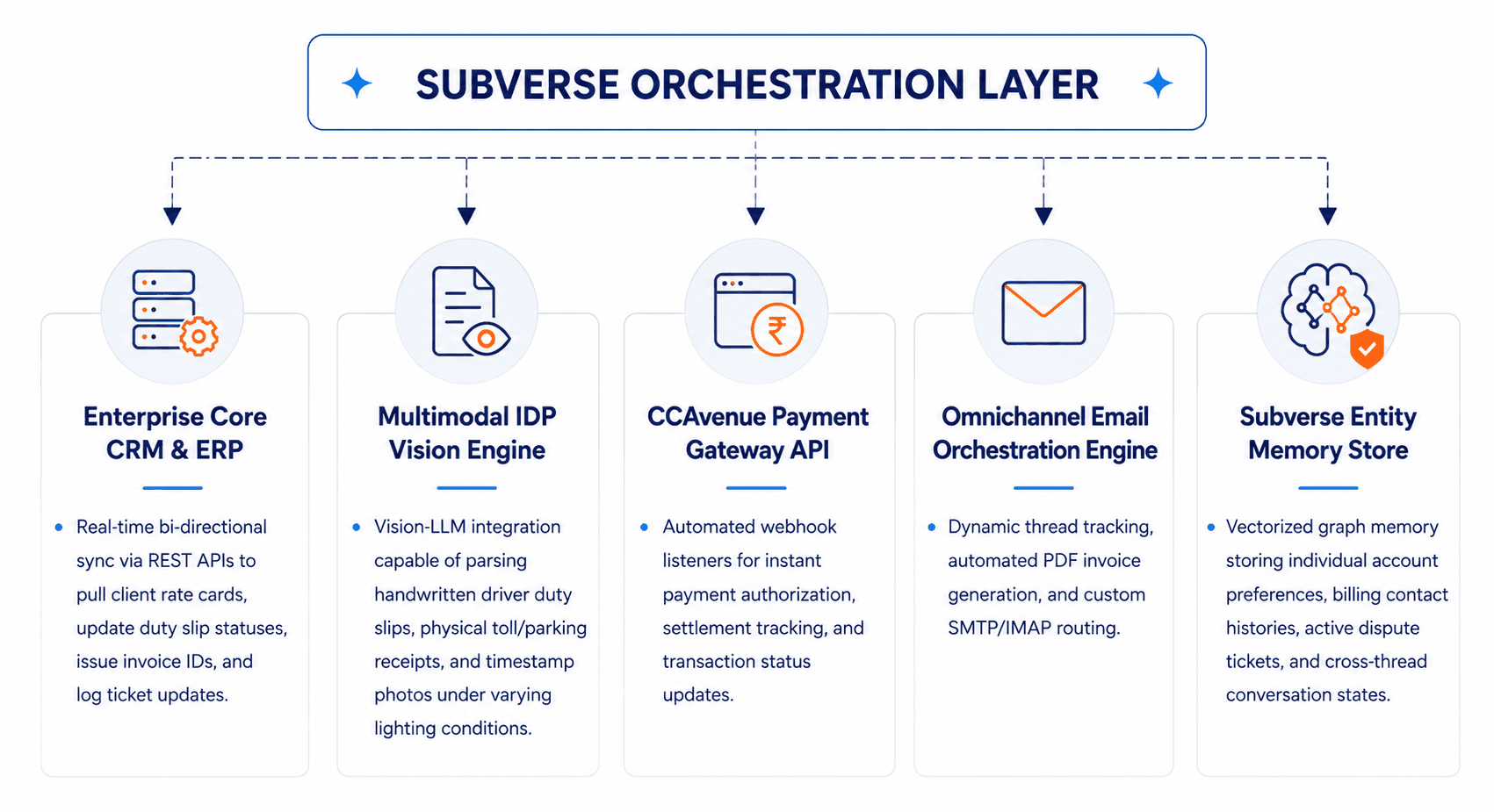
● Enterprise Core CRM & ERP: Real-time bi-directional sync via REST APIs to pull client rate cards, update duty slip statuses, issue invoice IDs, and log ticket updates.
● Multimodal Intelligent Document Processing (IDP): Vision-LLM integration capable of parsing handwritten driver duty slips, physical toll/parking receipts, and timestamp photos under varying lighting conditions.
● Payment Gateway Integration (CCAvenue): Automated webhook listeners for instant payment authorization, settlement tracking, and transaction status updates.
● Omnichannel Email Orchestration Engine: Dynamic thread tracking, automated PDF invoice generation, and custom SMTP/IMAP routing.
● Subverse Entity Memory Store: Vectorized graph memory storing individual account preferences, billing contact histories, active dispute tickets, and cross-thread conversation states.
Traditional Approach vs. Subverse Autonomous AI Workflow
Parameter | Legacy Operational Approach | Subverse Autonomous AI Solution |
Invoice Generation Time | 24–48 hours post-trip (manual proof auditing) | Instant (< 3 minutes post-trip completion) |
Rate Card Compliance | Human billing staff manually checking spreadsheets | 100% automated matching against CRM rate cards |
Dispute Resolution SLA | 5–7 business days | Under 2 hours (Instant AI response or HITL summary) |
Cross-Thread Context | Lost context across separate email threads | Persistent Entity Memory across all communications |
Invoice Consolidation | Manual cancellation, recalculation, and re-issuing | Automated single-command consolidation & dispatch |
Payment Reconciliation | Manual bank matching and CRM status updates | Real-time webhook reconciliation via payment gateway |
Scalability | Linear headcount growth required for fleet expansion | Infinite horizontal scaling without adding headcount |
What Was the Business Impact and KPI Improvement?
Deploying Subverse AI transformed the client’s billing, finance, and customer support operations, driving substantial operational gains:
Cost & Efficiency Metrics
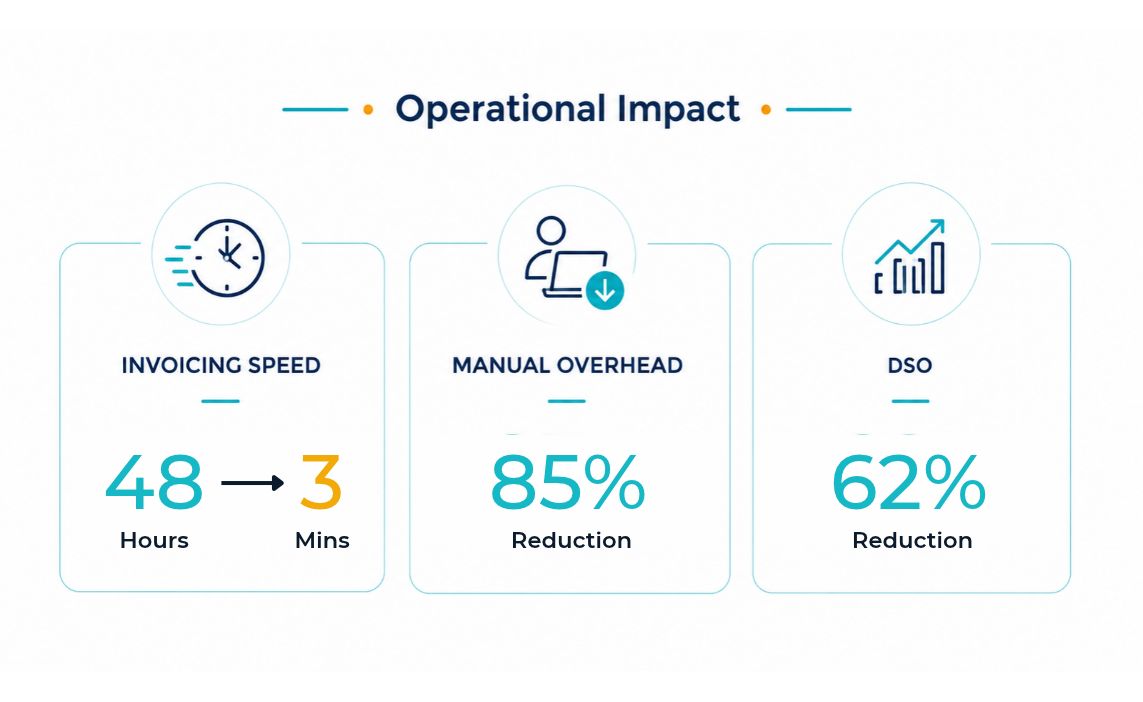
● 85% Reduction in Manual Billing Operations: Human billers transitioned from tedious manual line-item entry to managing high-value HITL exception handling.
● $1.8M Annual Operational Savings: Drastic reduction in manual verification labor, billing error write-offs, and delayed payment penalties.
● 99.4% Billing Accuracy Rate: Elimination of human calculation errors when applying complex corporate rate cards and extra-hour surcharges.
Speed & SLA Metrics
● 62% Reduction in Days Sales Outstanding (DSO): Faster invoice delivery and proactive automated follow-ups accelerated payment cycles from 45 days down to 17 days.
● Invoicing Turnaround Slashed: Average time to generate and dispatch an invoice dropped from 48 hours to under 3 minutes post-trip completion.
Quality & CSAT Metrics
● 90% Reduction in Dispute Resolution Time: Client inquiries regarding toll proofs or trip timings were resolved or escalated within minutes instead of days.
● +28 Point Increase in Corporate CSAT: Corporate booking managers reported higher satisfaction due to clean, fast, consolidated billing and clear communication.
Frequently Asked Questions (FAQ)
How does Subverse AI handle custom enterprise rate cards?
Subverse AI connects directly to your core CRM or ERP via APIs. When a trip completes, back-office agents pull the specific corporate account's rate rules—including airport transfers, local hourly caps, and outstation kilometer rates—and dynamically calculate accurate invoice totals instantly.
Can the platform merge multiple invoices if a corporate client requests it?
Yes. The Troubleshooting Agent processes natural language requests like "combine these bills." It automatically cancels the individual invoices in your CRM, generates a fresh, consolidated invoice containing all itemized trip proofs, updates the ledger, and emails the new document to the client.
How does Subverse AI handle billing disputes without making errors?
If a client disputes a charge, the agent gathers all context—including conversation history, driver receipts, and GPS logs—summarizes the issue, and routes it to a human supervisor via a Human-in-the-Loop (HITL) interface. Once approved, the agent handles dispatch and follow-up.
What is Entity Memory and how does it prevent email thread confusion?
Entity Memory tracks persistent context for every client, email address, and ticket ID over time. Even if a corporate booker responds to an old thread or asks about multiple invoices at once, the agent accurately links the message to the correct billing context and account state.
How does payment reconciliation work with gateway APIs?
Subverse AI integrates with payment gateways like CCAvenue via real-time webhooks. The moment a client completes a payment, the gateway notifies the agent, which updates the CRM invoice status to "Paid," halts automated follow-up emails, and issues a confirmation receipt.
Table of Content
More Insights


