Sep 16, 2026
Transform complex, labor-intensive card disputes into real-time, compliant, multi-agent workflows powered by Subverse AI.
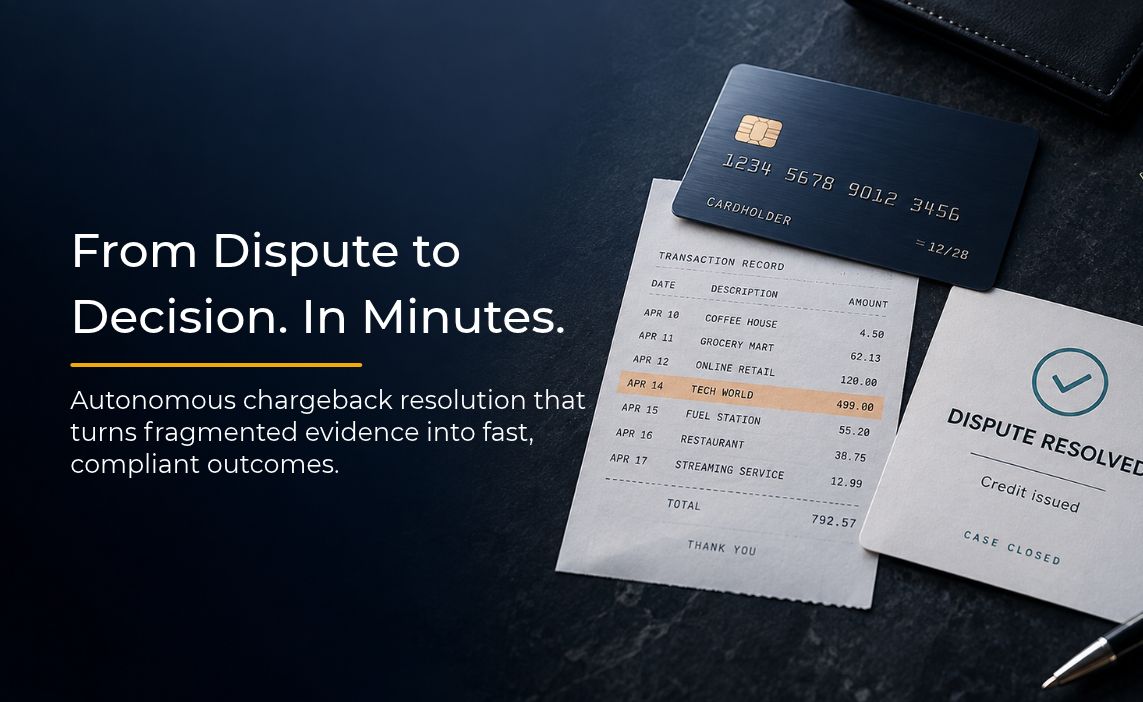
A Tier-1 retail bank handling 140,000 monthly dispute requests deployed Subverse AI to automate its chargeback operations. By orchestrating conversational front-office agents with deep back-office intelligent document processing (IDP) and card network integrations, Subverse AI reduced mean time to resolution (MTTR) from 12 days to under 4 minutes. The platform delivered an 82% Straight-Through Processing (STP) rate, increased merchant representment win rates by 42%, and reduced annual operational expenditure by $6.8M—all while ensuring strict regulatory compliance.
What Operational Challenges Was the Enterprise Facing?
A leading Tier-1 global retail bank processing over $15B in annual card transactions faced severe operational bottlenecks in its dispute and chargeback management operations.
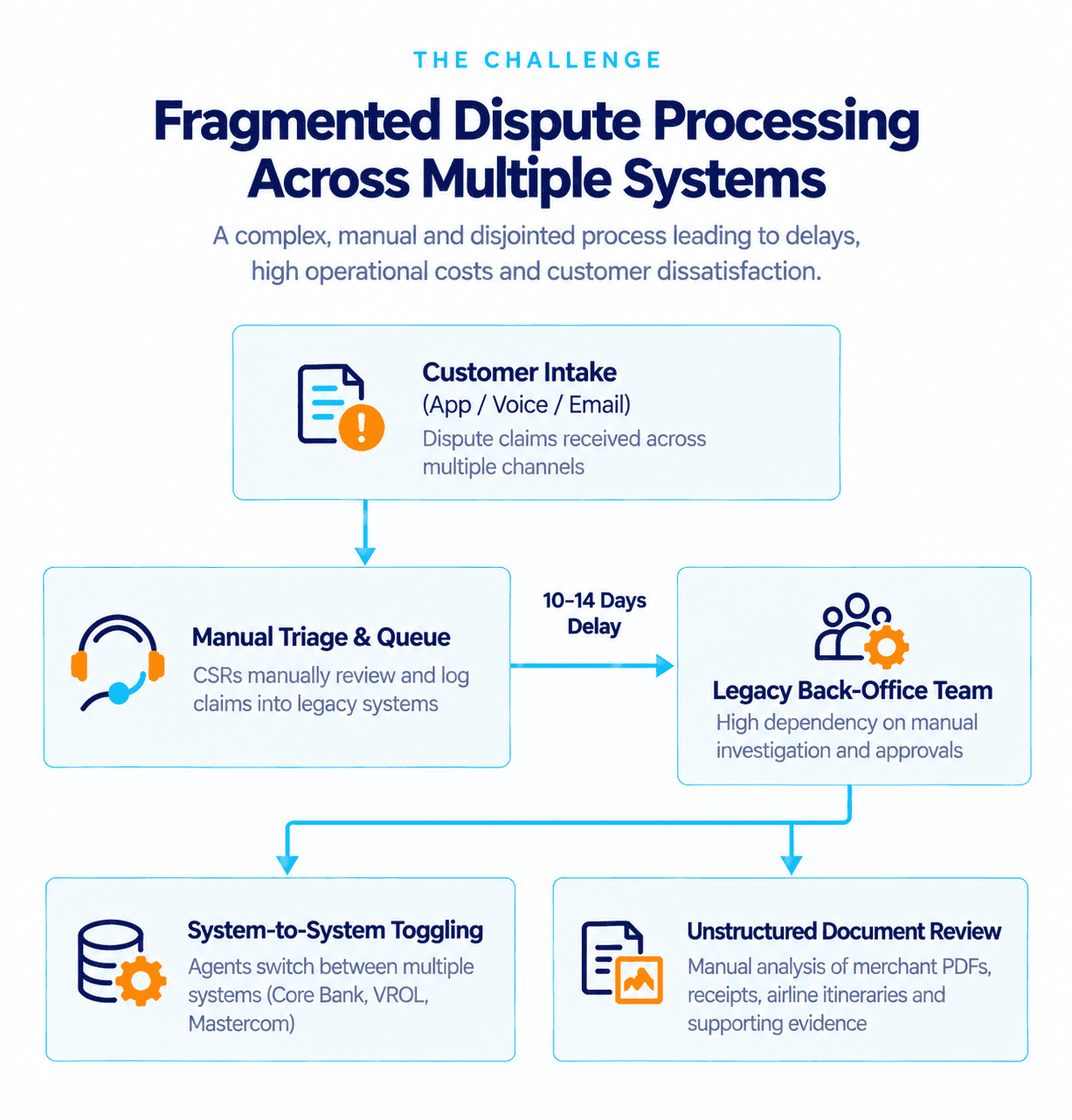
The bank struggled under the weight of manual triage, fragmented data across core systems, and stringent regulatory pressures.
Fragmented Data Intake & Customer Friction
Dispute claims initiated via mobile apps, call centers, and web forms resulted in incomplete context.
Customer service representatives (CSRs) spent up to 25 minutes per claim manually transcribing customer statements like "I didn't make this transaction" into legacy case management systems.
Regulatory Compliance & SLA Mandates
Under Regulation E and Regulation Z, the bank faced strict 10-day provisional credit mandates and 45-to-90-day total resolution windows.
Backlogged investigation queues frequently forced the bank to write off low-value disputes ($20–$75) as "cost-of-doing-business" losses rather than investigating them.
Complex Unstructured Evidence Analysis
Evaluating merchant compelling evidence required human analysts to open, read, and cross-reference multi-page PDFs, airline itineraries, IP address logs, and physical receipt scans.
This manual review created severe back-office throughput caps and drove high operational expenditure per dispute.
How Did Subverse AI Solve the Problem?
The enterprise deployed Subverse AI to deploy an autonomous, multi-agent dispute resolution workforce.
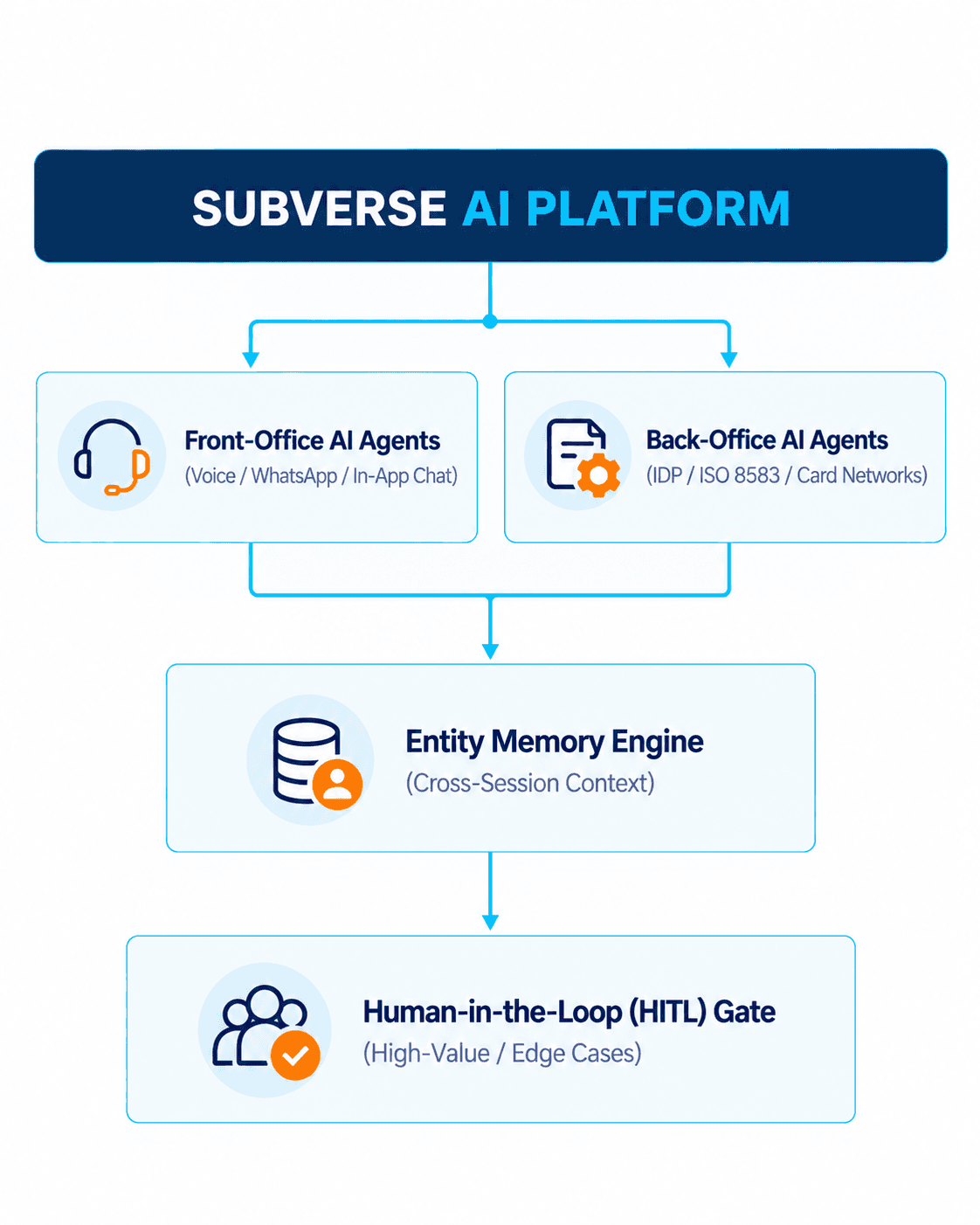
By leveraging Subverse AI’s orchestration framework, front-office conversational agents and back-office deep-reasoning agents work in tandem to execute the dispute lifecycle end-to-end.
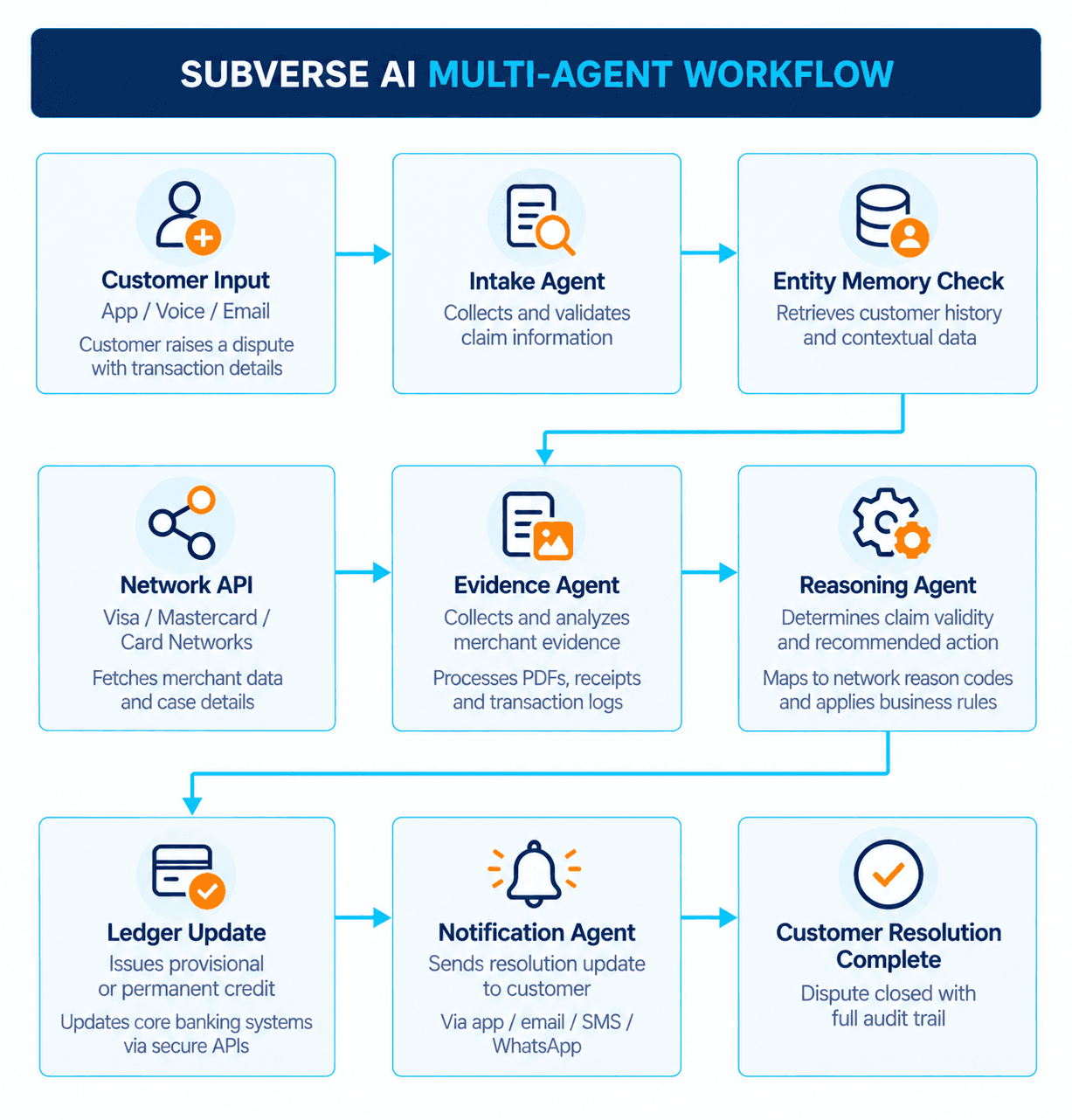
Step 1: Intelligent Intake & Statement Collection
When a customer declares "I didn't make this transaction," Subverse AI's Front-Office Agent engages via in-app chat, WhatsApp, or voice.
The agent dynamically interviews the customer, asking targeted follow-up questions to establish fraud indicators (e.g., loss of physical card, recurring billing error, or unauthorized card-not-present transaction).
Step 2: Transaction Retrieval & Deep History Analysis
Once intake is complete, a specialized Back-Office Agent queries the core banking ledger via REST APIs to pull granular ISO 8583 authorization payloads.
The agent analyzes 12 months of historical customer data using Subverse AI’s Persistent Entity Memory, evaluating typical spending geography, merchant interaction patterns, and device fingerprints.
Step 3: Automated Evidence Collection & Merchant Interoperability
Subverse AI connects directly to Visa Resolution Services (VROL) and Mastercard Mastercom gateways.
The agent requests evidence from the merchant acquirer, continuously pulling incoming compelling evidence documents into an Intelligent Document Processing (IDP) pipeline.
Step 4: Dispute Classification & LLM Reasoning Engine
A dedicated Reasoning Agent maps the incident context to official payment network chargeback reason codes (e.g., Visa Reason Code 10.4 or Mastercard Reason Code 4837).
The LLM evaluates the merchant’s compelling evidence against the customer’s statement and transaction history to determine claim validity.
Step 5: Decisioning, Ledger Updates, & Customer Notification
If the claim is verified, Subverse AI triggers automated ledger updates through core banking webhooks to issue provisional or permanent credit.
The notification agent automatically dispatches a detailed resolution breakdown to the customer via their preferred communication channel.
Step 6: Human-in-the-Loop (HITL) Safety Checkpoint
Disputes involving amounts over $2,500 or claims triggering low confidence scores (<85%) are routed to human fraud analysts.
Subverse AI pre-compiles a complete evidence dossier and recommended resolution, allowing analysts to review and approve claims in seconds.
What System Integrations & Multimodal Architecture Were Implemented?
The architecture seamlessly spans core banking infrastructure, credit card scheme APIs, and front-office communication channels.
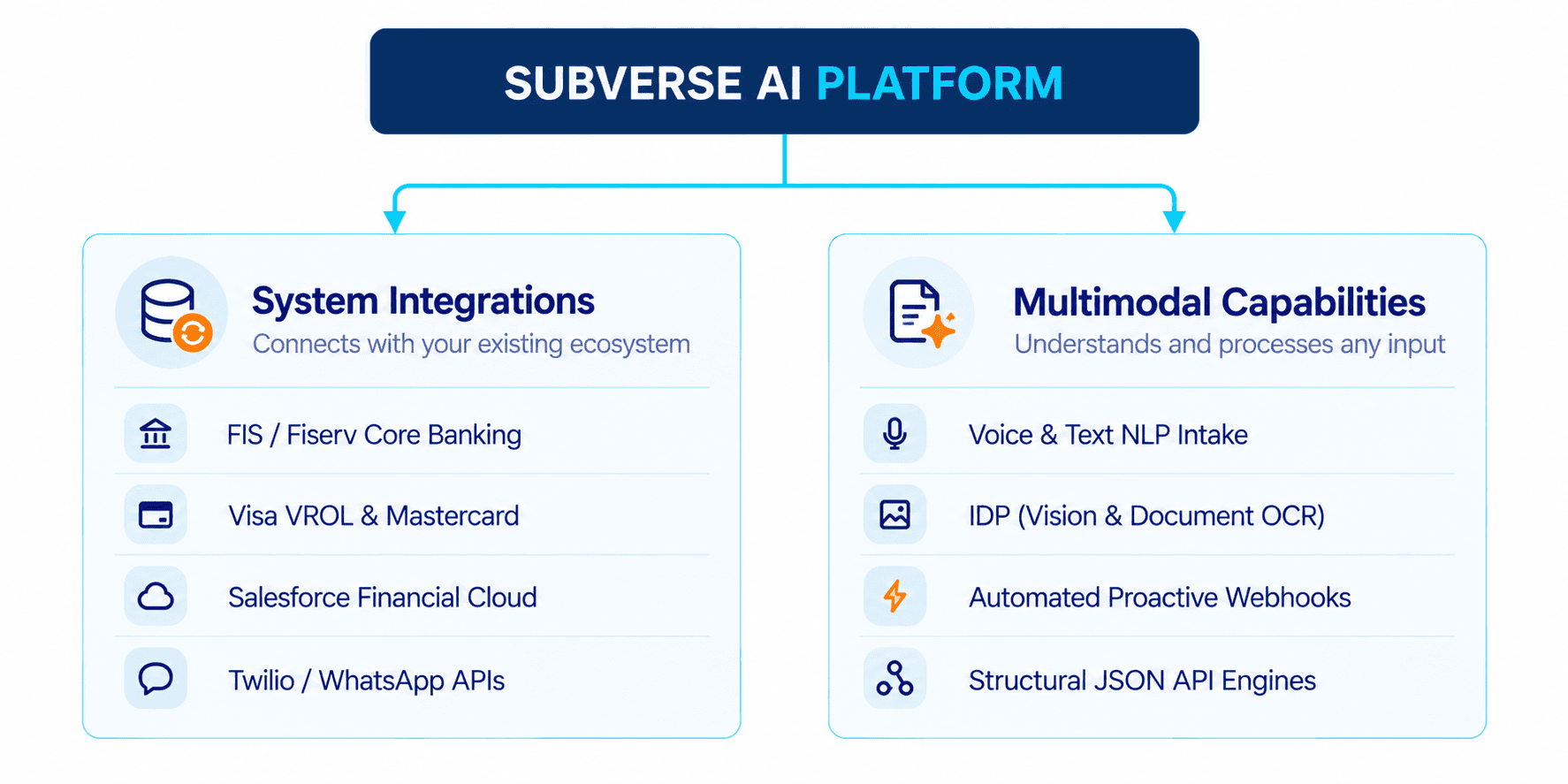
Enterprise System Integrations
● Core Banking Systems: Bi-directional REST/gRPC interfaces with FIS, Fiserv, and Thought Machine core ledgers for credit reversals and account holds.
● Card Network Gateways: Native API connectors for Visa Resolution Services (VROL) and Mastercard Mastercom for direct representment submission.
● CRM & Case Management: Integration with Salesforce Financial Services Cloud and ServiceNow to maintain audit trails.
● Omnichannel Communications: Native connectivity across WhatsApp Business API, WebSockets, in-app mobile messaging, and Genesys SIP voice trunks.
Multimodal AI Processing
● Conversational Voice & NLP: Real-time semantic extraction from unstructured customer voice interactions and chat messages.
● Vision & Document Analysis (IDP): Computer vision parsing of PDF receipts, airline ticket manifests, hotel folio logs, and IP login timestamps.
● Proactive Scheduling Engine: Automated background checks that poll card networks for merchant responses and send timely updates to customers.
Traditional Approach vs. Subverse Autonomous AI Workflow
Parameter | Traditional Manual Process | Subverse AI Autonomous Workflow |
Average Processing Time | 10 to 14 Business Days | Under 4 Minutes (Straight-Through Processing) |
Cost Per Dispute Handled | $38.50 per case | $3.20 per case |
Straight-Through Processing (STP) | 0% (100% manual review) | 82% fully automated resolution |
Evidence Analysis Speed | 25–35 minutes per document bundle | Real-time multimodal processing (<10 seconds) |
First Contact Resolution (FCR) | 22% | 88% |
Merchant Representment Win Rate | 34% | 76% (driven by automated reasoning) |
Compliance Audit Risk | High (Human oversight errors) | Zero (100% deterministic log retention) |
What Was the Business Impact and KPI Improvement?
Deploying Subverse AI transformed the bank's dispute management unit from an operational cost center into a high-efficiency automation driver.
Cost & Efficiency Metrics
● $6.8M Annual OpEx Savings: Drastically cut manual processing and operational overhead across tier-1 and tier-2 support queues.
● 91% Cost Reduction per Claim: Reduced processing costs from $38.50 per dispute to $3.20 per dispute.
● 70% Reduction in Loss Write-Offs: Eliminated automatic micro-chargeback write-offs through instant automated processing.
Speed & SLA Metrics
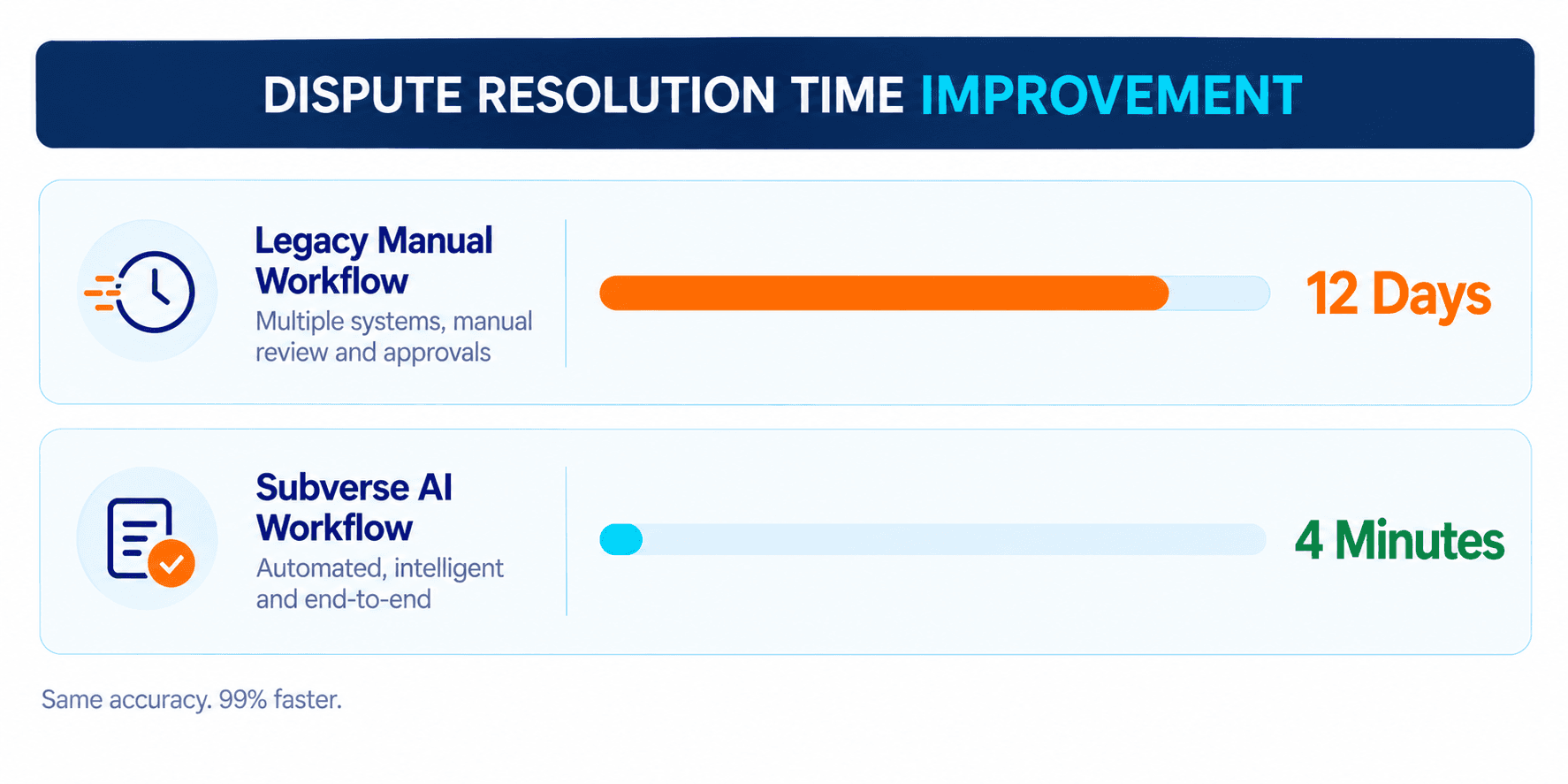
● Cycle Time Reduced by 99%: Accelerated dispute resolution time from an average of 12 days to under 4 minutes.
● 100% SLA Compliance: Zero regulatory fines or compliance breaches under Regulation E and Regulation Z guidelines.
● 82% Straight-Through Processing Rate: Over 8 out of 10 claims resolved without human intervention.
Quality & CSAT Metrics
● CSAT Score Jumped from 3.2 to 4.7: Instant dispute acknowledgments and provisional credit issuance improved trust.
● 42% Increase in Chargeback Win Rates: Rapid, AI-backed evidence analysis improved representment success against fraudulent merchant claims.
● First Contact Resolution hit 88%: Customers completed dispute filings in a single continuous session.
Frequently Asked Questions (FAQ)
How does Subverse AI ensure compliance with Regulation E and Regulation Z?
Subverse AI enforces strict regulatory compliance by automating deadline tracking for provisional credits and formal communications. Every step, reasoning decision, and network interaction is logged in an immutable, auditable format to satisfy federal banking oversight mandates.
Can Subverse AI integrate directly with Visa VROL and Mastercard Mastercom?
Yes. Subverse AI connects directly to Visa Resolution Services (VROL) and Mastercard Mastercom through secure APIs. Front and back-office AI agents pull evidence, retrieve inquiry details, and submit representments autonomously without manual operator intervention.
How does Subverse AI detect and prevent "friendly fraud"?
Subverse AI utilizes Persistent Entity Memory to cross-reference historical transaction trends, device attributes, geolocation, and past dispute behaviors. The platform's reasoning engine detects behavioral anomalies and flags suspicious recurring claims for human reviewer audit before issuing credit.
What happens when a high-value transaction dispute occurs?
Disputes exceeding customizable threshold amounts (e.g., $2,500) trigger human-in-the-loop (HITL) safety workflows. Subverse AI automatically compiles transaction records, merchant communications, and a recommended decision into a single-click summary dossier for fraud analyst approval.
Table of Content
More Insights