Sep 18, 2026
Transforming complex, unstructured corporate travel requests into instant, error-free bookings using multimodal AI agents

A leading enterprise ground mobility provider operating over 14,500 vehicles across 250+ cities faced severe operational bottlenecks, relying on 50+ manual operators to process complex B2B booking emails. By deploying Subverse AI, the enterprise implemented an autonomous multi-agent orchestration workflow capable of parsing unstructured emails, attachments, and historical thread contexts. Subverse AI reduced booking creation SLAs from hours to under 60 seconds, achieved an 80% Straight-Through Processing (STP) rate, and eliminated billing transcription errors across complex multi-passenger itineraries.
What Operational Challenges Was the Enterprise Facing?
As a market leader servicing enterprise B2B clients, corporate travel desks, and high-volume accounts, the mobility provider operates a fleet of 14,500+ vehicles across 250+ cities. Managing ground transportation for corporate clients involves a complex mix of bookers (corporate travel managers) and actual riders (employees, executives, or guest lists).
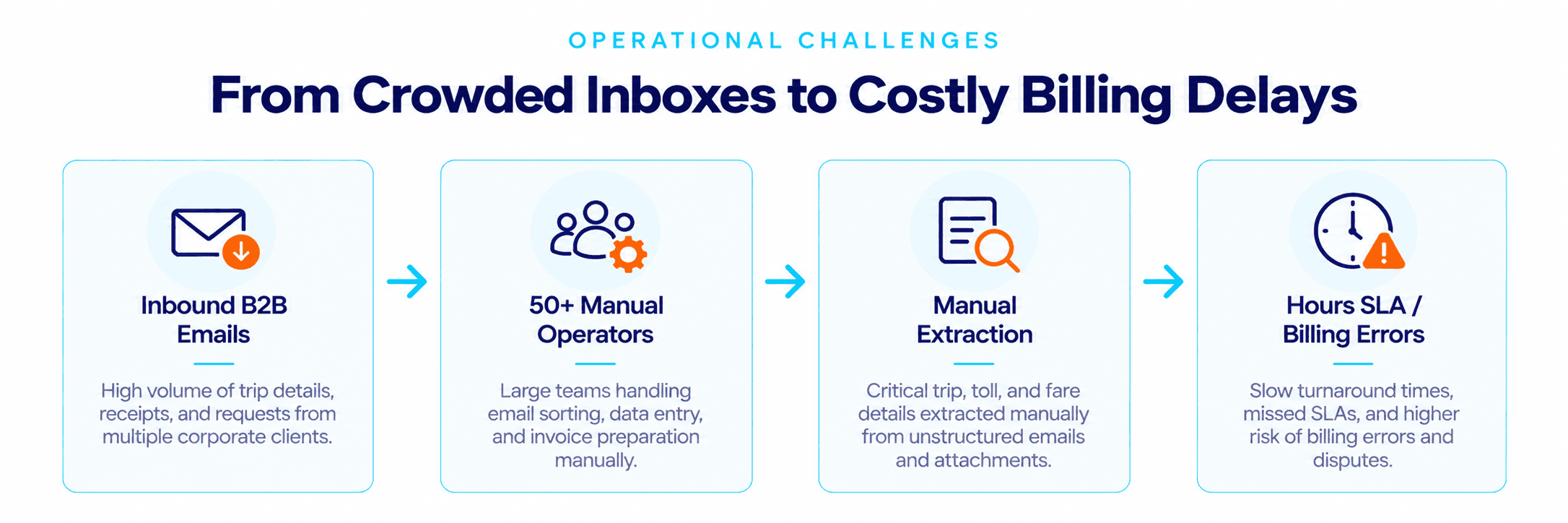
Despite heavy investments in back-end infrastructure, inbound booking intake remained overwhelmingly manual.
1. Unstructured & Multimodal Channel Ingestion
Corporate clients routinely submit booking requests through unstructured emails containing text descriptions, inline screenshots of internal travel portals, attached PDFs, Word documents, or complex Excel spreadsheets containing rider rosters. Manual agents had to visually inspect each file type to extract itinerary details manually.
2. High Context Loss & Ambiguous Requests
Frequent corporate bookers often submit vague requests, such as "Book the same vehicle for John as last week" or "Need an airport pickup in Mumbai per our corporate contract." Legacy systems could not infer context from past email threads or verify contractual terms (e.g., preferred vehicle models, hourly slabs, local vs. outstation limits), forcing human operators to search legacy databases manually.
3. Exponential Extraction Complexity
A single corporate travel request often includes multi-city, multi-leg itineraries (e.g., flight from Kolkata to Mumbai → 2-day local city usage → Mumbai airport drop → Delhi airport pickup). When a corporate booker submits an itinerary for 25 travelers, a single email expands into 100+ distinct booking transactions.
4. Heavy Operational Overhead & Billing Risk
The enterprise required a team of over 50 dedicated operators working around the clock just to ingest emails, validate account authorizations, and enter data into the core Booking Management System (BMS). Human error in mapping trip legs or passenger counts directly impacted downstream billing, invoice reconciliation, and financial auditing.
How Did Subverse AI Solve the Problem?
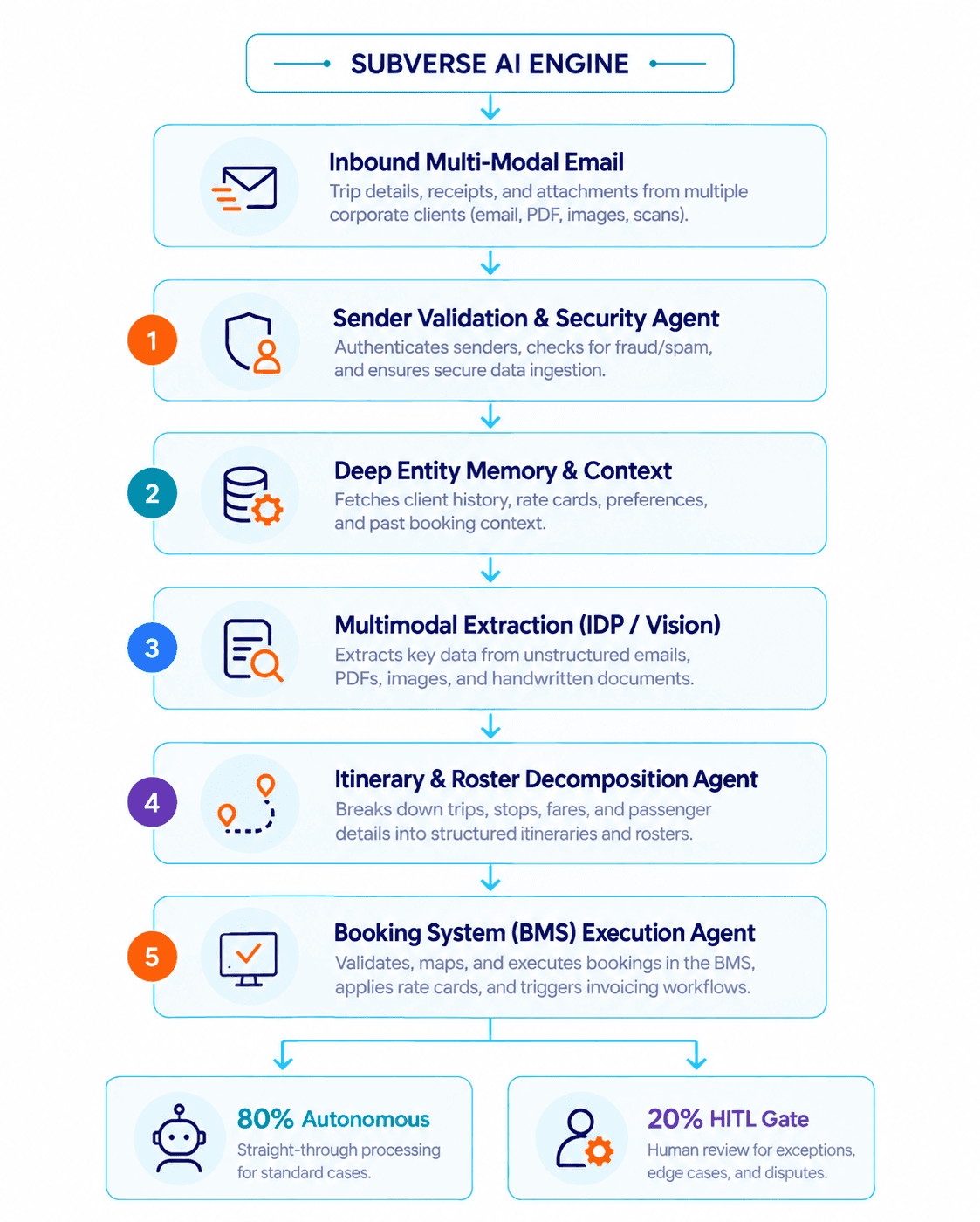
Subverse AI replaced the manual intake queue with an end-to-end, multi-agent autonomous workflow. By deploying tailored Front-Office and Back-Office agents orchestrated through the Subverse platform, the enterprise fully automated the intake-to-booking pipeline.
Step 1: Sender Validation & Authorization Agent
Upon receiving an inbound email, a specialized validation agent inspects the sender's metadata against B2B enterprise client directories. If an unauthorized employee sends a request, the agent immediately initiates a sub-workflow, referencing account rules to query designated corporate travel managers for approval before proceeding.
Step 2: Context Retrieval & Deep Entity Memory
The Subverse Deep Entity Memory engine tracks context for each corporate entity, booker, and rider over time. When an email states "Book this car again," the agent queries historical thread contexts and active B2B contracts to automatically retrieve:
● Vehicle preferences (e.g., Premium Sedan vs. SUV).
● Contracted rate cards and hourly package limits.
● Default billing codes, cost centers, and passenger profiles.
Step 3: Multimodal Extraction Pipeline
Back-office vision and Intelligent Document Processing (IDP) agents process all email attachments simultaneously. Whether the payload contains raw email body text, a scanned PDF itinerary, a screenshot of an internal portal, or a 25-row Excel sheet, the agents extract text, tables, and visual structures into standardized JSON schemas.
Step 4: Itinerary & Roster Decomposition Agent
The core processing engine breaks down multi-city trips and multi-passenger rosters into individual, actionable journey segments:
● Trip Leg 1: Kolkata Airport Drop (Point-to-Point)
● Trip Leg 2: Mumbai Airport Pickup (Arrival Transfer)
● Trip Leg 3: Mumbai City Usage (2-Day Full-Day Rental)
● Trip Leg 4: Mumbai Airport Drop (Departure Transfer)
● Trip Leg 5: Delhi Airport Pickup (Arrival Transfer)
For an email with 20 travelers, the agent autonomously expands and validates all 80 trip legs in parallel within milliseconds, verifying timing alignment and city parameters.
Step 5: BMS Execution & Human-in-the-Loop (HITL) Safety Gates
Once validated, the payload is pushed via API to the enterprise Core Booking Management System. If a request contains highly custom requirements outside standard contract bounds, Subverse AI automatically flags the exception and routes it to a human operator via a Human-in-the-Loop (HITL) approval dashboard with pre-filled fields.
Step 1: Sender Validation & Authorization Agent Upon receiving an inbound email, a specialized validation agent inspects the sender's metadata against B2B enterprise client directories. If an unauthorized employee sends a request, the agent immediately initiates a sub-workflow, referencing account rules to query designated corporate travel managers for approval before proceeding. Step 2: Context Retrieval & Deep Entity Memory The Subverse Deep Entity Memory engine tracks context for each corporate entity, booker, and rider over time. When an email states "Book this car again," the agent queries historical thread contexts and active B2B contracts to automatically retrieve: ●Vehicle preferences (e.g., Premium Sedan vs. SUV). ●Contracted rate cards and hourly package limits. ●Default billing codes, cost centers, and passenger profiles. Step 3: Multimodal Extraction Pipeline Back-office vision and Intelligent Document Processing (IDP) agents process all email attachments simultaneously. Whether the payload contains raw email body text, a scanned PDF itinerary, a screenshot of an internal portal, or a 25-row Excel sheet, the agents extract text, tables, and visual structures into standardized JSON schemas. Step 4: Itinerary & Roster Decomposition Agent The core processing engine breaks down multi-city trips and multi-passenger rosters into individual, actionable journey segments: ●Trip Leg 1: Kolkata Airport Drop (Point-to-Point) ●Trip Leg 2: Mumbai Airport Pickup (Arrival Transfer) ●Trip Leg 3: Mumbai City Usage (2-Day Full-Day Rental) ●Trip Leg 4: Mumbai Airport Drop (Departure Transfer) ●Trip Leg 5: Delhi Airport Pickup (Arrival Transfer) For an email with 20 travelers, the agent autonomously expands and validates all 80 trip legs in parallel within milliseconds, verifying timing alignment and city parameters. Step 5: BMS Execution & Human-in-the-Loop (HITL) Safety Gates Once validated, the payload is pushed via API to the enterprise Core Booking Management System. If a request contains highly custom requirements outside standard contract bounds, Subverse AI automatically flags the exception and routes it to a human operator via a Human-in-the-Loop (HITL) approval dashboard with pre-filled fields.
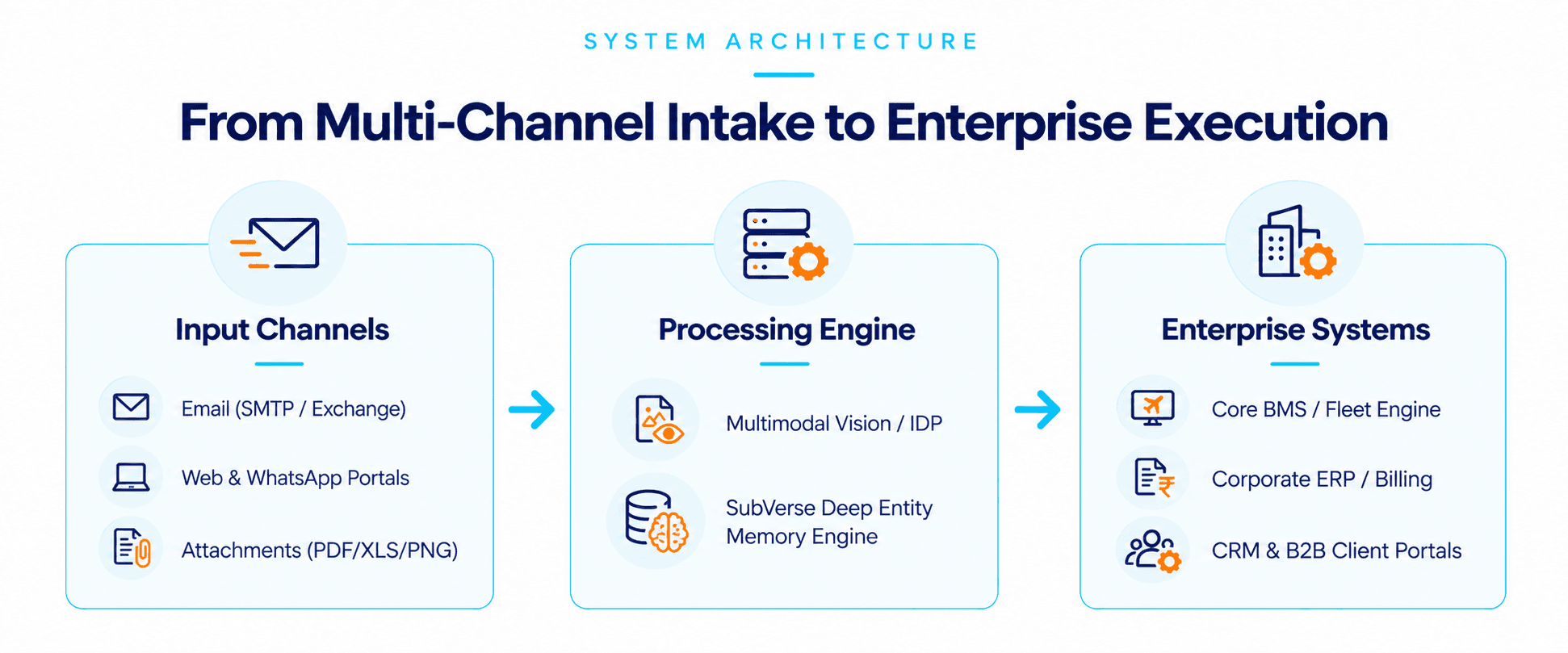
The architecture seamlessly bridges legacy B2B enterprise software with modern AI orchestration.
Core Architecture Capabilities
● Multimodal IDP Engine: Powered by vision-language models capable of parsing unstructured email threads, embedded screenshots, PDF travel vouchers, doc files, and multi-sheet Excel manifests.
● Deep Entity Memory: Maintains persistent state across historical interactions, associating preferences, frequent routes, and billing rules directly with specific enterprise account IDs.
● Enterprise Integrations: Native webhooks and REST APIs interface directly with internal Booking Management Systems (BMS), corporate ERPs, CRM databases, and dispatch management tools.
● Omnichannel Support: While centered on email processing, the Subverse platform natively extends the same orchestration logic to web portals, WhatsApp B2B messaging, and telephony intake channels.
Traditional Approach vs. Subverse Autonomous AI Workflow
Performance Parameter | Traditional Manual Workflow | Subverse AI Autonomous Workflow |
Booking Processing SLA | 2 to 4 hours per complex request | < 60 seconds end-to-end |
Operational Staffing | 50+ dedicated manual intake agents | Reallocated to high-value account growth |
Extraction Accuracy | Prone to human transposition errors (~85–90%) | Near-100% schema accuracy with validation |
Roster Extraction (20+ Pax) | 45–60 minutes of manual spreadsheet entry | Sub-second automated roster parsing |
Contextual Ambiguity | Requires back-and-forth email chains | Resolved instantly via Deep Entity Memory |
Straight-Through Rate (STP) | 0% (100% manual intervention) | 80% Autonomous STP (20% routed to HITL) |
What Was the Business Impact and KPI Improvement?
Deploying Subverse AI transformed the operational cost structure and responsiveness of the enterprise travel business, delivering high-ROI results across three primary categories:
Cost & Efficiency Metrics
● 80% Straight-Through Processing (STP): 8 out of 10 complex email booking requests are processed and created in the BMS with zero human intervention.
● Significant Capacity Unlocking: The enterprise eliminated the need for manual data entry, enabling existing operational teams to manage higher booking volumes without adding headcount.
Speed & SLA Metrics
● SLA Cut from Hours to Seconds: Average booking generation time dropped from several hours to under 60 seconds, dramatically improving B2B response metrics.
● Instant Multi-Passenger Roster Expansion: Roster files with 25+ travelers that previously required an hour of manual mapping are now parsed into 100+ trip legs instantly.
Quality & CSAT Metrics
● Zero Financial Transposition Errors: Automated extraction eliminated billing discrepancies caused by incorrectly mapped vehicle classes, city limits, or rider details.
● Higher B2B Booker Retention: Instant booking confirmations and zero context loss boosted enterprise corporate booker satisfaction scores.
Frequently Asked Questions (FAQ)
How does Subverse AI handle vague requests like "Book the same car as last time"?
Subverse AI uses Deep Entity Memory to analyze historical email threads and client contract rules. It retrieves past vehicle preferences, city parameters, and rider profiles to populate the new booking accurately without requiring manual operator intervention.
Can the platform parse complex travel itineraries from email attachments?
Yes. Subverse AI utilizes multimodal IDP and Vision models to ingest spreadsheets, PDFs, images, and raw text. Its Itinerary Decomposition Agent automatically parses multi-leg trips across dozens of passengers, generating discrete booking requests in the enterprise system.
What happens if an unauthorized employee submits a corporate booking?
The Authorization Agent cross-references inbound email senders against enterprise corporate directories. If an unauthorized request is detected, the system automatically triggers a validation protocol, requesting approval from the designated corporate travel manager before proceeding.
How does Subverse AI integrate with existing fleet management systems?
Subverse AI integrates seamlessly with legacy Booking Management Systems (BMS), ERPs, and CRMs via secure APIs, webhooks, or direct database connectors. It executes end-to-end workflows without requiring modernizing or replacing underlying core IT infrastructure.
How are edge-case or non-standard travel requests managed?
Subverse AI achieves an 80% straight-through processing rate. For bespoke or highly custom travel requests, the platform automatically routes pre-parsed payloads to human operators through built-in Human-in-the-Loop (HITL) approval gates for fast verification.
Table of Content
More Insights


