Sep 16, 2026
Eliminate helpdesk backlogs, automate identity verification, and resolve complex employee IT incidents instantly with Subverse AI multi-agent workflows.

A global enterprise serving over 300,000 internal employees faced overwhelming L1/L2 IT service desk volumes, leading to high support costs and delayed issue resolution. By deploying Subverse AI to orchestrate multi-agent workflows across Genesys telephony and ServiceNow, the organization automated end-to-end identity verification, ticket resolution, and proactive follow-ups. Subverse AI achieved an 82% straight-through processing (STP) rate for routine IT issues, slashed mean time to resolution (MTTR) from hours to under two minutes, and significantly boosted employee CSAT scores.
What Operational Challenges Was the Enterprise Facing?
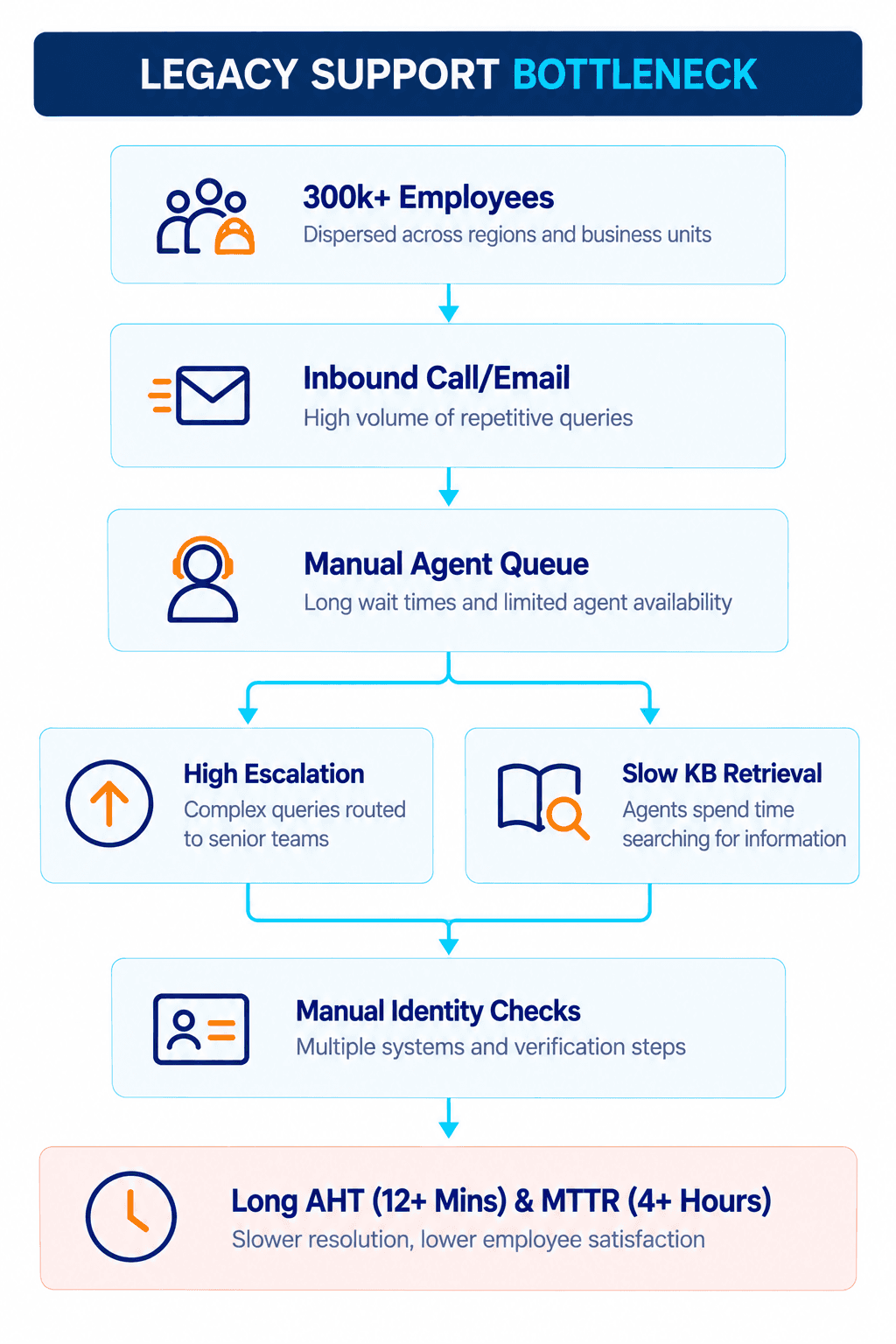
Managing IT infrastructure support for an enterprise workforce exceeding 300,000 employees presents immense operational complexity. The enterprise’s internal service desk was flooded with repetitive L1 and L2 support requests, creating severe operational bottlenecks.
High Volume of Low-Complexity Tickets
Over 60% of all incoming service desk calls and emails were tied to routine access issues, such as account lockouts, multi-factor authentication resets, password updates, and standard software provisioning requests. High-salaried IT support staff spent critical hours executing manual verification steps rather than focusing on strategic infrastructure tasks.
Extended Average Handle Times (AHT) and SLA Breaches
When an employee called the helpdesk, human agents spent up to four minutes manually verifying employee credentials, checking historical ticket logs, and navigating disconnected knowledge bases. This manual verification bloat drove Average Handle Times beyond 12 minutes per call and created massive queue wait times during peak shift shifts.
Fragmented Escalation & Support Overhead
Without unified real-time context, escalating a ticket from L1 to L2 required manual log re-entry in ServiceNow. Disjointed handoffs caused lost ticket context, inconsistent troubleshooting step execution, and delayed resolution timelines, ultimately impacting global employee productivity.
How Did Subverse AI Solve the Problem?
Subverse AI deployed an autonomous multi-agent orchestration architecture designed to handle inbound communications, execute identity checks, perform back-office tasks, and coordinate human interventions when necessary.
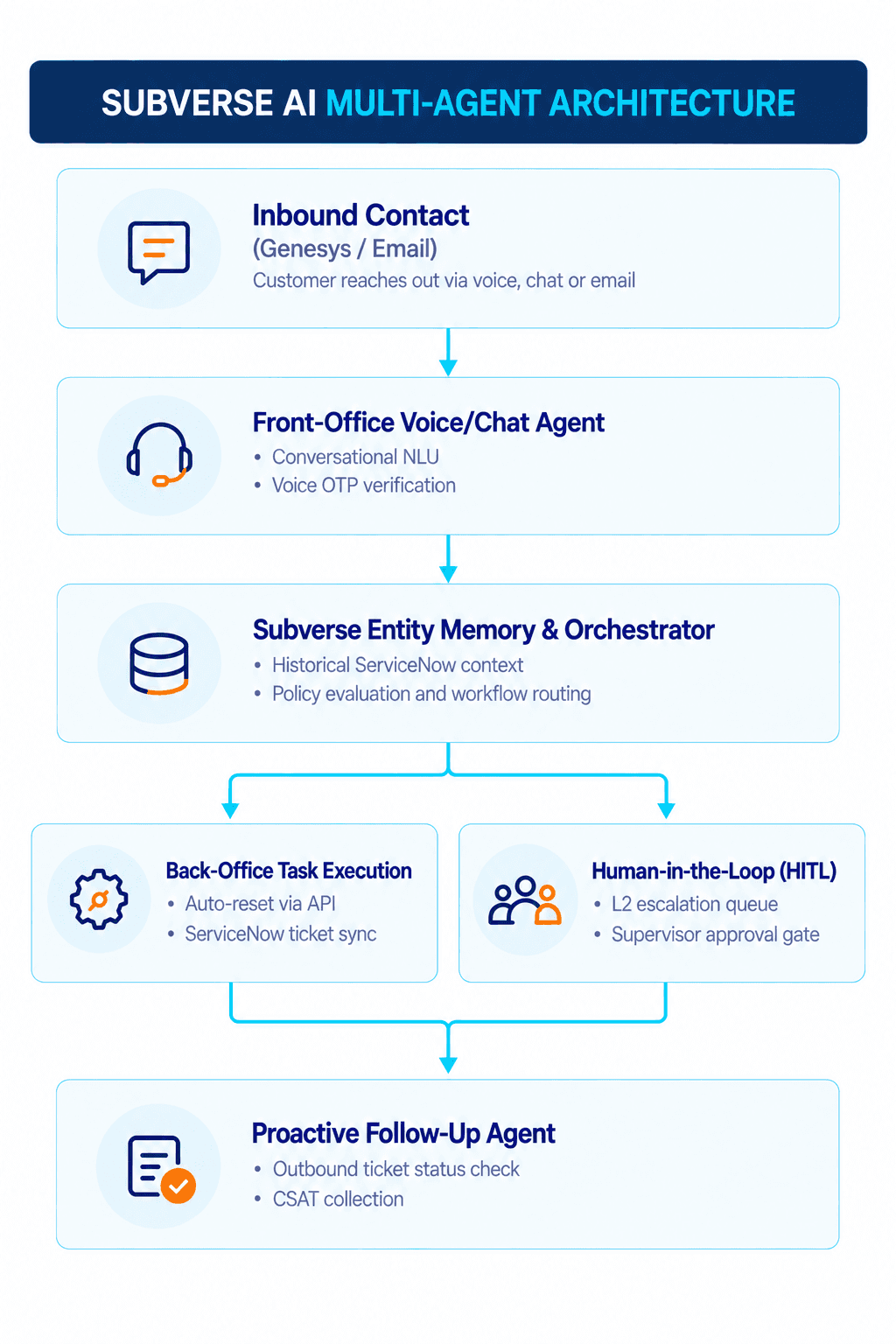
1. Inbound Omnichannel Reception & Voice Verification
When an employee calls the support hotline, Subverse Front-Office Voice AI Agents integrated with the Genesys telephony stack answer instantly. The agent initiates an automated primary identity match via employee ID and initiates a real-time, two-factor authentication (2FA) procedure by dispatching an out-of-band One-Time Password (OTP) over SMS or secure push notification.
2. Context-Aware Diagnostics via Entity Memory
Once authenticated, the platform leverages Subverse Entity Memory to contextualize the employee’s profile. Subverse retrieves recent ServiceNow tickets, assigned hardware assets, active active directory roles, and open incident logs. Rather than treating the interaction as a cold call, the AI agent understands the user's recent technical issues and environment immediately.
3. Back-Office Task Execution & KB Reasoning
For standard issues (e.g., active directory password resets or account unlocks), Subverse Back-Office Agents invoke authenticated REST API calls directly to directory management tools and ServiceNow to execute the fix instantly. For complex queries, Subverse agents ingest historical resolution patterns and query ServiceNow Knowledge Base articles to provide real-time voice-guided troubleshooting steps.
4. Human-In-The-Loop (HITL) Safety Gates
If an issue requires elevated administrative privileges or if the AI confidence threshold drops below predefined enterprise standards, Subverse seamlessly routes the live call along with a complete, structured transcript and context summary to a human supervisor. The human agent can approve action buttons directly within the Subverse control interface without forcing the employee to repeat information.
5. Autonomous Ticket Lifecycle & Proactive Follow-Up
Subverse automatically opens, updates, and updates the state of ServiceNow incidents in real time. Upon task completion, the platform triggers a Proactive Communication Agent to follow up with the employee via email or automated messaging to confirm issue resolution and record CSAT scores.
System Integrations & Multimodal Architecture
Subverse AI functions as a central orchestration layer, connecting existing telephony, ticketing, and identity infrastructure into a unified autonomous workflow.
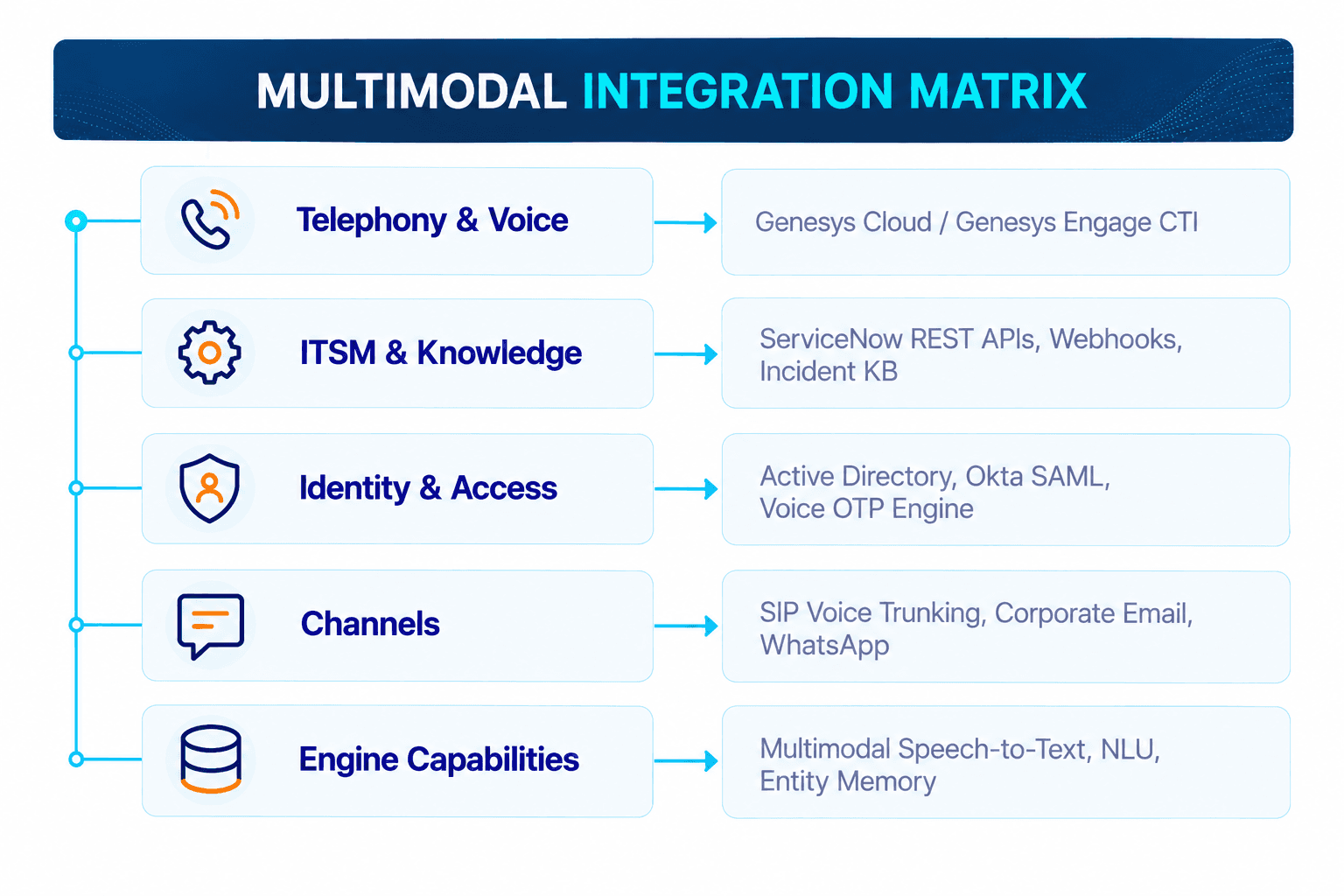
Telephony & Voice Infrastructure
● Genesys Cloud / Engage CTI Integration: Deep integration using SIP trunks and Genesys Web APIs allows Subverse Front-Office Voice AI to handle call routing, hold states, native transfer commands, and real-time audio streaming with zero latency.
ITSM & Service Desk Engine
● ServiceNow API & Webhooks: Bi-directional sync allows Subverse to create, update, query, and close incidents, requests, and change logs programmatically.
● Knowledge Base Parsing: Subverse agents process structured and unstructured ServiceNow KB articles, parsing technical documentation on-the-fly to deliver direct answers to calling employees.
Identity Management & Multimodal Capabilities
● Active Directory / Okta Orchestration: Enables secure, automated user status checks, group membership modifications, and credential resets.
● Multimodal Input Processing: Capable of processing voice streams, text-based email logs, and screenshot image attachments sent during support inquiries to diagnose error messages automatically.
Traditional Approach vs. Subverse Autonomous AI Workflow
Performance Metric | Traditional Manual IT Service Desk | Subverse Autonomous AI Workflow |
Average Handle Time (AHT) | 10 – 14 Minutes | < 2 Minutes (Voice & Automated Execution) |
First Contact Resolution (FCR) | 42% | 85% |
Authentication & 2FA Time | 3 – 5 Minutes (Manual Security Questions) | 15 Seconds (Automated Voice OTP) |
L1 Ticket Cost per Incident | $18.00 – $25.00 | < $2.50 |
Human Supervision Requirement | 100% Manual Processing | Human-in-the-Loop (HITL) for ~15% Escalations |
Service Desk Scalability | Linear (Requires Hiring More Helpdesk Staff) | Elastic (Handles Unlimited Concurrent Requests) |
Ticket Context Tracking | Manual Ticket Notes / Disconnected History | Subverse Continuous Entity Memory |
What Was the Business Impact and KPI Improvement?
Deploying Subverse AI transformed the client’s internal service desk operations, delivering immediate operational cost savings, SLA performance gains, and elevated employee productivity.

Cost & Operational Efficiency Metrics
● 82% Straight-Through Processing (STP): Over four out of five inbound support inquiries are fully resolved by Subverse agents without human support intervention.
● 72% Reduction in Operating Costs: Drastically lowered the cost per incident by shifting high-volume L1 tasks to autonomous multi-agent execution.
● 3.5x Staff Capacity Reallocation: Freed up internal IT personnel to focus on high-priority infrastructure security and strategic enterprise projects.
Speed & SLA Performance Metrics
● 75% Reduction in Average Handle Time (AHT): Average call duration dropped from 12 minutes to under three minutes for fully automated workflows.
● MTTR Dropped to < 3 Minutes: Mean time to resolution for account lockouts, software permissions, and password resets dropped from four hours to under 180 seconds.
● Zero Queue Wait Time: Instant inbound call processing eliminated employee hold times during major shift changes and IT outages.
Quality, Security, and CSAT Metrics
● CSAT Reached 4.8 / 5.0: Employee satisfaction scores rose dramatically due to zero wait times and rapid problem resolution.
● 100% Security Audit Compliance: Automated OTP verification removed human error and social engineering risks from telephone credential reset procedures.
Frequently Asked Questions (FAQ)
How does Subverse AI integrate with Genesys and ServiceNow?
Subverse AI integrates natively using CTI connectors and REST APIs. It receives live voice calls via Genesys SIP trunks and bi-directionally reads or writes ServiceNow ticket data, enabling real-time authentication, ticket updates, and automated resolution workflows without interrupting existing service desk operations.
How does the platform handle employee identity verification securely?
Subverse AI connects to Active Directory or Okta to verify caller identities. During an inbound call, the Front-Office Voice Agent automatically dispatches a secure two-factor authentication (2FA) One-Time Password (OTP) via SMS or app notification, validating the user before taking administrative action.
What happens when an IT issue cannot be resolved autonomously?
When an inquiry exceeds the AI’s confidence threshold or requires manual administrative permissions, Subverse routes the interaction to a live agent via Human-in-the-Loop (HITL) handoffs. The human agent receives a complete context summary and real-time call transcript, ensuring seamless continuation.
Can Subverse AI handle complex troubleshooting steps from Knowledge Base articles?
Yes. Subverse AI parses structured and unstructured ServiceNow Knowledge Base articles using specialized domain reasoning. It extracts technical step-by-step procedures, guides employees verbally or via chat through resolution checks, and records executed steps in the ServiceNow incident log.
How does Subverse AI maintain context across multiple user calls?
Subverse AI utilizes deep Entity Memory to maintain long-term context for every employee. If a user calls back regarding an ongoing ticket, the platform recalls previous interactions, active hardware assets, and prior agent notes, eliminating repetitive questions and speeding up resolution.
Table of Content
More Insights