Sep 7, 2026
Eliminate language barriers, misdiagnosed hardware tickets, and delayed merchant resolutions with Subverse AI's multimodal agent orchestration.

Servicing over 3.5 million merchant locations and 1.8 million POS & Soundbox devices across 19,000+ Indian pin codes, a top-tier payment acquirer faced severe operational bottlenecks within its 15,000+ Foot-on-Street (FOS) field force. Language barriers and rigid app forms caused a 38% ticket misclassification rate and average SLA delays of 72 hours. By deploying Subverse AI's autonomous agent orchestration platform, the acquirer implemented multimodal WhatsApp and Voice AI agents capable of processing vernacular audio notes, verifying visual terminal proof, dynamically routing bank-side vs. hardware issues, and conducting automated merchant resolution calls. The system reduced ticket resolution times by 78% and eliminated manual ticket logging errors across 85,000+ monthly service requests.
What Operational Challenges Was the Enterprise Facing?
As one of India's premier payment solution providers, the enterprise manages a vast merchant acquiring infrastructure comprising over 3.5 million active merchants and 1.8 million Point-of-Sale (POS) terminals and audio Soundboxes. Servicing this footprint requires a massive field force of 15,000+ Foot-on-Street (FOS) sales and service personnel operating across 19,000+ pin codes—ranging from Tier 1 metropolitan hubs to remote Tier 6 rural markets.
Processing over 85,000 service and repair tickets monthly, the enterprise faced severe operational drag due to legacy app-based logging and fragmented cross-departmental coordination:
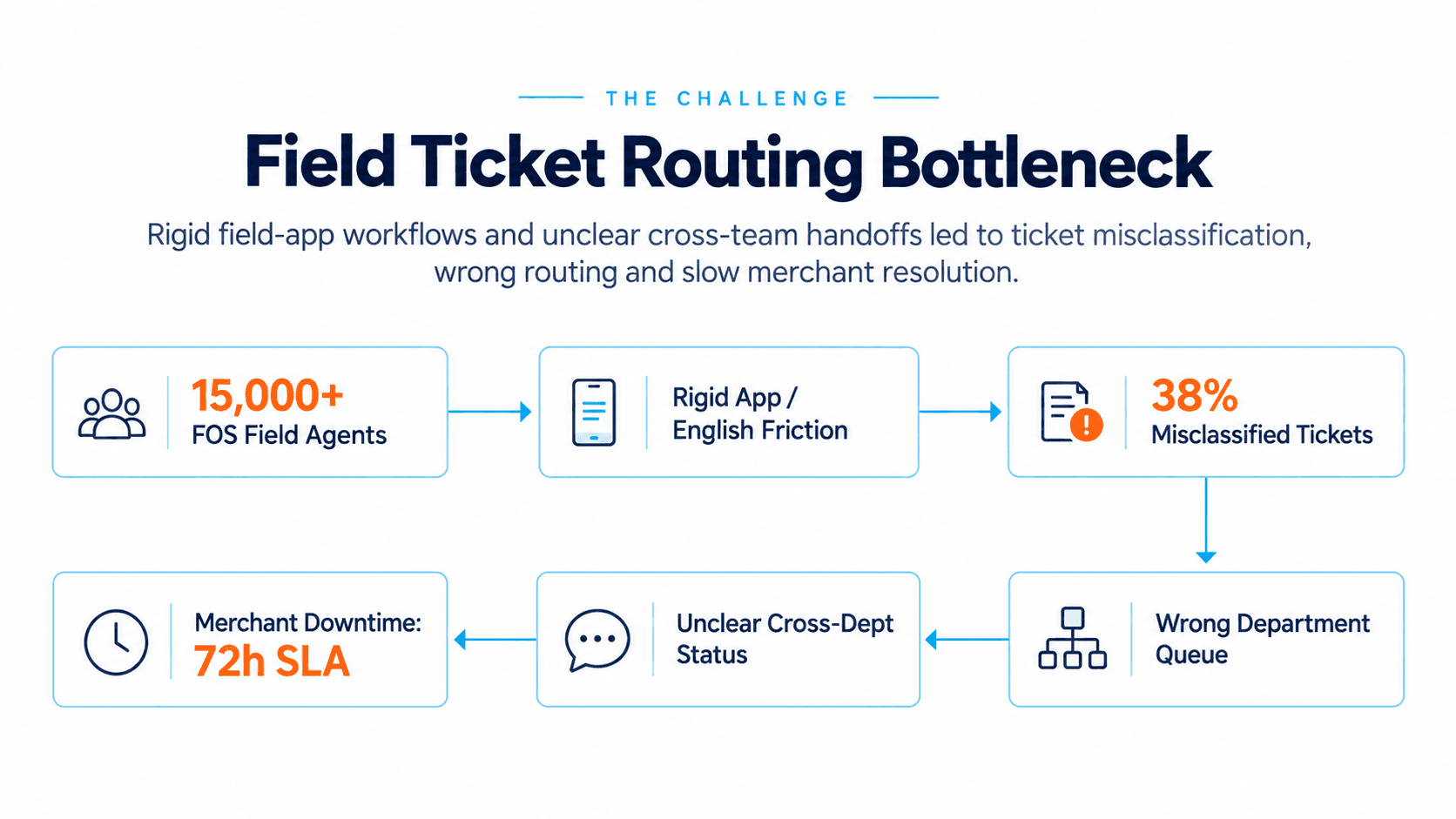
1. Vernacular Language Barriers Across a 15,000-Agent Fleet
Over 85% of the 15,000+ FOS personnel communicate primarily in local regional dialects. Requiring field representatives to type detailed technical error descriptions in English inside a mobile app resulted in incomplete descriptions, high error rates, and delayed task submissions.
2. High Diagnostic Error Rates & Redundant Dispatches
Field reps frequently misdiagnosed terminal failures. Out of 85,000 monthly reported issues, over 38% logged as "hardware defects" were actually bank-side host timeouts, network SIM deactivations, or account mapping errors. This misclassification triggered thousands of redundant physical device replacements and inflated reverse logistics costs.
3. Fragmented Cross-Department Tracking & SLA Delays
When an issue required intervention from internal banking operations, risk, or switch management, tickets were manually reassigned across isolated departmental queues. The absence of unified orchestration left field reps and merchants without visibility, driving average turnaround times (SLA) up to 72 hours.
4. Premature Ticket Closures and Unverified Fixes
To meet daily quotas, field representatives routinely marked tickets as "Resolved" without verifiable proof of system recovery. Over 22% of closed tickets resulted in recurring merchant complaints, eroding merchant trust and driving terminal churn.
How Did Subverse AI Solve the Problem?
To eliminate field data friction and streamline service delivery, the enterprise deployed Subverse AI to orchestrate an end-to-end, multimodal field operations workflow across WhatsApp and Voice channels.
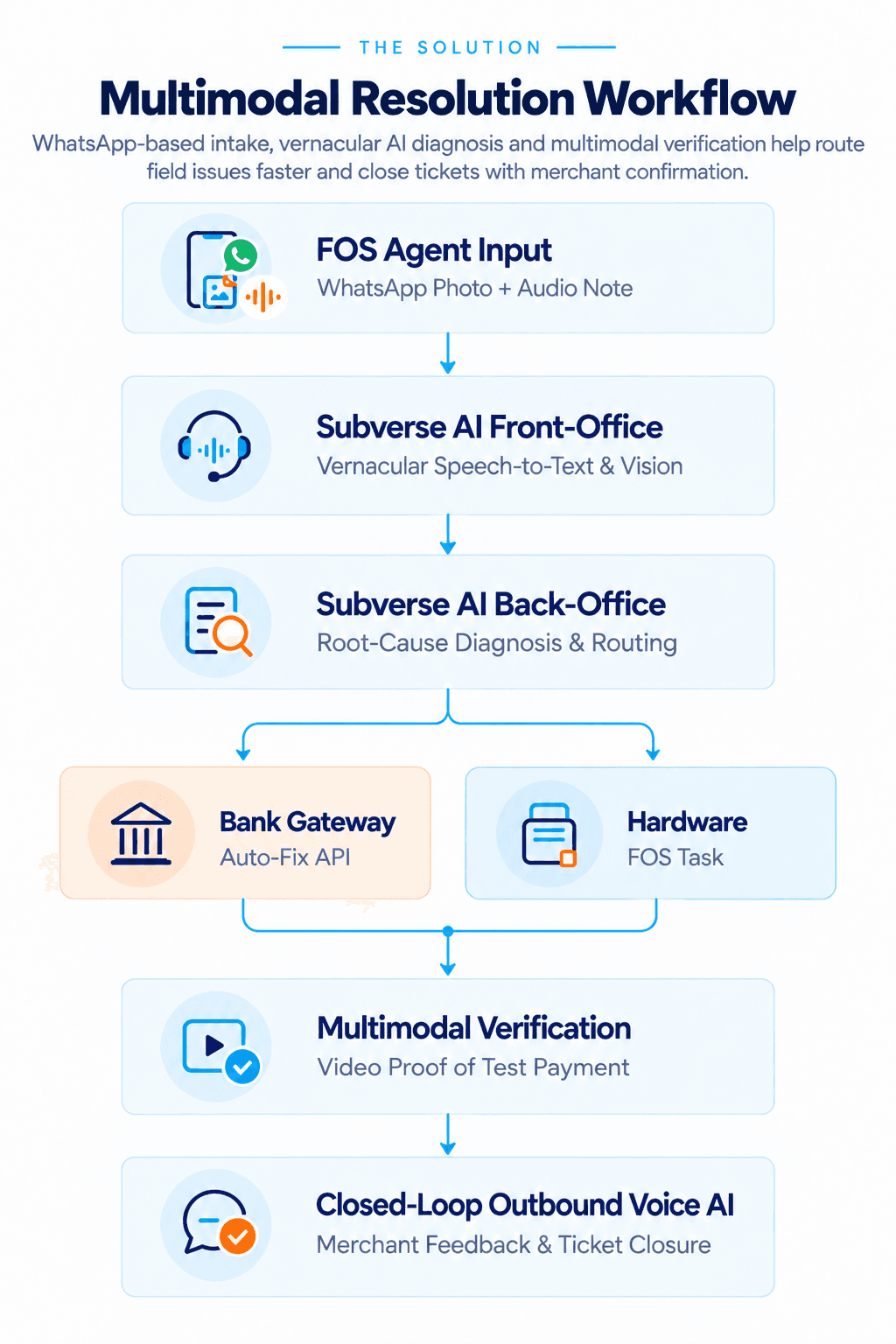
1. Multilingual Front-Office Interaction via WhatsApp & Voice
Instead of navigating complex app forms, FOS field agents interact with a Subverse Front-Office Agent directly over WhatsApp or phone calls.
When visiting a merchant, the agent takes a photograph of the POS terminal screen showing the error code and submits a brief spoken voice note in their native dialect (e.g., Hindi, Tamil, Marathi, Telugu, or Bengali).
2. Intelligent Vision & Speech Extraction
A Subverse Back-Office Agent receives the multimodal payload via webhooks. Using specialized OCR and vision models, it parses the screen error on the terminal image.
Simultaneously, Subverse AI transcribes and translates the voice note, combining visual and verbal inputs into a structured JSON diagnostic payload.
3. Automated Root-Cause Diagnosis and Cross-Department Routing
Subverse AI compares the extracted error context against core banking switch logs.
If the issue is host- or network-related (e.g., account mapping error or merchant ID suspension), Subverse AI routes the ticket via API directly to the core banking team, instructing the FOS agent that no hardware replacement is necessary.
If it is a true hardware fault (e.g., printer head failure or damaged SIM slot), the system logs a terminal replacement request and updates the internal inventory management system.
4. Proactive SLA Tracking and Entity-Level Memory
Utilizing Subverse Entity Memory, the platform continuously tracks the status of every Terminal ID (TID), Merchant ID (MID), and assigned FOS agent over time.
When an FOS agent provides an estimated repair timeline, Subverse AI schedules automated follow-up triggers.
If the repair window lapses, an outbound Subverse Voice Agent calls the FOS representative to prompt an immediate status update or escalate the ticket.
5. Multimodal Proof Verification
To ensure genuine issue resolution, Subverse AI enforces a strict verification gate. The FOS agent must record and upload a short video showing a successful test transaction on the POS terminal or Soundbox.
Subverse AI’s vision model parses the video frame-by-frame to verify transaction approval text on the terminal screen and audio confirmation from the Soundbox before approving ticket closure.
6. Closed-Loop Merchant Confirmation
Once visual proof is verified, a Subverse Outbound Voice AI Agent places an automated phone call to the merchant in their preferred language.
The voice agent confirms that the terminal is working properly and captures a real-time Customer Satisfaction (CSAT) rating before closing the ticket in the enterprise CRM.
What System Integrations & Multimodal Architecture Were Implemented?
Subverse AI integrated seamlessly into the enterprise’s legacy infrastructure without requiring modifications to core systems:

Core Integrations
● Core Banking Switch & Acquiring Engine: ISO 8583 and REST APIs for real-time terminal diagnostics, status queries, and transaction validation.
● Enterprise Ticketing & CRM Systems: Synchronized bi-directional hooks into ServiceNow and custom internal databases for cross-department ticket management.
● Telephony & Messaging Gateways: Integration with WhatsApp Business API and SIP/VoIP gateways for automated voice dialers and incoming audio processing.
Multimodal AI Capabilities
● Multilingual Speech-to-Text (ASR): Converts regional voice notes and spoken calls across 12+ dialects into structured text.
● Computer Vision & IDP: Screen-parsing models for terminal display reading, serial number extraction, and video transaction verification.
● Proactive Scheduling Engine: Automated background timers that trigger voice calls, SMS, and WhatsApp nudges based on SLA thresholds.
Traditional Approach vs. Subverse Autonomous AI Workflow
Parameter | Traditional App-Based Workflow | Subverse AI Autonomous Workflow |
Data Entry Channel | Manual English text forms in mobile app | Natural spoken voice notes & photos via WhatsApp |
Diagnostic Accuracy | High error rates; frequent hardware misdiagnosis | AI-verified cross-referencing of visuals with switch logs |
Cross-Dept Routing | Manual reassignment across slow queues | Automated instant API routing based on root cause |
Resolution SLA | 48 to 72 Hours | Average under 4 Hours |
Closure Verification | Unverified manual status toggles by field staff | Computer vision validation of video transaction proof |
Merchant Feedback | Periodic manual sample surveys | 100% automated Voice AI outbound confirmation calls |
FOS Usability | Low adoption due to language/typing barriers | Near 100% adoption; frictionless conversational entry |
What Was the Business Impact and KPI Improvement?
By automating field operations and ticket routing through Subverse AI, the payment acquirer transformed its service delivery metrics across India:
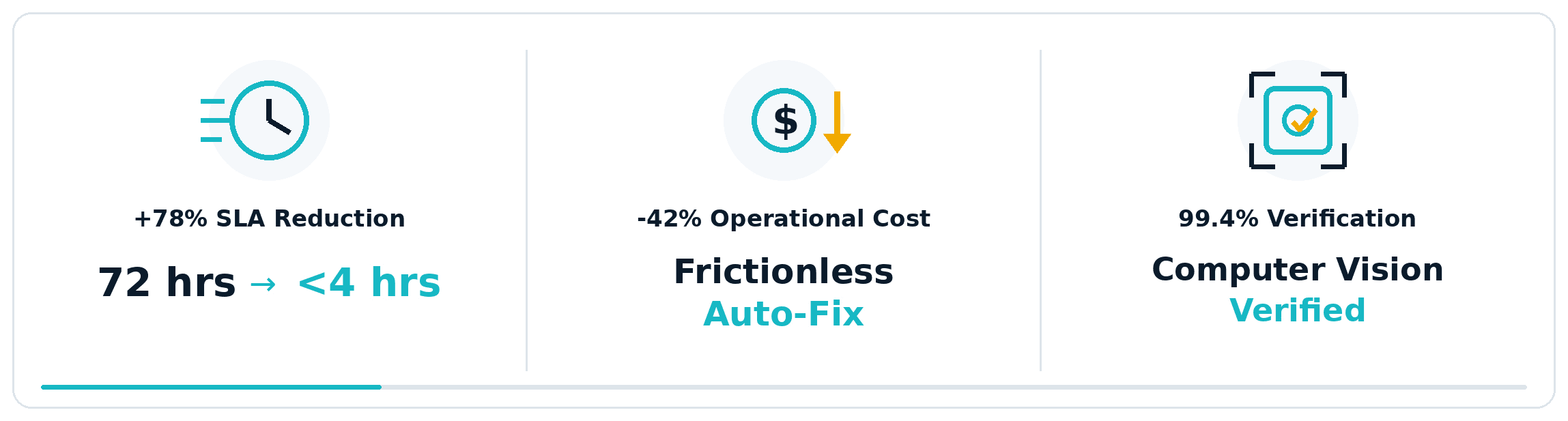
Cost & Efficiency Metrics
● 42% Reduction in Operating Costs: Automated diagnostic verification eliminated unnecessary technician dispatch for bank-side issues.
● 80% Straight-Through Processing (STP): Software and gateway issues were automatically identified and dispatched directly to core backend teams without human intervention.
Speed & SLA Metrics
● 78% Reduction in Ticket SLA: Average turnaround time dropped from 72 hours to under 4 hours nationwide.
● Zero Input Delays: Instant voice-to-ticket conversion eliminated delayed evening batch logging by field agents.
Quality & CSAT Metrics
● 99.4% Ticket Closure Accuracy: Video-based multimodal verification eliminated premature ticket closures.
● Merchant CSAT Increased to 4.8/5: Automated outbound voice calls ensured merchants were heard and verified before ticket closure.
Frequently Asked Questions (FAQ)
How does Subverse AI handle field agents who don't speak English?
Subverse AI accepts voice notes and phone calls in over 12 regional languages and local dialects. The platform automatically transcribes, translates, and structures spoken audio into enterprise-standard ticket data, eliminating language barriers for field representatives.
How does the platform differentiate between hardware and software errors?
Subverse AI combines visual screen data from uploaded photos with real-time API logs from the core banking switch. If error codes indicate a network or host issue, the platform routes it to backend IT, preventing unnecessary hardware technician dispatches.
Can Subverse AI integrate with legacy enterprise ticketing and core banking platforms?
Yes. Subverse AI connects to legacy CRMs, ERPs, and core acquiring switches using webhooks, REST APIs, or database connectors. It orchestrates workflows across these platforms without requiring major overhauls to existing core IT architecture.
How does Subverse AI verify that a device is fixed before closing a ticket?
Subverse AI requires the field agent to submit a video of a successful test transaction on the repaired device. Computer vision models analyze the video frame-by-frame to confirm payment approval before initiating an automated feedback call to the merchant.
Table of Content
More Insights


