Sep 18, 2026
Streamline high-volume delivery updates, address modifications, and inbound voice/WhatsApp inquiries with real-time, agentic workflow orchestration.

A Fortune 500 global express delivery carrier processing over 1.2 million daily shipments deployed Subverse AI to automate its high-volume last-mile delivery exception management. By leveraging Subverse AI’s ConVerse, AgentVerse, and DataVerse multi-agent orchestration platform, the enterprise automated omnichannel triaging across inbound voice and WhatsApp channels, modernized address modification workflows, and enabled dynamic delivery re-routing. The autonomous AI solution reduced re-delivery operational costs by 68%, increased first-attempt delivery success by 24%, and resolved over 85,000 daily delivery exception requests without human intervention.
What Operational Challenges Was the Enterprise Facing?
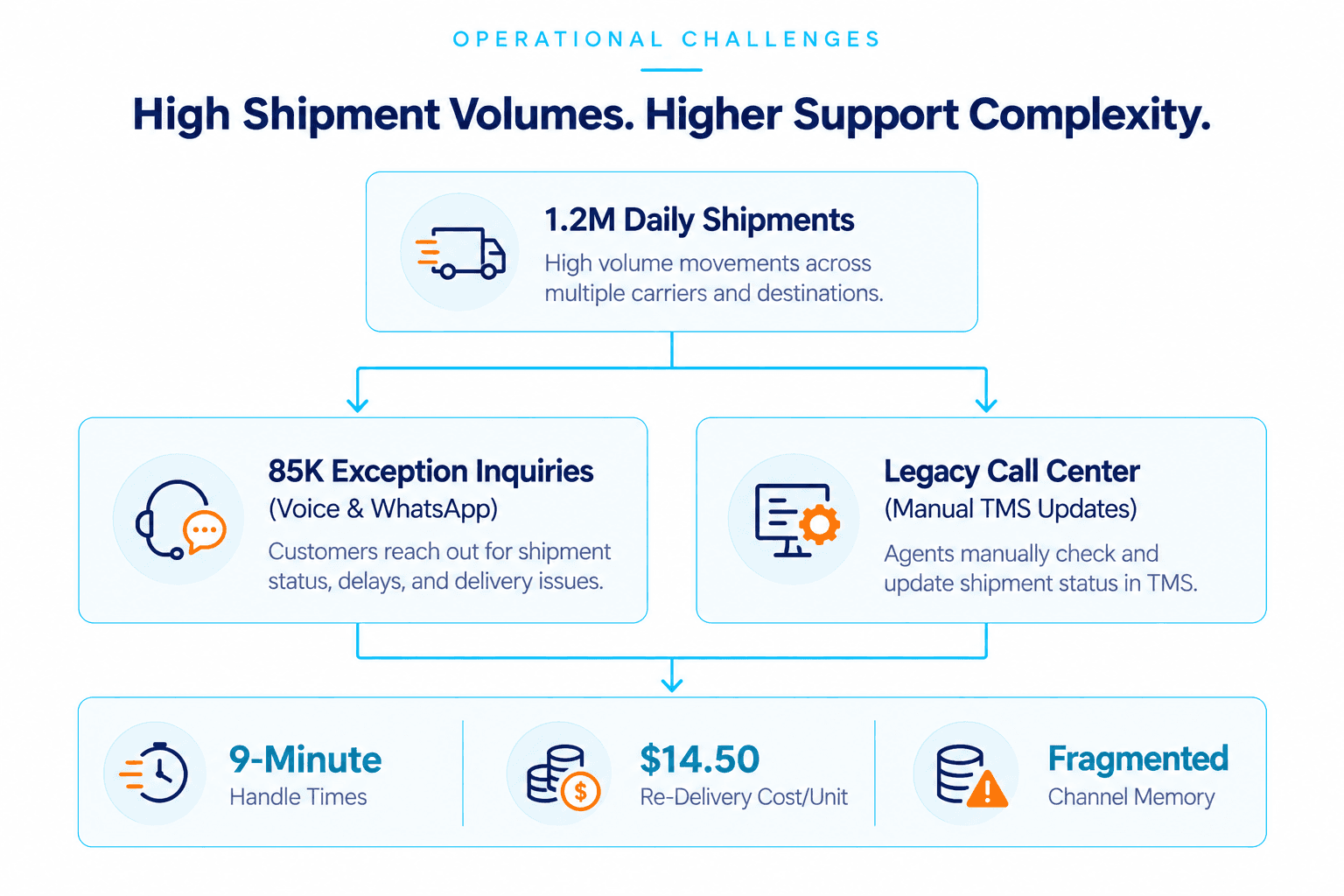
Operating a global logistics network handling 1.2 million package deliveries daily presents complex last-mile operational friction. The enterprise faced severe customer support and fulfillment bottlenecks caused by late-stage delivery exceptions, dynamic address changes, gated access challenges, and recipient time-window preferences.
Skyrocketing Operational Costs and Missed Cutoffs
With over 85,000 daily exception inquiries, human support teams were overwhelmed by manual data entry. Representatives took an average of 9 minutes per call to verify package credentials, check dispatch manifests, and manually update entries across legacy Transportation Management Systems (TMS) and Warehouse Management Systems (WMS).
Because these manual updates took hours to sync, delivery drivers frequently departed sorting hubs with outdated manifests. This resulted in failed delivery attempts, costing the enterprise $14.50 per failed re-delivery in wasted fuel, driver overtime, and fleet wear.
Fragmented Multichannel Context
Recipients frequently initiated inquiries on one channel (e.g., an inbound telephony voice call while driving) and followed up on another (e.g., uploading identity documents or drop-off location photos via WhatsApp). Legacy contact center software treated each touchpoint as an isolated interaction.
Customers were forced to repeatedly provide tracking numbers and personal credentials. This context fragmentation reduced Customer Satisfaction (CSAT) scores to 62% and caused delays in time-sensitive express deliveries.
Address Modification Fraud and Compliance Risks
Mid-transit delivery rerouting introduces significant fraud risk, particularly for high-value retail freight. Human call center representatives lacked instant document verification tools to validate address modification requests against recipient identities.
As a result, strict compliance policies required mandatory multi-step human supervisor approvals for any address change, creating operational backlogs during peak delivery windows.
How Did Subverse AI Solve the Problem?
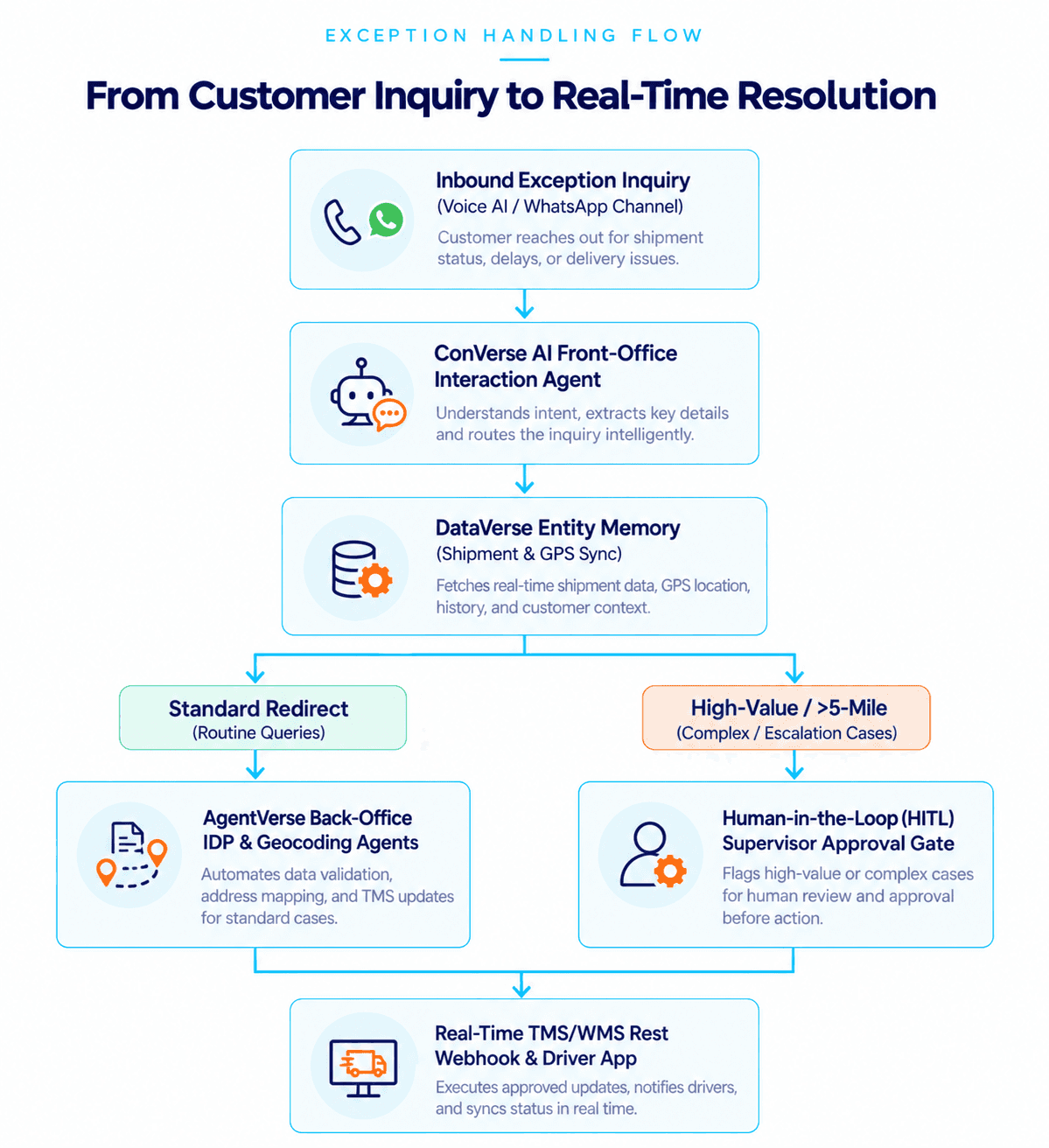
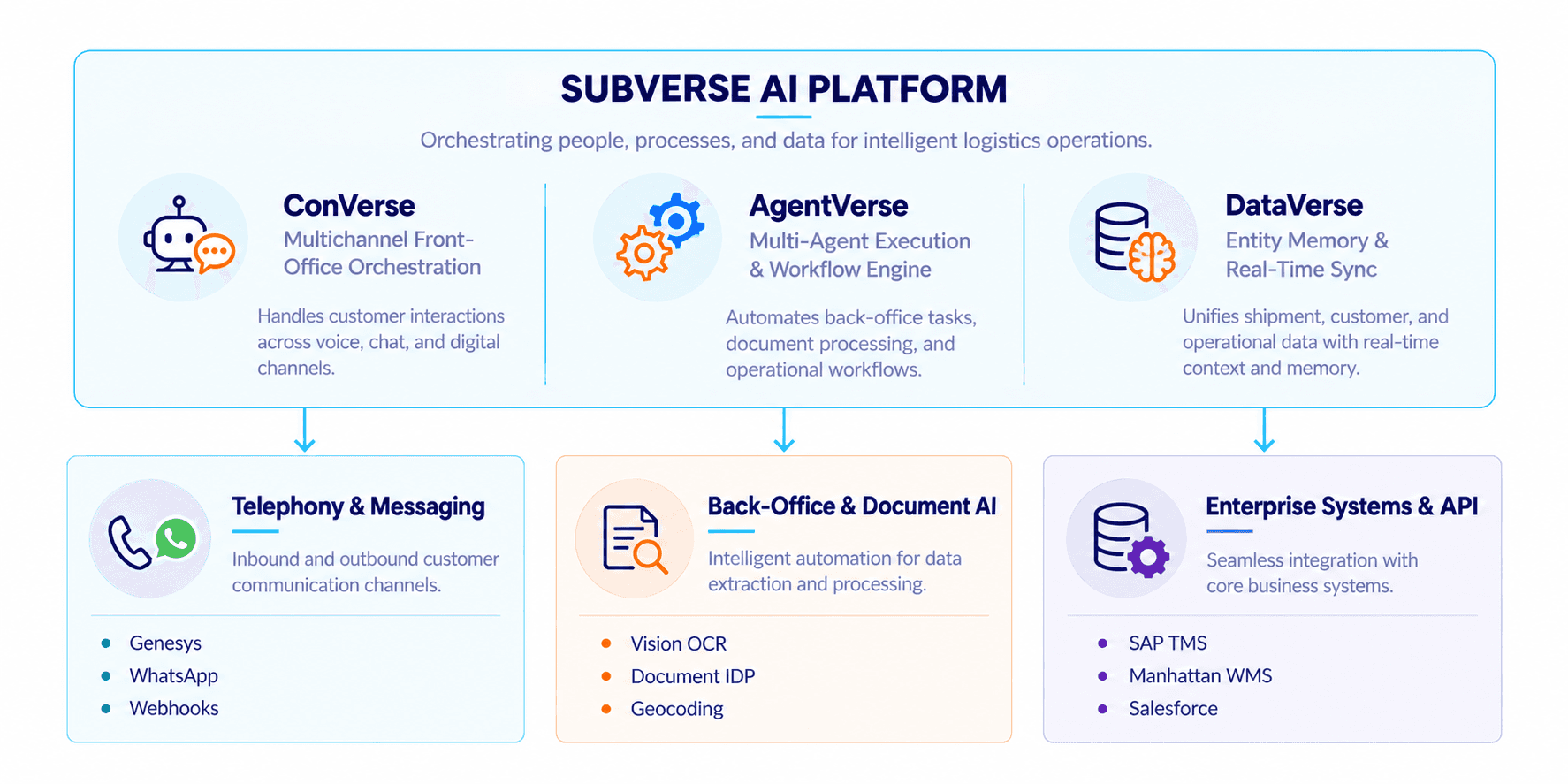
Subverse AI implemented a stateful, multi-agent orchestration framework designed to handle end-to-end delivery triaging and exception resolution autonomously. Built on Subverse's ConVerse (Interaction Layer), AgentVerse (Execution Layer), and DataVerse (Unified Data & Entity Memory Layer), the system coordinates front-office communication and back-office logistics execution in real time.
1. Inbound Omnichannel Triaging via ConVerse
When a recipient calls customer service or messages via WhatsApp regarding a package status, Subverse AI’s ConVerse Interaction Agent immediately anchors the conversation. Utilizing natural language understanding (NLU) and real-time speech processing, the agent extracts package tracking identifiers, intent (e.g., delivery hold, address edit, access code submission), and urgency metrics.
2. Entity Memory Context Retrieval via DataVerse
Before responding, the system queries DataVerse, Subverse AI’s deep entity-level memory layer. DataVerse aggregates historical recipient preferences, past delivery notes, live GPS coordinates of the delivery vehicle, and current sorting hub status. This ensures the AI maintains stateful context even if the customer switches seamlessly between voice calls and WhatsApp chat.
3. Back-Office Verification & Geocoding via AgentVerse
For address modification requests, AgentVerse deploys specialized back-office agents:
● Geocoding & Spatial Agent: Verifies the new street address against GIS mapping APIs, checking route feasibility, zone boundaries, and delivery cutoff windows.
● IDP & Vision Agent: If a high-value parcel requires identity verification for a delivery location edit, the back-office document agent prompts the user on WhatsApp to upload proof of residence or photo ID. The agent processes the image via OCR and validates the document within 3 seconds.
4. Autonomous Systems Execution & Driver Manifest Sync
Once verified, an Execution Agent issues secure REST API calls directly to the enterprise’s SAP Transportation Management System (TMS) and driver mobile applications. Route optimization algorithms recalculate the driver's sequence automatically, updating the handheld manifest without dispatcher intervention.
5. Human-in-the-Loop (HITL) Safety Checkpoints
If an address modification request exceeds a 5-mile radius from the primary sorting zone or involves hazardous materials, the system triggers a Human-in-the-Loop (HITL) gate. A dispatcher receives an prioritized alert with pre-analyzed AI recommendations, allowing one-click approval or modification.
What System Integrations & Multimodal Architecture Were Implemented?
The Subverse AI platform was integrated into the enterprise’s hybrid logistics stack within 30 days. The solution acts as an intelligent orchestration plane, bridging customer touchpoints with core back-office infrastructure.
Core Enterprise Integrations
● Transportation Management Systems (TMS): SAP Transportation Management and Oracle Logistics via bi-directional REST webhooks for live route and manifest updates.
● Warehouse Management Systems (WMS): Manhattan Associates WMS for intercepting packages at distribution centers prior to last-mile dispatch.
● CRM & Helpdesk: Salesforce Service Cloud and ServiceNow for real-time ticket logging and escalation history.
Multimodal Processing Capabilities
● Conversational Voice AI: Lifelike, sub-300ms latency voice interface running on telephony links, capable of comprehending dynamic delivery instructions, accents, and noisy environments.
● WhatsApp Vision & IDP Agents: Intelligent Document Processing (IDP) capable of analyzing uploaded images (e.g., utility bills, gated community entry maps, written drop-off notes) and parsing unstructured image text into structural JSON payloads.
● Proactive Notification Engine: Automated outbound calls and WhatsApp pushes triggered by GPS geofence events to re-confirm recipient presence prior to delivery attempts.
Traditional Approach vs. Subverse Autonomous AI Workflow
Parameter | Legacy Call Center & Manual Triaging | Subverse Autonomous Multi-Agent Workflow |
Average Handle Time (AHT) | 8 to 12 minutes per call | Less than 45 seconds (Instant execution) |
Straight-Through Processing (STP) | < 12% (Heavy reliance on manual intervention) | 82% fully autonomous exception resolution |
First-Attempt Delivery Rate | 74% across metro delivery zones | 91.8% success rate |
Data Sync Latency (TMS/WMS) | 2 to 4 hours (Batch processing updates) | Real-time (< 2 seconds via REST APIs) |
Multichannel Context Memory | Non-existent; fragmented per channel | Unified Entity Memory (DataVerse) |
Cost Per Exception Handled | $8.50 – $14.50 (Labor + Re-delivery fuel) | $0.42 per resolved exception |
Scalability Cap | Constrained by seat headcount and staffing | Unlimited elasticity during seasonal surges |
What Was the Business Impact and KPI Improvement?
Deploying Subverse AI transformed the carrier’s last-mile operations from a cost-heavy reactive center into an efficient, proactive delivery engine.
Cost & Efficiency Metrics
● 68% Reduction in Re-Delivery OpEx: Automated confirmation and address accuracy checks eliminated thousands of unnecessary secondary delivery trips.
● $6.4 Million Annual Cost Savings: Realized across 12 regional distribution hubs through labor optimization and reduced fleet fuel consumption.
● 82% Straight-Through Processing (STP) Rate: Over 4 out of 5 delivery exception requests are handled from customer request to TMS route update with zero human dispatcher involvement.
Speed & SLA Metrics
● 92% Reduction in Resolution Time: Processing time for last-mile address changes dropped from 9 minutes down to under 45 seconds.
● 24% Increase in First-Attempt Delivery Success: Proactive WhatsApp dynamic scheduling ensured recipients were available during scheduled arrival windows.
● Instant Route Recalculation: Driver manifests updated via API webhooks in less than 2 seconds.
Quality & CSAT Metrics
● CSAT Boosted to 91%: Parcel recipient satisfaction jumped by 29 percentage points due to instant resolution and zero hold times.
● 99.4% Geocoding Accuracy: AI-driven address validation eliminated driver navigation errors caused by ambiguous street entries.
● Zero Unapproved Reroutes: Automated IDP document validation virtually eliminated fraudulent delivery redirection attempts.
Frequently Asked Questions (FAQ)
How does Subverse AI prevent fraudulent delivery address modifications?
Subverse AI triggers automated identity verification workflows via WhatsApp or SMS when a high-value parcel reroute is requested. Its IDP agents parse government IDs and utility bills in seconds, while security rules escalate suspicious or out-of-boundary requests to human supervisors.
Can Subverse AI handle high call volumes during peak holiday delivery seasons?
Yes. Subverse AI’s cloud-native multi-agent architecture scales dynamically to process hundreds of thousands of concurrent voice and messaging interactions without delay or service degradation. It eliminates peak-season queue wait times entirely.
How does Subverse AI sync address updates with driver routing apps in real time?
Through secure REST APIs and webhooks, Subverse AI’s AgentVerse layer directly updates core systems like SAP TMS and Manhattan WMS. These updates automatically trigger dynamic route recalculations on the driver’s handheld application within seconds.
What happens if a customer requests a delivery change outside the original sorting hub radius?
If an address modification crosses regional delivery boundaries, Subverse AI evaluates the distance and route rules. It either calculates an updated freight charge automatically or routes the ticket to a human dispatcher via a Human-in-the-Loop (HITL) gate for policy approval.
Table of Content
More Insights


