Sep 9, 2026
Unify omnichannel voice, email, and WhatsApp communications with multimodal AI agents to resolve POS hardware issues instantly and optimize back-office field operations.

A Tier-1 merchant acquiring processor servicing over 500,000 active merchant locations and managing 1.2 million annual support requests deployed Subverse AI to automate end-to-end merchant support and Point-of-Sale (POS) terminal troubleshooting. By orchestrating front-office voice, email, and WhatsApp AI agents alongside multimodal back-office vision agents, Subverse AI eliminated a legacy 12-to-24-hour email triage delay, instantly converting inbound queries into actionable tickets. The deployment boosted First Contact Resolution (FCR) from 40% to 78%, cut field agent dispatches by 62%, and established real-time SLA tracking with automated manager escalation.
What Operational Challenges Was the Enterprise Facing?
Merchant acquiring enterprises operate in high-velocity environments where Point-of-Sale (POS) downtime directly translates to lost transactional revenue. The client’s legacy support infrastructure suffered from severe operational bottlenecks that severely compromised merchant satisfaction and inflated operational costs.
1. Severe Email Processing Latency
Inbound support emails containing error descriptions or photo attachments required manual review by Tier-1 agents. This created a processing lag of 12 to 24 hours before a ticket was even logged into the CRM, leaving merchants stranded during critical trading hours.
2. Missing Modern Communication Channels
Merchants demanded instant, mobile-first communication options like WhatsApp. The lack of conversational messaging channels forced merchants onto long phone queues or slow email threads to report basic POS hardware faults.
3. High Field-Dispatch Overhead & Low First Contact Resolution
The legacy setup achieved an online/First Contact Resolution (FCR) rate of only 40%. The remaining 60% of issues—many of which were simple software glitches or minor hardware misconfigurations—were indiscriminately routed to expensive field sales agents or third-party bank support teams.
4. Zero End-to-End Visibility & Frequent SLA Breaches
Once a ticket moved past initial logging, internal teams lacked centralized visibility into ticket ownership and progress. Tickets frequently stalled for weeks in siloed back-office departments without oversight, leading to recurring SLA breaches and frustrated merchant merchants.
How Did Subverse AI Solve the Problem?
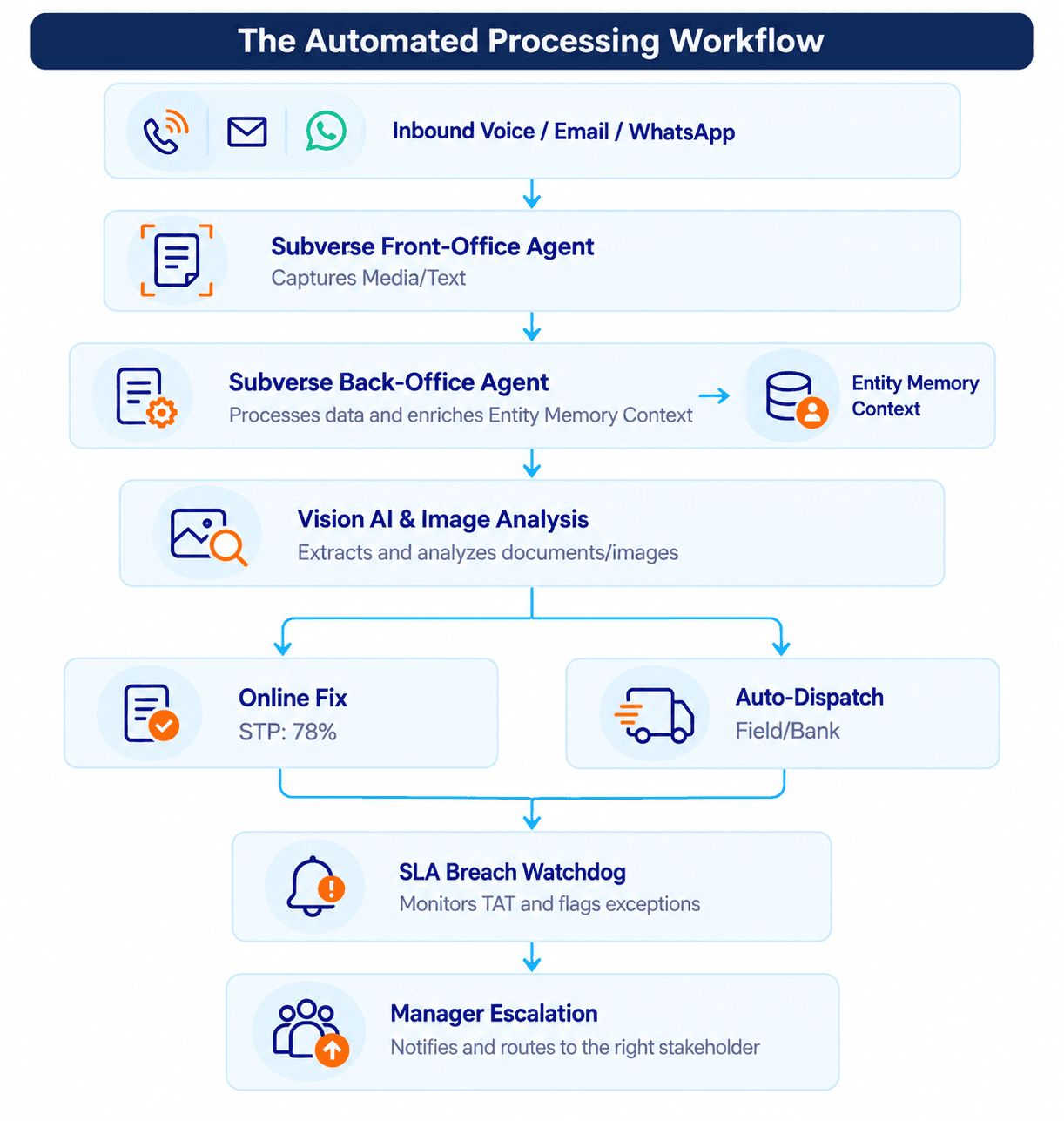
The enterprise deployed Subverse AI to orchestrate an autonomous, end-to-end support workflow across all inbound communication channels. Subverse AI deployed specialized Front-Office and Back-Office AI agents that act synchronously to resolve terminal issues and manage operational handoffs.
Step 1: Multi-Channel Autonomous Intake
Subverse Front-Office Agents handle incoming phone calls (Voice AI), parse incoming emails instantly, and manage structured, interactive conversations on WhatsApp. Regardless of the entry point, the platform creates an immediate, unified ticket record.
Step 2: Multimodal Visual Diagnostics
When merchants send photos or short videos of frozen POS screens, damaged card readers, or error codes via WhatsApp or email, Subverse Back-Office Vision Agents automatically analyze the media. Using fine-tuned visual models, the agents identify terminal models, detect on-screen error codes, and evaluate physical cable/port conditions.
Step 3: Entity Memory & Knowledge Retrieval
Subverse Entity Memory continuously maintains deep contextual records for each merchant ID, including active terminal serial numbers, past ticket history, and store layout details. When a query arises, the AI references past incidents to recommend precise troubleshooting steps.
Step 4: Automated Dispatch & Human-in-the-Loop (HITL)
If the issue cannot be resolved digitally (e.g., physical hardware destruction), Subverse automatically categorizes the fault, packages the diagnostic logs, and dispatches a ticket to the precise internal department, partner bank, or field representative.
Step 5: Real-Time Tracking & Automated SLA Escalation
Subverse AI tracks every ticket across all departments in real time. If a ticket sits idle near an SLA boundary, Subverse triggers an automated managerial escalation, notifying team managers via WhatsApp and email to guarantee rapid resolution.
What System Integrations & Multimodal Architecture Were Implemented?
Subverse AI integrated seamlessly into the enterprise’s existing IT ecosystem via robust API payloads and webhook architectures without requiring a core system overhaul.

● Core Payment & Terminal Processing APIs: Direct bidirectional link to fetch active terminal states, merchant account standings, and transaction ping status.
● CRM & Helpdesk Connectors: Native webhooks to Salesforce Service Cloud and Zendesk for instant ticket creation, updating, and closure sync.
● WhatsApp Business Cloud API: Automated conversational interface supporting high-resolution image and video ingestion directly from merchants.
● Multimodal Vision Engines: Custom computer vision pipeline capable of interpreting terminal LED indicators, screen error prompts, and video demonstrations of hardware failures.
● Cloud Telephony Gateways: Low-latency Voice AI integration enabling natural, conversational troubleshooting over telephone calls.
Traditional Approach vs. Subverse Autonomous AI Workflow
Performance Parameter | Legacy Operational Approach | Subverse AI Autonomous Workflow |
Email Triage Time | 12 to 24 Hours (Manual Review) | Instant (< 5 Seconds) |
Supported Support Channels | Inbound Call & Email Only | Omnichannel (Voice, Email, WhatsApp) |
Hardware Troubleshooting | Text descriptions / Manual Agent Guesses | Multimodal AI Vision (Photo/Video Analysis) |
First Contact Resolution (FCR) | ~40% | 78% Straight-Through Processing |
Field Agent Dispatch Rate | 60% of all incoming requests | 22% (Targeted Dispatches Only) |
Ticket Lifecycle Visibility | Siloed, zero tracking across departments | 100% Centralized Real-Time Monitoring |
SLA Escalation Mechanism | Manual, post-breach customer complaints | Proactive Automated Manager Alerts |
What Was the Business Impact and KPI Improvement?
Deploying Subverse AI transformed the enterprise's merchant support operations, driving measurable cost reductions and raising operational speed.
Cost & Efficiency Metrics
● $3.4M Annual Operational Cost Reduction: Drastically lowered manual support handling costs and field agent travel expenses.
● 62% Drop in Field Sales Agent Dispatches: Automated digital fixes eliminated unnecessary on-site technician visits for simple software configurations.
● 90% Lower Ticket Logging Overhead: Eliminated manual data entry for incoming email and messaging channels.
Speed & SLA Metrics
● Instant Ticket Ingestion: Reduced initial email-to-ticket lag from up to 24 hours to under 5 seconds.
● 85% Reduction in SLA Breaches: Proactive tracking and manager escalations eliminated long-standing, forgotten tickets.
● 4.5x Faster Mean-Time-to-Resolution (MTTR): Average resolution time decreased from 3.5 days to under 4 hours for non-field issues.
Quality & CSAT Metrics
● 78% First Contact Resolution (FCR): Broadened online resolution rates via guided AI troubleshooting over WhatsApp and Voice.
● 94% Merchant CSAT Rating: High satisfaction driven by instant response times and convenient mobile-first communication options.
Frequently Asked Questions (FAQ)
How does Subverse AI handle image and video terminal error analysis?
Subverse AI uses back-office multimodal vision models to parse photos and videos sent via email or WhatsApp. The AI detects hardware models, interprets screen error codes, and evaluates terminal status to guide merchants through step-by-step visual troubleshooting.
Can Subverse AI integrate with existing payment processing CRMs?
Yes. Subverse AI connects natively via REST APIs and webhooks to core payment platforms, ERPs, and standard CRMs like Salesforce, Zendesk, and ServiceNow. It updates merchant context and ticket statuses in real time without replacing legacy infrastructure.
What happens when an internal department delays resolving a support ticket?
Subverse AI monitors ticket lifecycles against target SLAs in real time. If a ticket sits unresolved past designated time thresholds, the platform triggers an automated escalation, notifying department managers over email or WhatsApp to ensure immediate attention.
How does Subverse AI reduce unnecessary field agent dispatches?
By using conversational Voice AI and WhatsApp multimedia workflows, Subverse resolves software glitches, configuration errors, and network issues digitally. Only verified physical hardware failures are routed to field sales agents or partner banks.
Table of Content
More Insights