Sep 4, 2026
Transforming POS and Soundbox Merchant Retention with Proactive Voice AI, Dynamic Escalation Workflows, and Algorithmic Offer Engines.

A leading global merchant acquiring and payments enterprise, backed by India's largest banking network, serves 1.1M+ merchants across 1,050+ cities through 1.7M+ payment terminals, spanning POS, UPI and Soundbox-based payment acceptance. Facing high early-stage merchant attrition across its Point-of-Sale (POS) and Soundbox terminal networks, the enterprise deployed Subverse AI to establish an end-to-end, multi-agent orchestration workflow covering the critical T+90 merchant lifecycle. Subverse AI integrated outbound conversational Voice AI, real-time transaction telemetry, back-office ticket escalation, and dynamic competitive offer engines. This autonomous solution reduced T+90 merchant churn by 38%, accelerated technical issue resolution times by 75%, and preserved millions in annual gross processing volume (GPV).
What Operational Challenges Was the Enterprise Facing?
Merchant acquiring institutions operating massive networks of physical Point-of-Sale (POS) terminals and audio-based transaction verification devices ("Soundboxes") operate in a hyper-competitive ecosystem. For this enterprise, merchant drop-off within the first 90 days (T+90) represented a massive loss in customer acquisition cost (CAC) and long-term Merchant Discount Rate (MDR) revenue.
The enterprise struggled with several operational bottlenecks across the merchant lifecycle:
● Manual Onboarding Verification & Compliance Friction: Following merchant deployment, compliance reading, operational checks, and post-setup guidance were handled via manual call centers. Agents struggled to collect structured compliance responses, leading to backlogs and low completion rates.
● Passive, Post-Mortem Churn Detection: The legacy infrastructure detected merchant churn reactively—typically 30 to 45 days after a merchant stopped processing transactions. By the time a relationship manager intervened, the merchant had already switched to a competitor.
● Fragmented Support Ticketing & Unclosed Feedback Loops: Technical failures (e.g., POS terminal connectivity errors, Soundbox battery defects, settlement delays) required manual intervention across siloed IT, hardware, and finance teams. Tickets were frequently lost or delayed without proactive status updates back to the merchant.
● Inability to Counter Competitive Pricing Threats in Real Time: Competitors frequently targeted active merchants with lower MDR rates or cashback incentives. The acquiring enterprise lacked an automated mechanism to identify competitive pricing loss drivers and present instant, algorithmic counter-offers to retain the merchant on the spot.
How Did Subverse AI Solve the Problem?
To eliminate merchant churn and automate operational workflows, the organization deployed Subverse AI's multi-agent orchestration platform. Subverse AI established a continuous, autonomous T+90 lifecycle management system powered by coordinated Front-Office and Back-Office AI Agents anchored by deep Entity Memory.
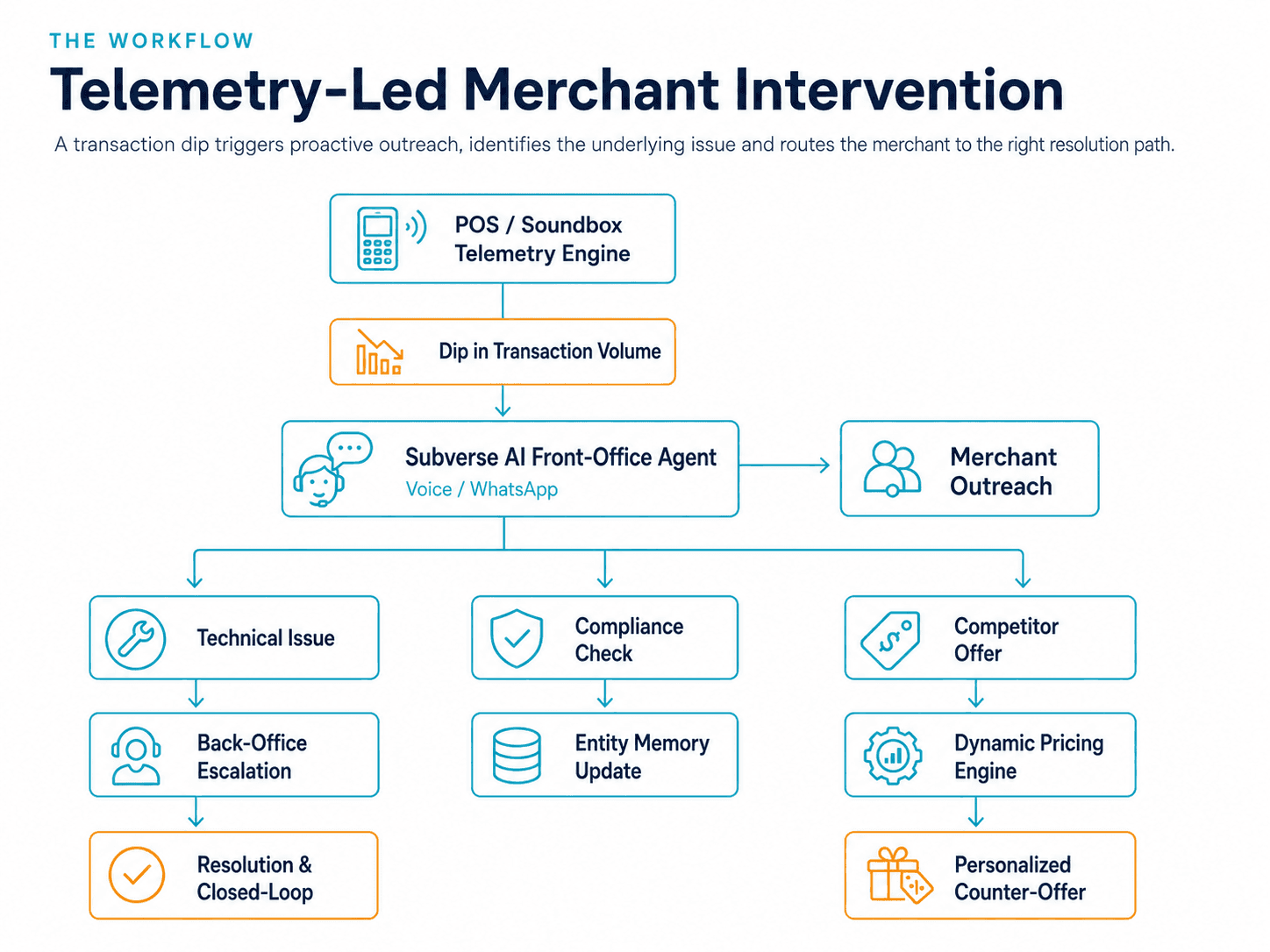
Step 1: T+0 to T+90 Onboarding & Compliance Orchestration
Immediately upon terminal activation, Subverse AI’s Front-Office Voice Agent initiates an outbound conversational Voice AI call to the merchant in their preferred regional language. The agent conducts mandatory compliance interviews, parses spoken responses into structured JSON payloads, and logs verification notes directly into the enterprise's central records.
Step 2: Real-Time Transaction Telemetry & Anomaly Detection
Subverse AI continuously ingests real-time transaction streams from POS devices and Soundboxes. If a merchant's transaction velocity or average daily volume dips below an individual baseline stored in Subverse AI’s Entity Memory, an automated trigger activates immediate intervention.
Step 3: Proactive Multi-Channel Outreach & Issue Classification
Within minutes of detecting a volume anomaly, Subverse AI dispatches an outbound Voice AI call combined with a parallel WhatsApp/SMS notification. The Front-Office Agent dynamically prompts the merchant to identify the underlying cause for the volume decline:
● Operational/Technical Issue (e.g., broken Soundbox speaker, terminal offline, delayed daily settlements).
● Commercial/Competitive Threat (e.g., lower fee structures or device subsidies offered by competing acquirers).
● Business Instability (e.g., temporary store closure or seasonal downturn).
Step 4: Back-Office Task Execution & Closed-Loop Resolution
If the merchant reports a technical or operational failure:
1. The Subverse Back-Office Agent autonomously generates a priority ticket in the enterprise CRM/ticketing platform.
2. The agent routes the ticket to the exact field service or technical department along with detailed, AI-extracted diagnostic notes.
3. Subverse AI monitors internal SLA progress. Once internal systems register ticket completion, the Front-Office Voice Agent places a follow-up verification call to confirm directly with the merchant that the device or service is operating normally.
Step 5: Algorithmic Retention & Dynamic Counter-Offer Execution
If the merchant indicates they are migrating to a rival provider due to aggressive competitor pricing (a tactic popularized by market leaders like Pine Labs), Subverse AI triggers its Proprietary Retention Pricing Engine:
1. The agent evaluates the merchant's historical transaction volume, lifetime value (LTV), and risk score stored in Entity Memory.
2. The system dynamically computes customized, merchant-specific counter-offers (e.g., reduced MDR percentage, terminal fee waivers, or transaction-based cashback rebates).
3. The Voice AI agent presents the counter-offer directly on the call or dispatches an instant approval link via messaging channels. If the threshold exceeds standard autonomous caps, Subverse AI routes the request to a Human-in-the-Loop (HITL) manager for one-click approval.
What System Integrations & Multimodal Architecture Were Implemented?
Subverse AI acted as the central intelligence layer, integrating disparate legacy enterprise engines and channels into a unified workflow:
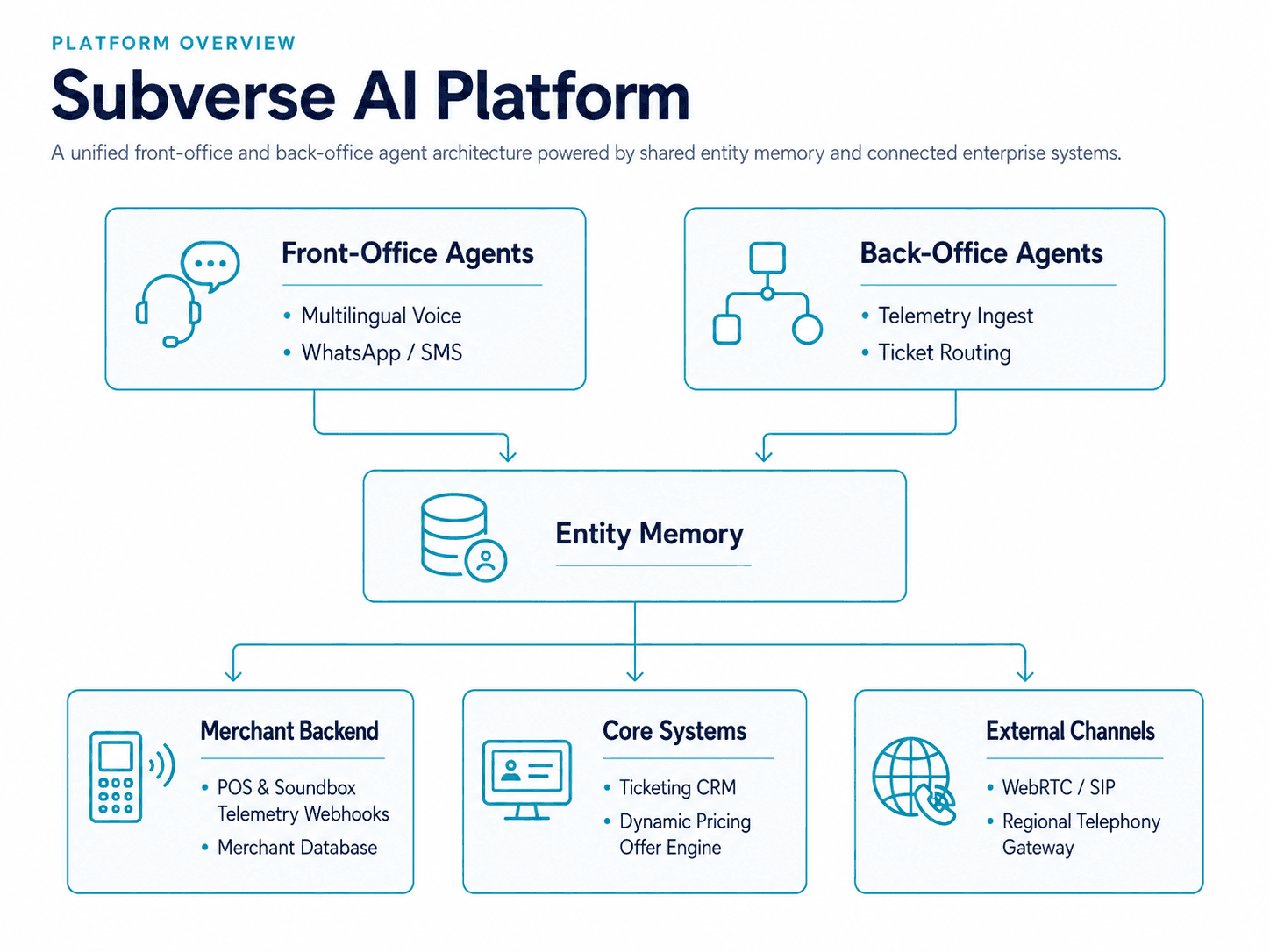
● POS & Soundbox Telemetry Streams: Ingested low-latency transaction webhooks to compute baseline moving averages for every active terminal.
● Telephony & Conversational Voice Infrastructure: Connected via SIP/WebRTC to low-latency Voice AI engines supporting real-time speech-to-text, natural language understanding, and regional accent adaptation.
● Core Merchant Management Systems (MMS): Synchronized bi-directional data flow to update merchant status, compliance validation, and onboarding milestone completion.
● Enterprise Ticketing & Field Management: Automated direct API payload dispatch for fast creation, assignment, and status-tracking of hardware and settlement tickets.
● Proprietary Retention & Pricing Engine: Integrated REST APIs to execute real-time margin calculations and output customized offer matrices.
Traditional Approach vs. Subverse Autonomous AI Workflow
Parameter | Legacy Operational Process | Subverse AI Autonomous Workflow |
Onboarding Compliance | Manual outbound calls; low completion rate and unstructured notes. | Autonomous Voice AI executes T+0 compliance, parsing data into structured JSON. |
Churn Anomaly Detection | Reactive detection after 30–45 days of zero transaction volume. | Real-time telemetry monitoring; automated intervention within hours of a volume dip. |
Technical Support Routing | Disjointed multi-department routing; long SLA resolution cycles. | Autonomous back-office ticket creation, targeted dispatch, and continuous SLA monitoring. |
Issue Verification | Closed tickets assumed resolved without merchant confirmation. | Closed-loop Voice AI calls to verify hardware/service functionality directly with the merchant. |
Competitive Retention | Static retention offers requiring days of manual approval. | Instant, algorithmic calculation of merchant-specific counter-offers with optional HITL gates. |
Context Retention | Disconnected notes scattered across multiple support tools. | Unified Entity Memory tracking merchant baseline behavior, history, and offers. |
What Was the Business Impact and KPI Improvement?
Deploying Subverse AI transformed the client's merchant acquiring operations from a reactive cost center into an automated retention engine:
Cost & Efficiency Metrics
● 62% Reduction in Operational Overhead: Replaced manual outbound check-in calls with autonomous conversational voice agents.
● 4.5x Increase in Merchant Touchpoint Capacity: Expanded proactive outreach to 100% of the active merchant base without adding support headcount.
Speed & SLA Metrics
● 75% Faster Ticket SLA Resolution: Streamlined issue identification and automated back-office routing cut mean-time-to-resolution (MTTR) from 96 hours to under 24 hours.
● Real-Time Churn Intervention: Anomaly detection window reduced from 30+ days down to 2 hours from the initial volume drop.
Revenue & CSAT Metrics
● 38% Reduction in T+90 Merchant Churn: Preserved active terminal counts and prevented premature churn during the highest-risk merchant lifecycle window.
● $6.5M Annual GPV Preserved: Algorithmic counter-offering and rapid hardware resolution successfully retained high-volume POS and Soundbox merchants.
● +28 Point Increase in Merchant CSAT: Closed-loop verification ensured technical issues were fully resolved, significantly building merchant trust.
Frequently Asked Questions (FAQ)
How does Subverse AI detect when a merchant is about to churn?
Subverse AI continuously ingests transaction telemetry from POS terminals and Soundboxes. It leverages entity memory to establish individual merchant volume baselines. When processing velocity drops below historical thresholds, the platform triggers immediate, proactive outreach via Voice AI and messaging.
Can the Voice AI agent handle regional languages and accents?
Yes. Subverse AI integrates advanced multilingual conversational voice models designed for regional accents and colloquial terminology. This allows the agent to conduct onboarding compliance interviews and feedback calls smoothly across diverse merchant demographics.
How does Subverse AI prevent agents from giving excessive discounts?
Subverse AI connects directly to the enterprise's proprietary pricing engine, which calculates discount bounds using merchant LTV and volume data. If a proposed counter-offer exceeds predefined business rules, Subverse AI automatically triggers a Human-in-the-Loop (HITL) approval workflow.
How does closed-loop issue verification work?
Once back-office teams or field engineers mark a support ticket as resolved in the CRM, Subverse AI triggers an outbound Voice AI call to the merchant. The agent verifies that the POS or Soundbox is functioning correctly before closing the lifecycle workflow.
Table of Content
More Insights


