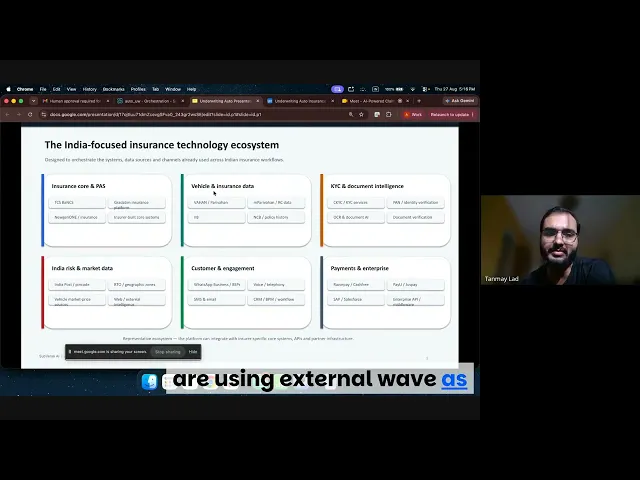
Aug 31, 2026
Hosted by InsurTech Insiders – The Insurance AI Community | Presented by SubVerse AI

"The conversation itself is rarely the bottleneck. The real value comes from what happens after the conversation." – Rishi Kumar, Co-founder, SubVerse AI
The insurance industry has spent years digitizing conversations. Customers can renew policies online, upload documents through WhatsApp, and speak with AI-powered voice agents. But as the latest InsurTech Insiders webinar demonstrated, conversations alone don't solve the biggest operational challenge.
The real transformation begins when those conversations trigger intelligent workflows.
In AI-Powered Claims & Underwriting Workflows, SubVerse AI Co-founders Rishi Kumar and Tanmay Lad demonstrated how voice AI, WhatsApp, enterprise APIs, document intelligence, and human decision-making can work together inside a single orchestrated workflow.
Rather than presenting AI as another chatbot, the session showed how underwriting and claims can become connected, end-to-end processes.

From Conversations to Intelligent Insurance Workflows
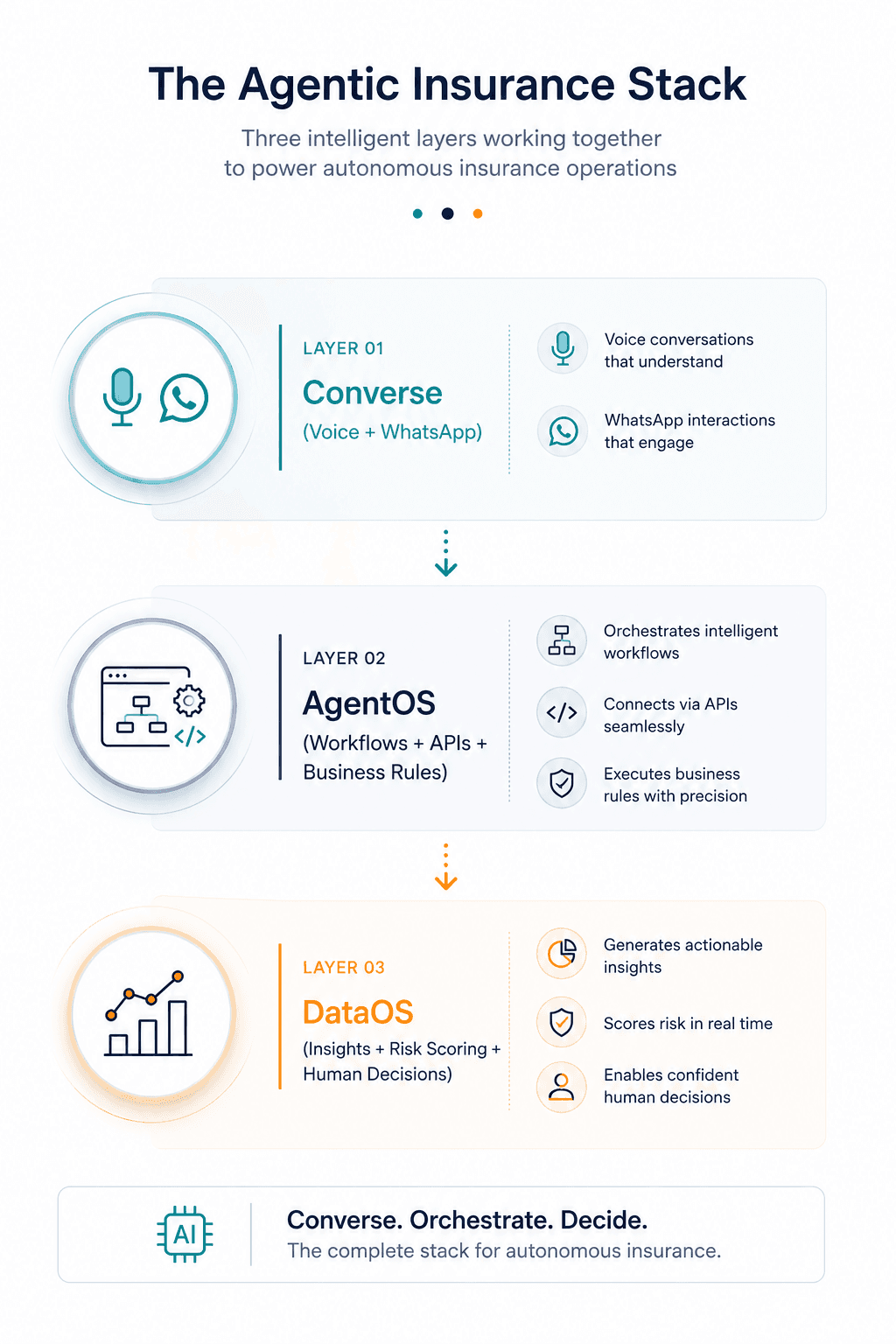
Rishi opened the session by introducing SubVerse AI's Agentic Orchestration Platform, built specifically for BFSI.
Instead of treating AI as a standalone assistant, the platform operates through three connected layers.
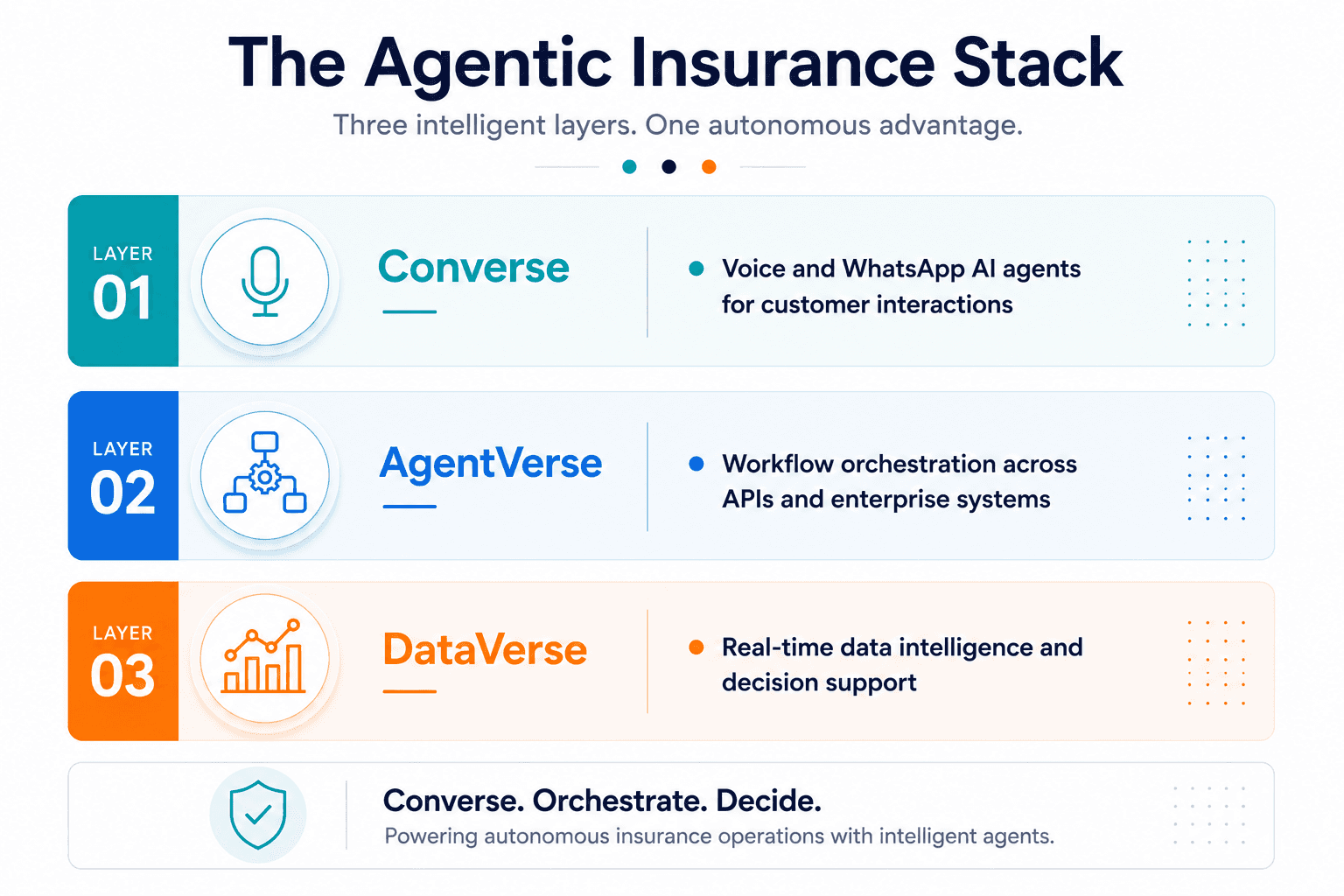
To illustrate how this architecture works in practice, Rishi shared insights from SubVerse AI's engagement with ACKO Insurance.
The collaboration expanded from conversational AI into broader workflow orchestration, with the platform scaling from approximately 6,000 daily calls to over one lakh calls, while improving lead-to-sale conversion and call center throughput.
The takeaway was clear:
"Voice is simply the front door."
Behind every conversation lies a much larger operational process.
The first demonstration showed what happens when customer conversations, APIs, and underwriting rules operate as one continuous process rather than separate handoffs.
Live Workflow #1: Motor Insurance Underwriting
The first demonstration focused on something familiar to every insurer, a customer renewing a motor insurance policy.
Instead of showing isolated product features, Tanmay walked attendees through a complete underwriting journey where every step remained connected.
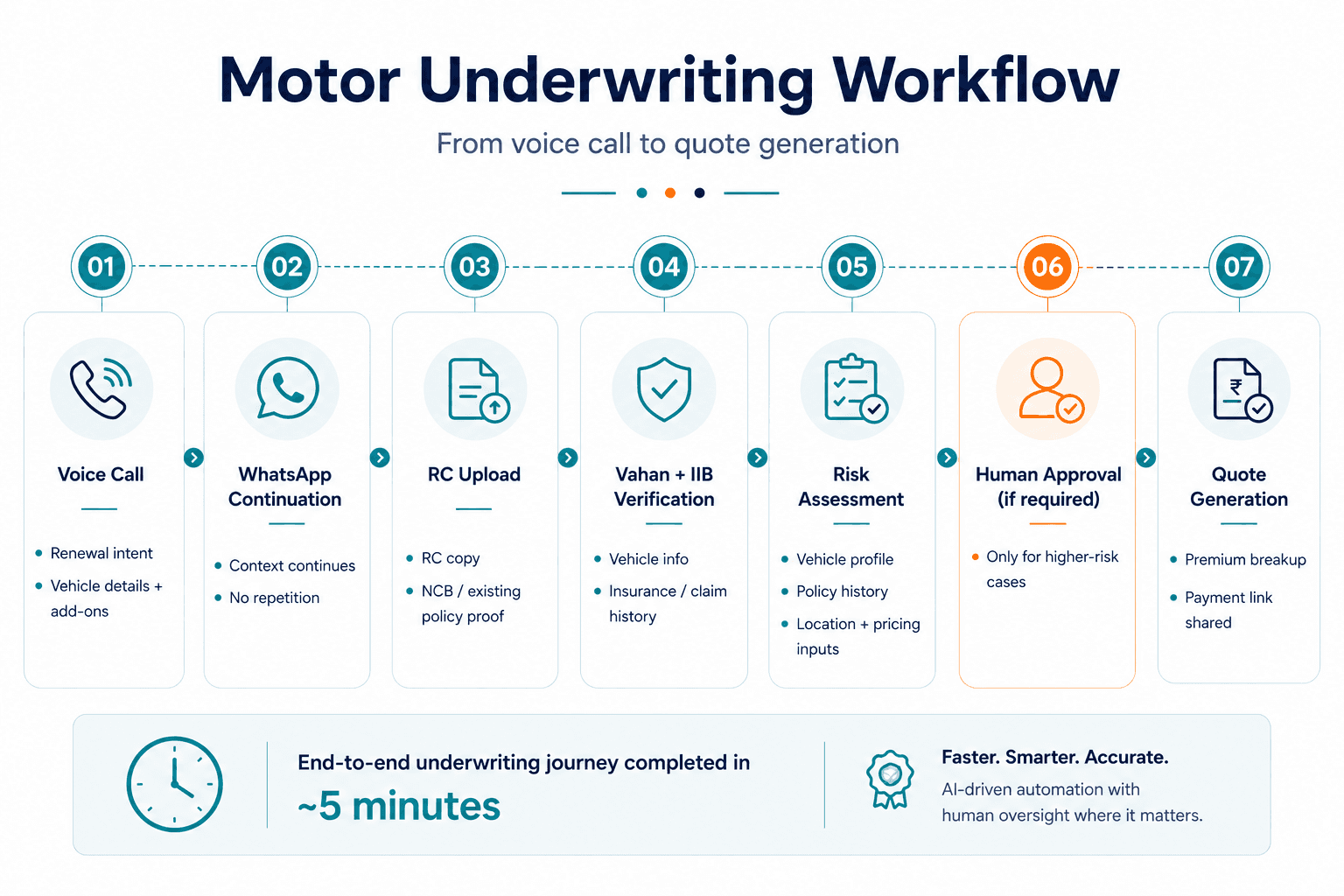
Step 1: The Voice Conversation Begins
The journey started with an AI voice agent handling an inbound renewal request.
During the conversation, the agent:
Collected customer details
Identified the vehicle make and model
Detected the existing insurer
Explained add-ons such as Zero Depreciation, Engine Protection, and Roadside Assistance
Recognized a 50% No Claim Bonus (NCB)
Most importantly, the conversation didn't restart when the channel changed.
Step 2: WhatsApp Without Losing Context
Once the customer uploaded the RC through WhatsApp, the workflow continued exactly where the voice conversation ended.
Instead of asking repetitive questions, the system automatically:
Extracted vehicle information from the RC
Verified the existing policy
Validated NCB proof
Updated internal databases in real time
Behind the scenes, multiple enterprise systems were already working simultaneously.
Two important integrations powered this process:
Vahan API for vehicle information
IIB API for insurance and claim history
Step 3: Intelligent Risk Assessment
Once customer information was verified, the underwriting engine began evaluating multiple risk signals simultaneously.
These included:
Vehicle Profile
Vehicle age
Fuel type
Capacity
Vehicle category
Customer & Policy History
Previous insurer
Claim history
NCB validation
Location Exposure
PIN code mapping
Geographic underwriting zones
Pricing Inputs
IDV
Depreciation
Selected add-ons
The workflow wasn't simply calculating a premium.
It was building a complete underwriting context before making a decision.
Step 4: Human-in-the-Loop Decisions
One of the strongest messages from the webinar was that automation doesn't eliminate human judgment.
Instead, AI prepares the case before handing it to an underwriter.
The reviewer receives:
A summarized customer profile
Risk calculations
Interaction history
Supporting documents
Workflow visibility
That keeps accountability with human underwriters while reducing repetitive preparation work.
Step 5: Personalized Quote Generation
Once approved, the workflow generated:
A personalized quotation PDF
Premium breakdown
Payment link
Applied NCB discount
Selected add-ons
The entire underwriting journey, from phone call to quotation, was completed in roughly five minutes.
Watch the video for a live demo.
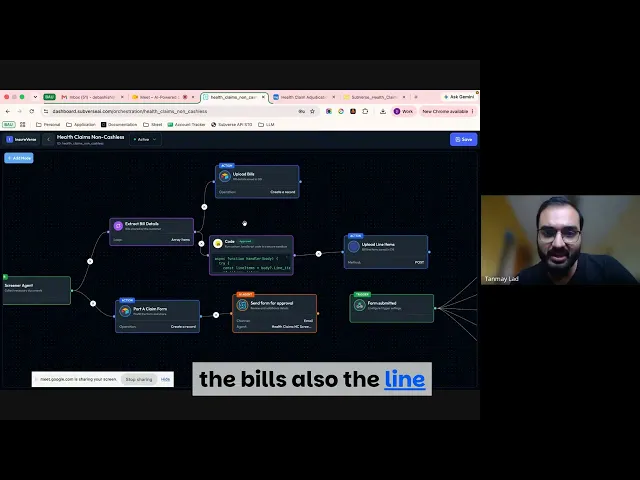
Live Workflow #2: Making Health Insurance Claims Easier
The second demonstration tackled a more complex problem.
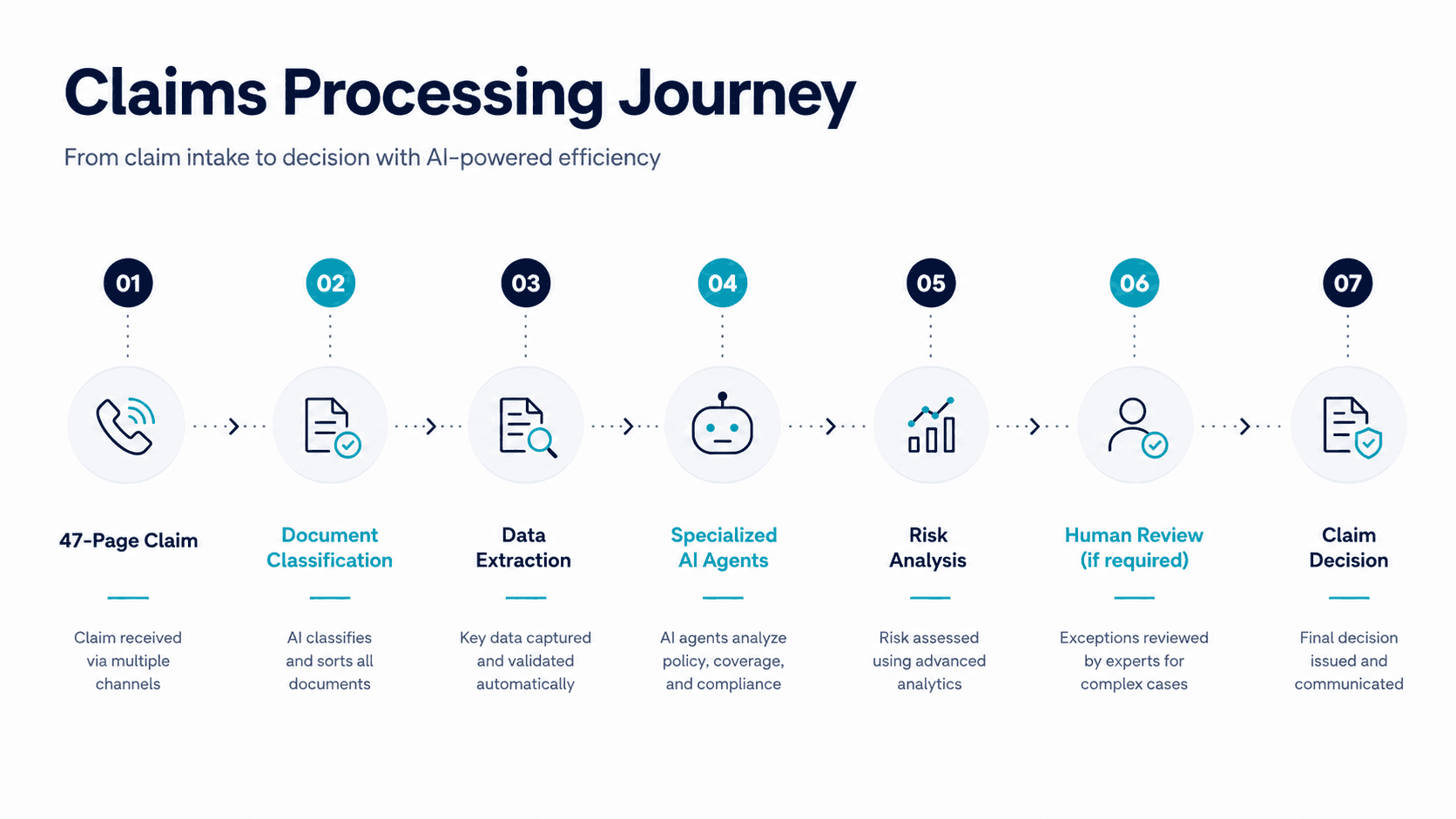
Health insurance reimbursement claims often involve 40-100 pages of documents, multiple stakeholders, and long processing times.
Before deciding a claim, the workflow first determines whether it has enough evidence to make a fair decision.
Instead of immediately adjudicating a claim, the AI first checked whether the customer had submitted everything required.
That included:
Bills
Medical reports
Prescriptions
Claim forms
Consultation records
Only after verifying document completeness did the workflow move forward.
Turning 47 Pages into Structured Data
During the live demo, the team uploaded a 47-page reimbursement claim.
Within minutes, the system extracted:
Customer details
Policy information
Claim information
More than 100 individual bill line items
Rather than forcing customers to repeatedly enter information, the workflow also pre-filled portions of the claim form wherever possible.
This reduced repetitive manual effort before the actual assessment even began.
Why One AI Agent Isn't Enough
One of the most interesting parts of the session was Tanmay's explanation of specialized AI agents.
Instead of assigning every task to one large model, different agents handled different responsibilities.
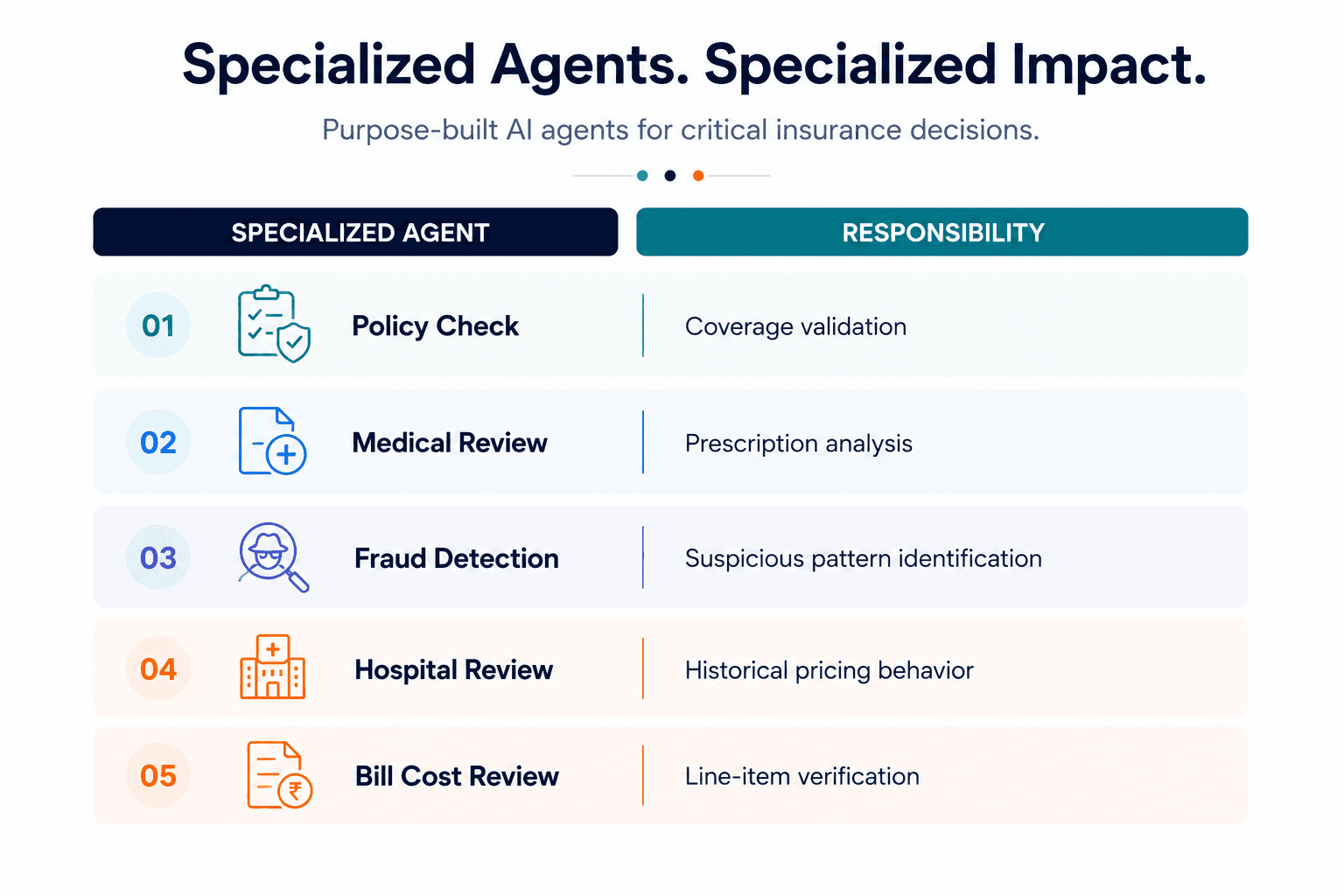
Each agent produced independent observations before contributing to a final risk assessment.
This reduced unnecessary context while improving decision quality.
Watch the video for a live demo.
Enterprise Questions: The Live Q&A
The final portion of the webinar shifted from product demonstrations to enterprise adoption questions.
Attendees focused on governance, document intelligence, IDV calculation, and fraud detection.
How Is Customer Data Protected?
Rishi explained that enterprise AI adoption requires governance alongside automation.
The platform supports:
Tenant isolation
Encryption
Role-based access controls
Private deployments
DPDP-aligned safeguards
Tanmay added another important point.
Organizations don't necessarily have to send sensitive healthcare data outside their own infrastructure.
Through Bring Your Own Model and Bring Your Own Agent, enterprises can integrate existing AI investments while keeping data within their own environments.
How Does the System Calculate IDV?
Tanmay explained that IDV isn't based on a single lookup.
The workflow combines:
Vahan vehicle data
Insurance history
Depreciation rules
Market benchmarks
Web-based pricing comparisons
The calculation adapts depending on vehicle age and available market information.
Can AI Really Understand Large Insurance PDFs?
The answer was yes, but with an important distinction.
Instead of feeding an entire 47-page document into every model, the workflow first categorizes documents.
Bills go to billing agents.
Medical reports go to medical agents.
Prescriptions go to prescription analysis.
This reduces unnecessary context while minimizing hallucinations.
Fraud Detection Goes Beyond Documents
Fraud prevention combines multiple verification layers.
For motor insurance, additional vehicle imagery can strengthen verification.
For health insurance, the workflow evaluates:
Bill consistency
Prescription alignment
Hospital pricing behavior
Geographic comparisons
Historical claim patterns
AI-assisted anomaly detection
The objective isn't replacing investigators.
It's helping them process far more information without missing critical details.
Three Takeaways from the Webinar
The session highlighted three important shifts happening inside insurance operations.
1. AI Works Best Inside Workflows
The biggest insight wasn't conversational AI.
It was orchestration.
Voice, messaging, APIs, documents, and approvals create far more value when they work together.
2. Human Expertise Remains Essential
Both demonstrations kept humans involved wherever financial or medical judgment mattered.
AI prepared cases.
People made decisions.
3. Enterprise AI Is Becoming Practical
Rather than discussing theoretical possibilities, the webinar demonstrated live integrations, real APIs, document intelligence, and governance mechanisms that insurers can begin building today.
Looking Ahead
The webinar concluded with an invitation for attendees to explore a 2-week Proof of Concept with SubVerse AI for relevant insurance use cases.
But the strongest takeaway wasn't the giveaway.
It was a broader shift in how insurers should think about AI.
The next competitive advantage won't come from adding another chatbot.
It will come from connecting conversations, enterprise systems, document intelligence, and human decision-making into workflows that move cases from first interaction to final resolution with far less friction.
As insurers continue modernizing underwriting and claims, that orchestration layer may prove to be the real differentiator.
More Insights


