Sep 18, 2026
Transforming fleet expense management with multi-agent orchestration, intelligent document processing (IDP), and automated fraud detection.
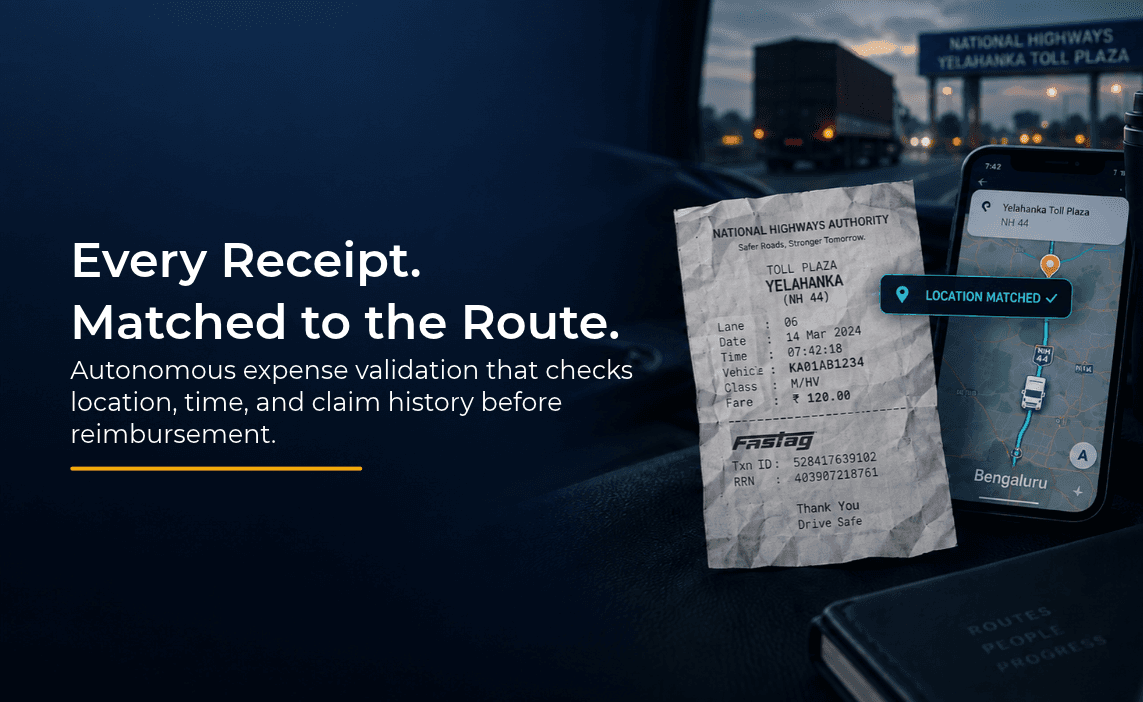
The Problem: A global logistics and delivery corporation—processing over 15 million packages daily with a fleet exceeding 80,000 vehicles—faced massive revenue leakage and operational bottlenecks due to manual validation of driver toll receipts and fuel bills.
The Solution: By deploying Subverse AI as the central orchestration platform, the enterprise automated the end-to-end expense validation workflow. Using Subverse's back-office Intelligent Document Processing (IDP) agents, spatial GPS cross-referencing, and entity-level memory, the system autonomously ingested, parsed, and verified millions of mobile-uploaded receipts against dynamic fleet data.
The Outcome: The enterprise achieved a 95% Straight-Through Processing (STP) rate, eliminated $8.4M in annual expense leakage, and reduced reimbursement cycles from 14 days to under 2 hours.
What Operational Challenges Was the Enterprise Facing?
For a Tier-1 global logistics corporation operating in over 200 countries, the daily operational scale is staggering. With tens of thousands of drivers navigating complex routes, the sheer volume of daily expense claims—specifically toll receipts, weigh station fees, and emergency fuel bills—created a crippling administrative bottleneck.
Drivers were instructed to snap photos of physical receipts and upload them via an internal mobile application. However, the manual validation of these unstructured, often highly degraded images required hundreds of full-time finance personnel. Back-office teams were tasked with manually reading crumpled, low-light receipts, verifying amounts, and checking for policy compliance.
This manual legacy process resulted in severe revenue leakage. Duplicate receipts, altered amounts, and out-of-policy claims were routinely slipping through the cracks due to human fatigue and the sheer volume of processing required. Malicious actors could easily submit the same toll receipt multiple times across different billing cycles.
Furthermore, the lack of real-time contextual validation meant that finance teams could not easily cross-reference a driver's uploaded toll receipt with their actual GPS fleet data. Reconciling a $15 toll claim against telematics data to ensure the truck was actually at that toll plaza at that specific timestamp was virtually impossible at scale.
Consequently, the enterprise suffered from an exorbitant cost per claim, inflated operational overhead, and a frustrating 14-day reimbursement Service Level Agreement (SLA). The company needed an autonomous, highly accurate AI orchestration layer capable of parsing multimodal inputs and executing complex validation logic without human intervention.
How Did Subverse AI Solve the Problem?
To eradicate revenue leakage and automate the expense workflow, the logistics giant deployed Subverse AI to orchestrate a multi-agent validation pipeline. Rather than relying on rigid, rule-based OCR templates, Subverse AI introduced dynamic, autonomous AI agents capable of contextual reasoning.
The workflow begins the moment a driver uploads a receipt image through the employee mobile app. This action triggers a Subverse Front-Office API Agent, which instantly ingests the unstructured image payload and initiates the orchestration sequence.
Next, Subverse’s Back-Office Vision & IDP Agent takes over. Utilizing advanced multimodal capabilities, this agent parses the image regardless of lighting conditions, folds, or obscure angles. It autonomously extracts critical structured data, including the merchant name, date, exact timestamp, total amount, tax identifiers, and transaction IDs.
The most critical phase of the solution relies on Subverse AI’s deep Entity Memory. Once the data is extracted, the Orchestration Engine builds an entity profile for the specific driver, the assigned vehicle, and the historical claim timeline. The AI agent cross-references the newly extracted transaction ID and image hash against the entity’s historical database, instantly flagging any duplicate submissions or "double-dipping" attempts.
Simultaneously, a Subverse Logic Agent pings the enterprise’s fleet management API. It validates the extracted toll location and timestamp against the truck's actual GPS telematics data for that exact moment. If the truck was not geographically present at the toll plaza at the time printed on the receipt, the claim is instantly flagged for fraud.
For claims that pass all AI validations, Subverse orchestrates the final approval, pushing the data directly to the ERP for immediate payout. For anomalous or suspicious claims, the Subverse orchestration layer routes the specific file to a Human-in-the-Loop (HITL) approval gate. Here, a human auditor is presented with a conversational reporting dashboard detailing exactly why the AI flagged the receipt, allowing for a rapid, informed final decision.
What System Integrations & Multimodal Architecture Were Implemented?
Deploying a true end-to-end autonomous workflow requires deep integration into existing enterprise architectures. Subverse AI acted as the connective tissue between disparate legacy systems and modern AI models.
To facilitate seamless ingestion, Subverse integrated directly with the enterprise's custom Employee Mobile Application via secure webhook triggers and REST APIs. This allowed for real-time, asynchronous processing the moment a driver tapped "Submit."
For multimodal processing, the platform utilized Subverse’s Bring Your Own Model (BYOM) architecture. The enterprise routed standard structured receipts through high-speed OCR models, while routing highly degraded, unstructured, or handwritten receipts to advanced multimodal LLMs (like GPT-4o or Gemini 1.5 Pro) for contextual vision parsing.
Crucially, Subverse integrated with the enterprise’s Fleet Telematics and GPS Tracking System. This API integration allowed the Subverse Logic Agent to pull real-time spatial data, cross-referencing latitude and longitude coordinates with the merchant addresses extracted from the receipts.
Finally, the orchestration layer was deeply integrated with the company’s SAP ERP and HRMS systems. Upon autonomous approval, Subverse triggered automated API payloads to SAP, categorizing the expense, attributing it to the correct regional cost center, and initiating the automated clearing house (ACH) reimbursement process without any manual data entry.
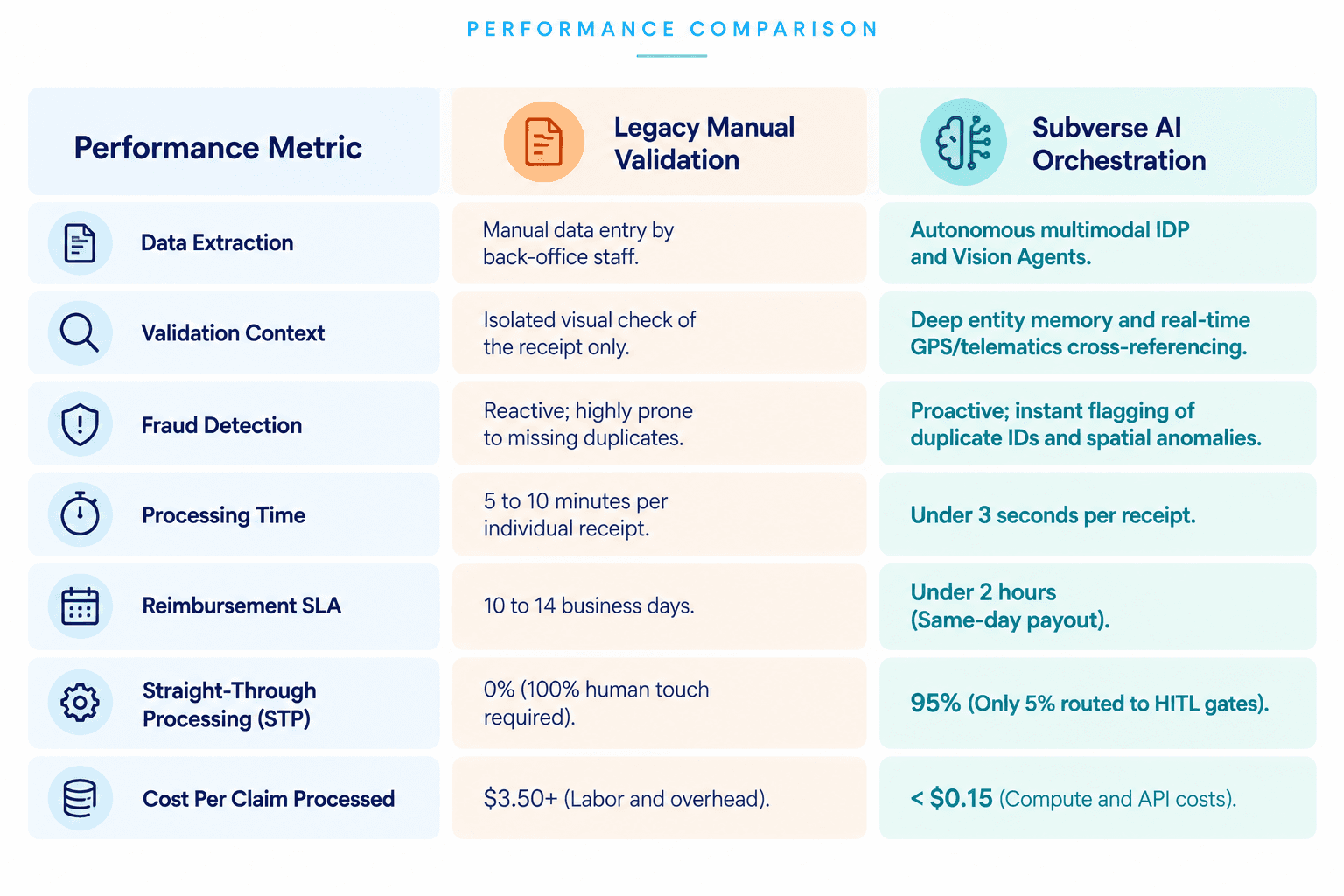
Traditional Approach vs. Subverse Autonomous AI Workflow
What Was the Business Impact and KPI Improvement?
The implementation of Subverse AI’s orchestration platform completely transformed the logistics provider’s finance operations, driving massive cost savings and operational efficiency.
By eliminating the manual bottlenecks, the enterprise realized profound improvements across all key performance indicators:
● Cost & Efficiency Metrics:
○ $8.4M Annual Savings: Eliminated extensive revenue leakage caused by fraudulent, out-of-policy, and duplicate expense claims.
○ 95% Cost Reduction per Unit: Dropped the processing cost from over $3.50 per claim to less than $0.15.
○ 80% Reduction in Manual Labor: Allowed the enterprise to reallocate hundreds of back-office finance personnel to higher-value analytical roles, mitigating the need for seasonal temp hiring.
● Speed & SLA Metrics:
○ 95% STP Rate: Achieved a massive Straight-Through Processing rate, with only highly complex or highly suspicious claims requiring HITL intervention.
○ 99% Faster Turnaround Time: Reduced the end-to-end expense reimbursement cycle from an average of 14 days down to less than 2 hours.
○ Sub-3-Second Processing: Decreased the actual validation time per receipt from minutes to mere seconds.
● Quality & CSAT Metrics:
○ 99.8% Data Extraction Accuracy: Surpassed human accuracy levels in reading and structuring data from highly degraded receipt images.
○ Surge in Employee Satisfaction (ESAT): Dramatically improved driver morale and retention by providing same-day reimbursement for out-of-pocket expenses.
○ Zero-Day Audit Readiness: Ensured 100% compliance and traceability, with every AI decision logged and auditable in real-time.
Frequently Asked Questions (FAQ)
What is AI-driven receipt validation?
AI receipt validation uses Intelligent Document Processing (IDP) and multimodal LLMs to automatically extract, structure, and verify data from receipt images. It replaces manual data entry by autonomously checking amounts, dates, and merchant data against company policies.
How does Subverse AI detect expense fraud?
Subverse AI detects fraud using Entity Memory and external API integrations. It cross-references historical claims to catch duplicate submissions and verifies transaction locations against real-time fleet GPS data, flagging spatial anomalies instantly.
What is a Human-in-the-Loop (HITL) checkpoint?
A HITL checkpoint is an orchestration safety net. When an AI agent encounters a low-confidence extraction or a suspected fraudulent claim, it routes the specific task to a human auditor for final review, ensuring high accuracy on edge cases.
Can Subverse AI read crumpled or blurry receipts?
Yes. Subverse AI utilizes advanced multimodal Vision models that go beyond traditional OCR. These models use contextual reasoning to accurately read and infer text from degraded, crumpled, handwritten, or poorly lit receipt images.
How does straight-through processing (STP) reduce costs?
STP automates the entire lifecycle of a transaction from ingestion to final ERP payout without any human intervention. By achieving high STP rates, enterprises drastically reduce manual labor costs and accelerate processing SLAs.
Table of Content
More Insights


