May 21, 2026
Imagine talking to a customer support chatbot or a virtual assistant that feels more like chatting with a friend, responsive, attentive, and natural. Sounds like magic, right? Well, behind the scenes, engineers have discovered a simple but powerful trick inside a modern voice AI tech stack: using backchannel cues, those little filler words and acknowledgments that make human conversations flow smoothly. SubVerseAI is excited to be launching this powerful backchannel feature, bringing truly human-like responsiveness to our AI voice agents.
For all their intelligence, most Large Language Models (LLMs) tend to give formal, distant, or overly polished responses. They lack the subtle human cues the timely “mhm,” the quick “uh-huh,” or the simple “okay” that signal active listening. Without them, users often wonder, “Is this AI really listening?” or “Am I talking to a wall?” This silent struggle breaks the illusion of a genuine conversation, even when the underlying voice AI tech stack is advanced.
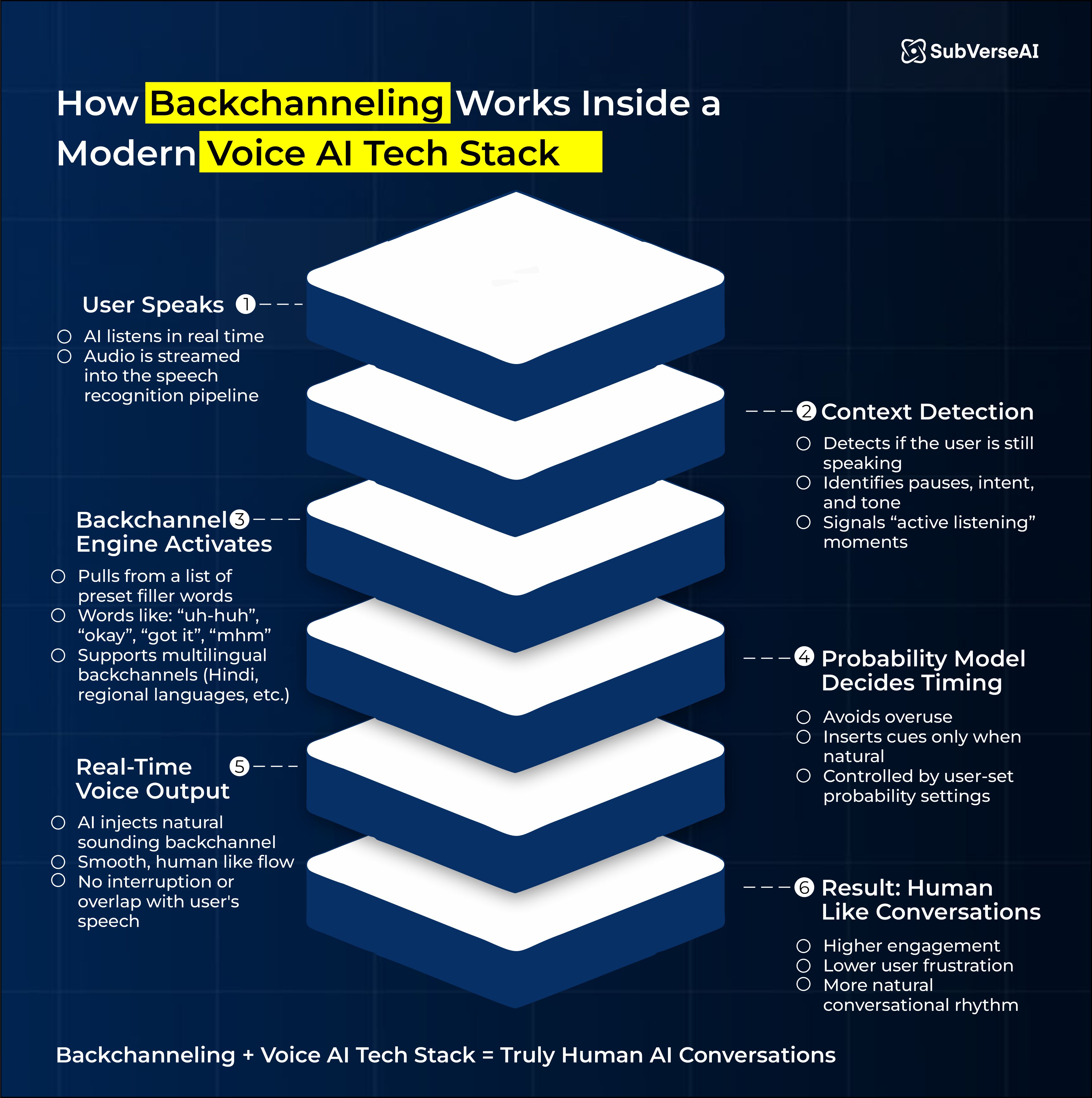
This is where agent backchanneling steps in. We've tackled this problem by implementing a simple yet highly effective system: we proactively inject natural sounding filler words (like yeah, uh-huh, or their localized equivalents) into the audio stream based on applied probabilities. This means we're not waiting for the LLM to generate the cue; instead, our voice AI tech stack passes the array of appropriate backchannel words for the use case and randomly selects one with a specific probability to make the conversation feel seamlessly responsive and deeply human.
Let’s take a journey into this fascinating world and discover how something as small as an “uh-huh” can transform AI interactions into engaging dialogues.
The Silent Struggle of AI Conversations
Most large language models (LLMs), like those powering virtual assistants or chatbots, tend to give very formal, polished responses. While professional, these responses often sound distant and robotic, lacking the subtle cues that make human conversation effortless and warm.
Think about a typical support call: when someone genuinely listens, they nod, say “mhm,” or “uh-huh” at just the right moment. These tiny backchannel cues tell the speaker, “I’m with you,” “I understand,” or “Keep going.” Without them, conversations can feel one-sided or disconnected. Users might ask themselves, “Is this AI really listening?” or “Are they paying attention?”
The challenge? Creating an AI that knows when and how to use these cues without sounding fake or overbearing, something only a well-designed voice AI tech stack can accomplish.
The Power of the Backchannel
Enter agent backchanneling, a clever approach where AI models are trained not just to respond, but to participate in the conversation using natural cues. Essentially, the AI becomes a part-time listener, offering those human like sounds “uh-huh,” “okay,” “got it” at just the right moments.
What makes this approach so special? It’s all about timing and context. An AI voice agent with backchannel capability doesn’t just spout filler words randomly; it uses a dedicated system within the voice AI tech stack to decide when it’s appropriate, based on what’s being said and the flow of the conversation.
Customizing Filler Words for Different Scenarios
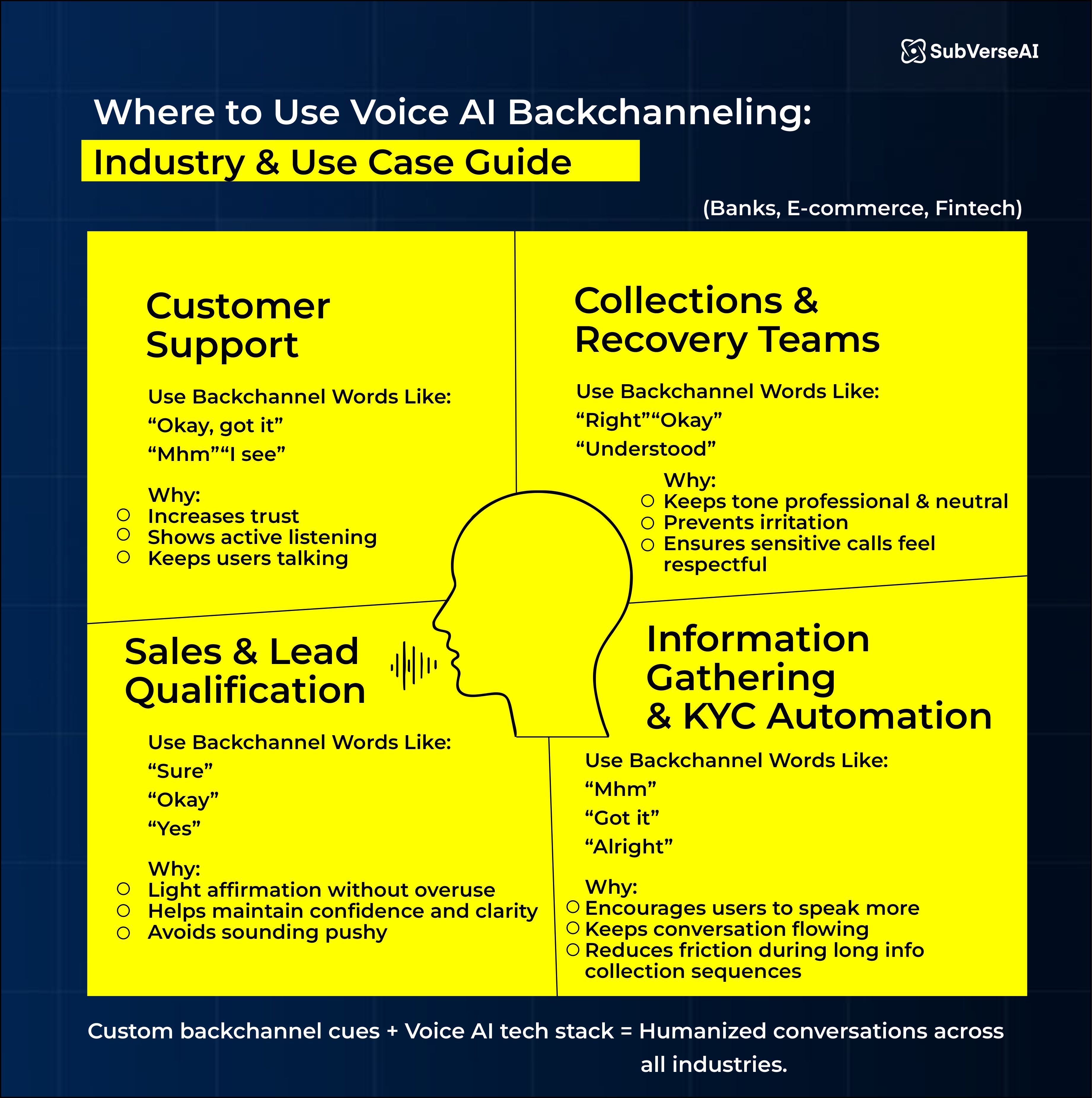
Not all interactions are the same, and the backchannel must match the context and tone:
Information Collection (e.g., virtual assistant gathering details):
Use affirmations like “uh-huh,” “okay,” or “got it” (“हाँ,” “ठीक है,” “समझ गया” in Hindi) to show active listening and encourage users to continue sharing.
Support Role (e.g., troubleshooting support):
Prefer neutral acknowledgments like “I see,” “right,” or “hmm,” which indicate understanding but stay professional.
Sales Conversations:
Use fewer fillers, opting for subtle affirmations like “okay,” “yes,” or “sure,” to keep the tone friendly but confident.
By selecting appropriate words and controlling how often they are spoken, using probabilities the AI can adapt its style for different use cases. This is exactly what an adaptive voice AI tech stack is designed for: making each conversation feel natural and personalized.
Practical Use: How to Implement Backchannel Cues
Here’s a quick guide to integrating this into your AI system:
Create a list of filler words suited for your agent’s role and audience.
Set probabilities for each word, how frequently should the AI use them?
Enable the backchannel feature in your conversational platform with the SubVerse AI solution, which supports customizable backchannel cues through its voice AI tech stack.
Test and refine: For example, support agents can use more “uh-huhs,” while sales agents should keep things minimal for a polished touch.
Why It Matters: Human Connection, Even With Bots
Adding backchannel cues isn’t just about sounding more natural; it’s about building trust and engagement. Studies show that conversations enriched with these cues are perceived as warmer and more attentive, leading to better user experience and satisfaction.
Think of it as turning a stiff, formal dialogue into a friendly chat, the kind that makes people want to stay on the call, share their concerns, and even feel understood. These subtle improvements are precisely what modern enterprises expect from a next-gen voice AI tech stack.
In Closing
The next time you interact with an AI, listen closely. Those subtle “uh-huhs” and “okay” are more than filler, they’re the spices that make conversations savory, engaging, and human. Whether it’s customer support, personal assistants, or sales bots, backchannel cues are transforming AI from cold to caring, making technology feel a little more human, one word at a time.
At SubVerse AI, this philosophy is built into everything we do. Our voice agents are designed with proactive, dynamic backchanneling so your users always feel heard, supported, and connected. If you’re building your own AI agent, don’t underestimate the power of these tiny cues. With SubVerse AI’s advanced voice AI tech stack, every chat is a warm handshake, a friendly nod, and a genuine step closer to truly human conversation.
Table of Content
More Insights


