Sep 11, 2026
Insurance has already become digital. The next competitive advantage is making every workflow work together.

The insurance industry's biggest challenge is no longer digitisation. It is making disconnected workflows work together. Customers can buy policies online, renew them through mobile apps, and initiate claims without visiting a branch. These improvements have transformed how insurers interact with policyholders and raised expectations around speed, convenience, and transparency.
Beneath these digital experiences, however, many insurance operations continue to rely on fragmented workflows.
A motor insurance quote may require information from multiple verification systems before underwriting is complete. A health claim often moves between hospitals, TPAs, internal teams, and policy records before a decision is made. Customer conversations happen across WhatsApp, email, call centres, and portals, while operational teams switch between different platforms to complete what customers experience as a single journey.
The technology exists.
The coordination often does not.
This has become one of the industry's biggest operational challenges because customers no longer compare insurance with other insurance companies alone. They compare it with banking apps that provide instant updates, e-commerce platforms that offer real-time tracking, and digital services that remove friction from every interaction.
For insurers, improving customer experience is no longer about launching another digital feature. It is about ensuring that underwriting, claims, fraud detection, and customer servicing work together as one connected operation.
That is where InsurVerse comes in.
The Shift From Digital Tools to Connected Operations
Most insurers already operate sophisticated technology ecosystems. Customer relationship platforms, claims management systems, communication tools, and enterprise applications are already part of everyday operations. Each system performs an important function, but work often slows down when information has to move between them.
A policy application might require customer verification, underwriting approval, internal coordination, and communication back to the customer. Individually, each step is digital. Collectively, the journey can still involve multiple handoffs.
Instead of replacing existing infrastructure, InsurVerse acts as an orchestration layer across those systems. Teams interact with a conversational assistant, while specialised AI agents work together behind the scenes to execute insurance workflows across underwriting, claims, fraud detection, and customer servicing.
The objective is simple. Existing systems continue doing what they do best while workflows move without unnecessary friction.
One Platform. Multiple Autonomous Insurance Processes.
Insurance is not built around a single workflow. Underwriting follows different rules than claims. Health insurance operates differently from motor insurance. Fraud detection depends on different signals than policy servicing. Treating every process as one generic automation problem creates limited value.
InsurVerse approaches insurance through autonomous processes that are executed by multiple AI agents working together behind the scenes. Instead of assigning one agent to one business function, each process is powered by a coordinated set of agents that handle verification, decision support, document processing, and workflow execution.
The InsurVerse Autonomous Insurance Processes
Headline: One Platform. Six Autonomous Insurance Processes.
Designer Direction: Create a central InsurVerse hub with six connected cards around it. Each card represents a business process, not an individual agent.

This reflects how insurance actually operates. Different parts of the value chain require different levels of speed, oversight, and expertise. By orchestrating autonomous processes through multiple AI agents, insurers can improve execution without forcing every decision through the same operational path.
How Connected Workflows Change Insurance Operations
The biggest opportunity in insurance is not automating individual tasks. It is connecting the work happening across departments.
Motor underwriting becomes faster when vehicle verification, risk assessment, and quote generation happen as one coordinated process instead of several disconnected steps. Health underwriting becomes more efficient when applicants automatically follow the right validation path based on business rules rather than a single process for everyone.
Claims benefit from the same approach. Motor claims require damage assessment and coordination, cashless health claims involve hospitals and approvals, and reimbursement claims depend on reviewing bills, prescriptions, and policy conditions together. When repetitive work around these journeys is handled automatically, claims professionals can focus on exceptions that require experience and judgement.
Fraud detection follows the same principle. Instead of reviewing every case equally, teams can focus on higher-risk claims that deserve closer investigation.
The business rules remain the same.
The execution becomes more connected.

Better Visibility Creates Better Decisions
One of the biggest operational challenges inside large organisations is understanding what is happening while work is still in progress.
Managers often rely on reports generated after delays have already occurred. Teams switch between multiple dashboards before identifying where workflows have slowed down.
InsurVerse changes how operational questions are answered.
Instead of searching across systems, teams can ask questions conversationally and receive insights into workflow performance, delayed stages, and operational patterns. A question such as, "Why are reimbursement approvals slowing this week?" becomes the starting point for understanding what is happening across operations instead of the beginning of a manual investigation.
For insurers operating in regulated environments, this visibility matters because operational decisions need both speed and accountability. The platform helps business teams move from reviewing execution logs after the fact to understanding workflow performance while work is still moving.
Built Around the Insurance Systems You Already Use
One of the biggest concerns surrounding enterprise technology adoption is disruption. Replacing core systems is expensive, and rebuilding established workflows carries significant operational risk.
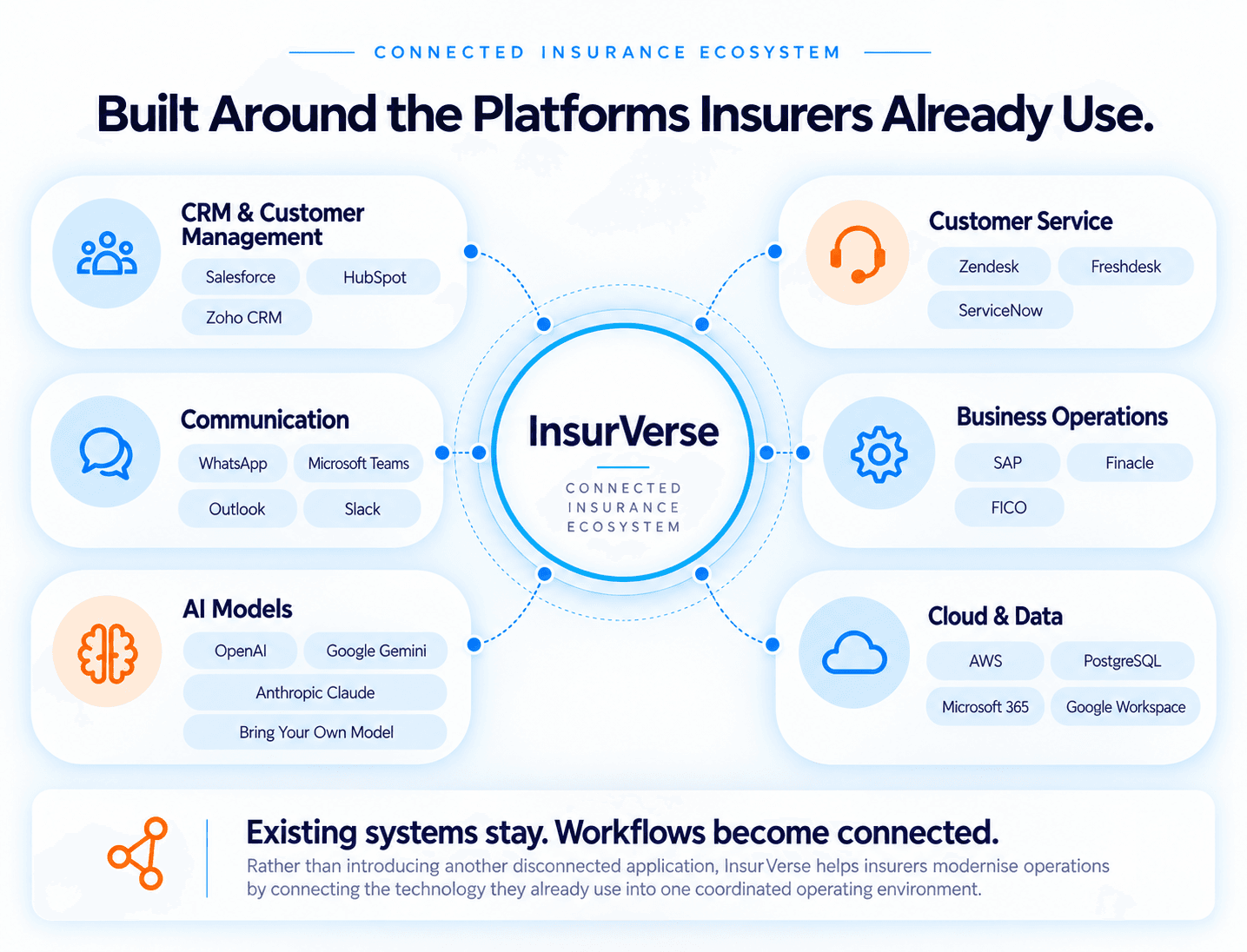
InsurVerse has been designed around a different assumption. The most practical path forward is connecting the systems insurers already depend on rather than asking organisations to replace them.
Whether teams work inside Salesforce for customer management, Zendesk or ServiceNow for service operations, SAP for enterprise workflows, Finacle and FICO for business operations, WhatsApp, Microsoft Teams, and Outlook for customer communication, or cloud infrastructure such as AWS, InsurVerse connects these platforms into a single operational workflow.
The same approach extends to modern AI ecosystems, allowing organisations to work with platforms such as OpenAI, Google Gemini, Anthropic Claude, or even their own preferred models without rebuilding their technology stack.
The Connected Insurance Ecosystem
Why Human Judgement Still Matters
Insurance has always balanced speed with responsibility.
Some decisions can follow established business rules. Others require context, experience, and judgement.
A complex claim, a medical exception, or a fraud investigation cannot always be reduced to automation.
That is why InsurVerse has been designed around human oversight.
Routine work moves faster.
Exceptions remain visible.
Experienced professionals continue making the decisions that require accountability.
Technology becomes more valuable when it removes repetitive effort instead of replacing expertise.
The Next Chapter of Insurance
Insurance has already become digital.
The next competitive advantage will come from making digital systems work together.
Customers only experience the outcome. A faster quote. A smoother cashless approval. A reimbursement claim that requires less paperwork. A motor claim that moves without unnecessary delays.
Behind each of those moments are dozens of operational decisions that need to happen together.
InsurVerse was built to help insurers connect those decisions across underwriting, claims, fraud detection, and customer operations while keeping experienced professionals in control of the decisions that require judgement.
The industry's next competitive advantage will not come from adding more tools.
It will come from making every existing tool work as one.
Table of Content
More Insights