May 21, 2026
Ever asked a voice assistant a simple question only to be cut off mid-sentence or left hanging in awkward silence? That tiny mismatch between when humans expect a response and when AI chooses to speak is one of the biggest challenges in conversational AI.
The secret ingredient behind natural, human like dialogue?
Turn detection - the ability to know exactly when the user is done speaking and when the AI should jump in.
It’s subtle, it’s complex, and it’s one of the main factors separating average voice systems from the best global voice AI providers with telecom support.
At SubVerse AI, we’re tackling this challenge with a three-layered turn detection framework:
Open-source context-aware models
Voice activity-based detection
STT-inbuilt semantic turn prediction
Let’s break it down.
Why Turn Detection Is So Hard (And Why Most Voice AI Fails at It)
In a real conversation, humans don’t rely solely on silence. We use context, tone, hesitation, filler words, and natural pauses to signal whether we’re done or still thinking.
AI, by contrast, historically relied on one simplistic rule:
Silence = end of speech.
But silence can mean many things:
You’re thinking
You’re searching for a word
You’re emphasizing something
You're pausing before continuing
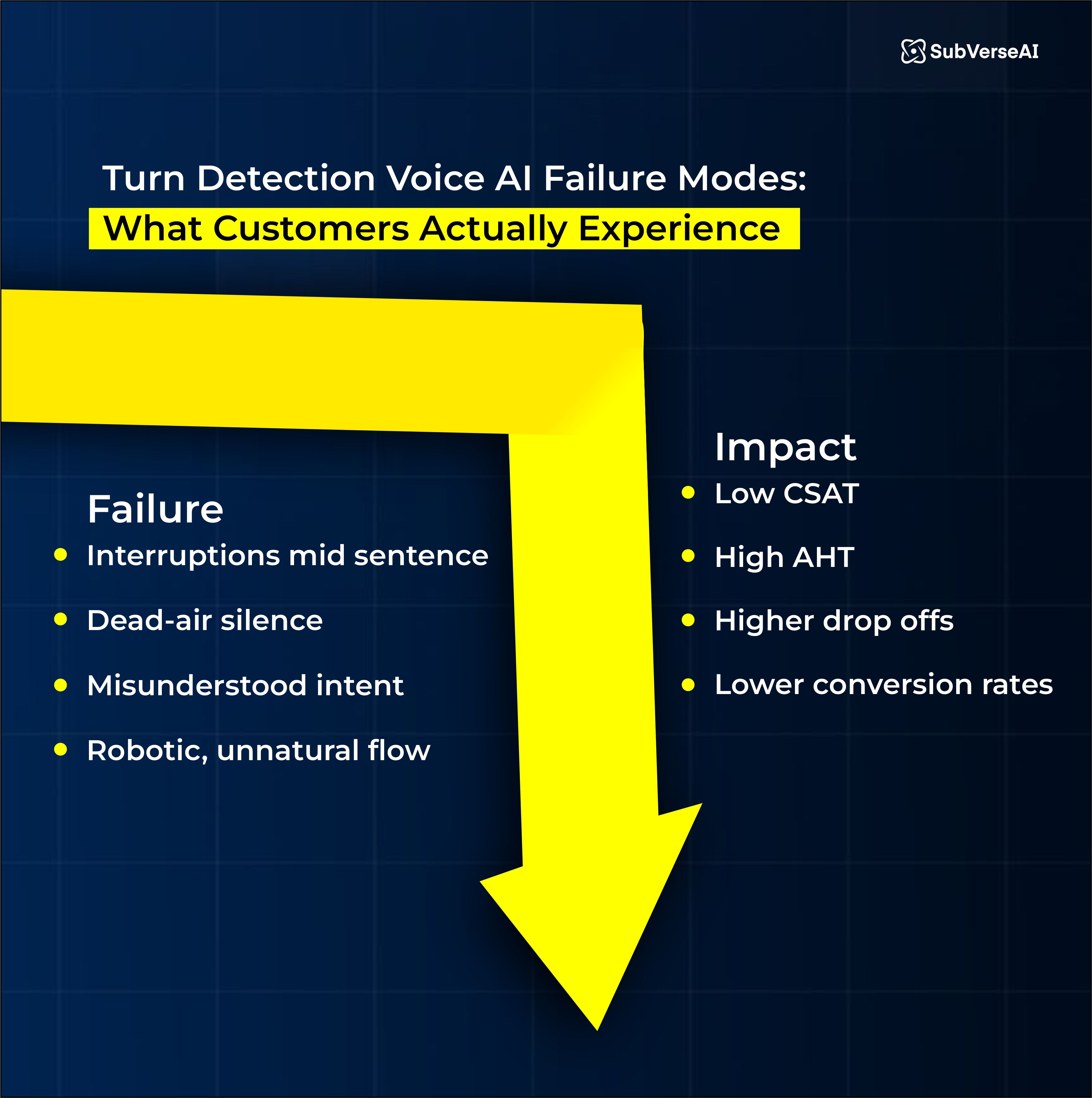
This leads to:
Frequent, frustrating interruptions
Painfully slow “dead air” after you finish talking
Misinterpreted user intent
Robotic, unnatural experience
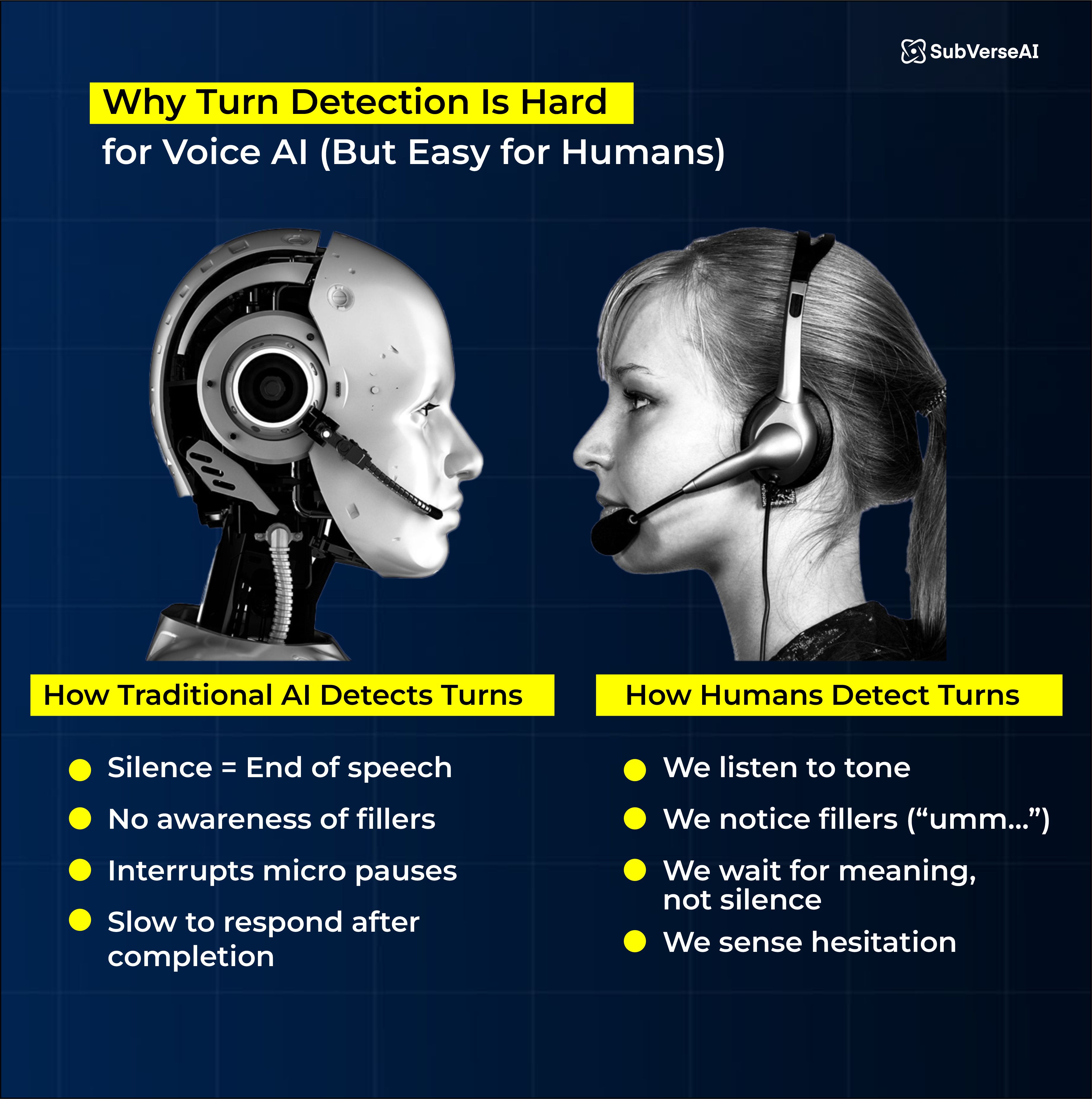
To compete with the best global voice AI providers with telecom support, a system must go beyond silence and understand speech behavior.
Three Modern Approaches to Turn Detection
1. Open-Source Models (Context-Aware & Multilingual)
Open-source turn detectors - like LiveKit’s Turn Detector plugin or Pipecat’s Smart Turn Intelligence - look at rhythm, sentence structure, prosody, and filler words. They excel in multilingual settings, including Indian languages.
Pros:
Customizable
Transparent and self-hostable
Works across accents and languages
Ideal for enterprise privacy compliance
Cons:
Requires integration effort
Depends on dataset quality
This is a flexible choice for platforms operating globally with diverse telecom environments.
2. Voice Activity Detection (VAD): Fast & Lightweight
Popularized by models like Silero VAD, this approach monitors the audio waveform for speech vs. non-speech and applies smart thresholds.
How it works:
Detect when someone is actively speaking
Track micro-pauses
Trigger a response after a configurable silence window
Pros:
Simple
Low latency
Works well for direct phone calls and IVR-like flows
Cons:
Fails with hesitation, accents, or overlapping speech
Not context-aware
Many legacy call automation tools rely only on VAD, which is why they often feel “off.”
3. STT-Inbuilt Turn Detection (Semantic + Acoustic Intelligence)
This is where the future is headed - models like Deepgram Flux integrate turn-taking inside the speech-to-text engine.
Flux analyzes both sound and meaning:
If you say: “Uhh… okay wait…” → Not done
If you say: “That’s all, thanks.” → Done
Pros:
Most natural experience
Extremely low latency (200-600ms faster)
Far fewer interruptions
Great for customer-facing voice agents
Cons:
Still learning cultural speech patterns
Fine-tuning required for industry-specific use
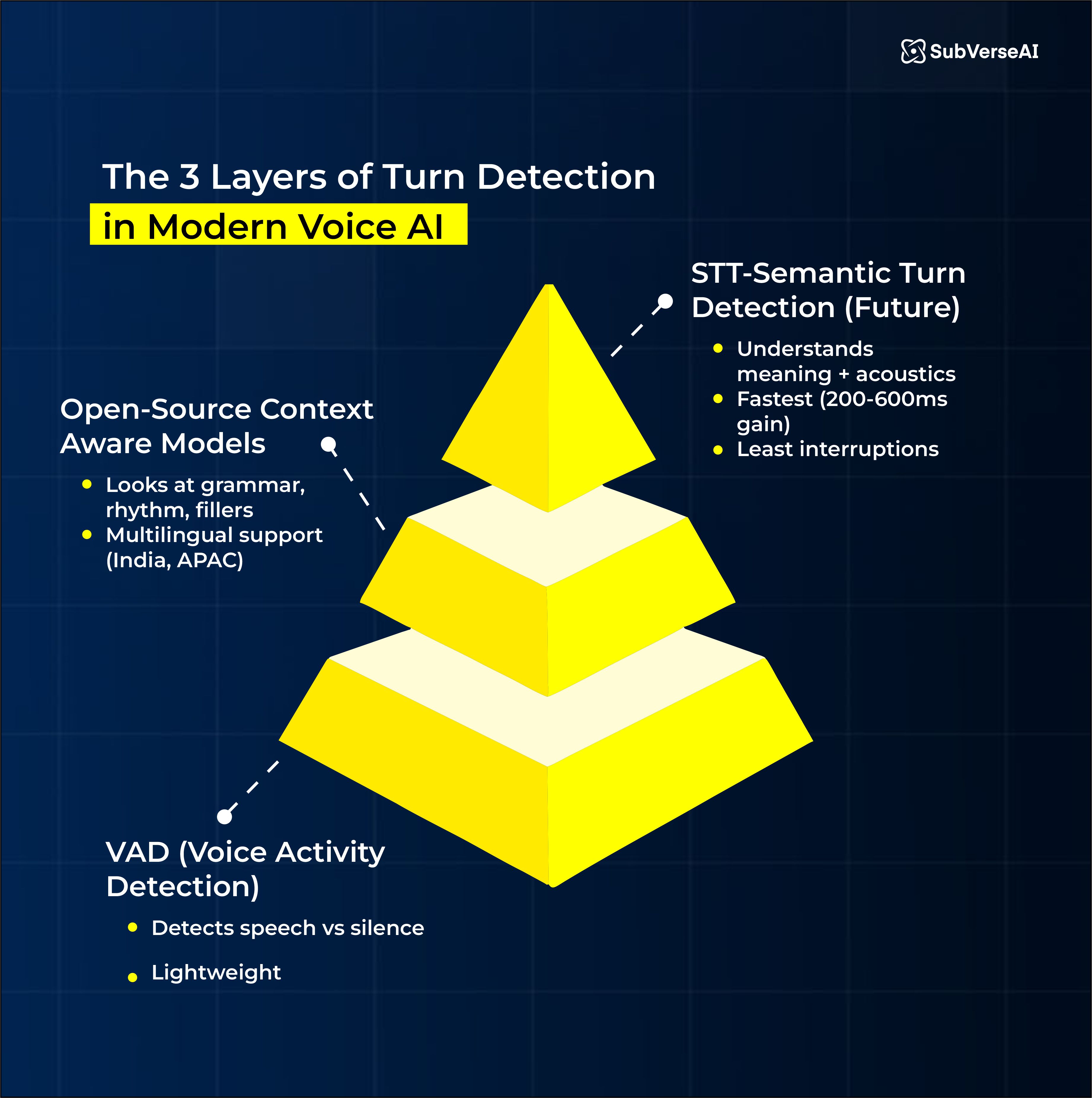
This is the approach used by the leaders in the space - and one SubVerse integrates for top-tier conversational quality.
The Sweet Spot: Combining All Three
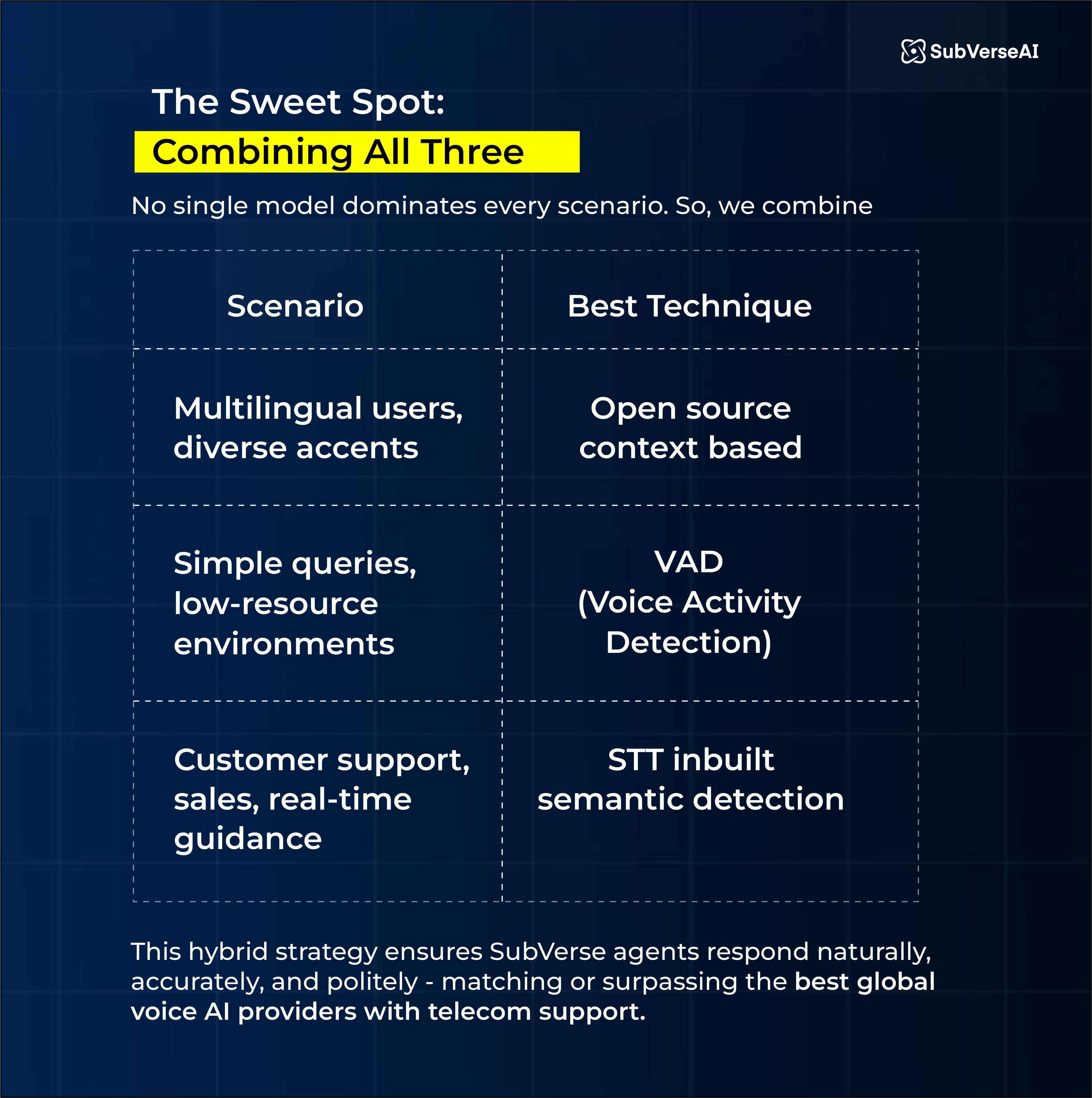
This hybrid strategy ensures SubVerse AI agents respond naturally, accurately, and politely - matching or surpassing the best global voice AI providers with telecom support.
Why This Matters for Enterprises
In industries like BFSI, e-commerce, insurance, healthcare, hospitality, or logistics, the difference between a smooth and a clumsy conversation directly impacts:
Customer satisfaction
Call resolution rates
AHT (Average Handling Time)
Conversion rates
Drop-off rates
Turn detection is not flashy, but it’s a make or break capability in modern Voice AI.
The Road Ahead: Truly Human Conversations
Turn detection sits at the heart of natural voice experience. By combining open-source intelligence, VAD, and next-gen STT models like Flux, we’re building agents that genuinely wait, listen, and respond like humans.
If clunky IVRs and awkward chatbots drove you mad in the past, the future is sounding a lot smoother - and significantly more polite.
More Insights


