Jul 14, 2026

Insurance has a unique customer experience challenge: customers may interact with their insurer only a few times a year, but those few moments often decide whether they trust the company.
A motor accident, a medical emergency or a claim settlement is not just a service request. It is a moment when customers are looking for certainty, speed and support. The way an insurer responds during these situations can define the relationship long after the transaction is complete.
This creates a difficult question for insurers: how do you build customer relationships in a business where customers often engage only when something goes wrong?
For Bajaj Allianz General Insurance, the answer has not been to automate customers away from human interaction. It has been to use technology to make important customer moments simpler, faster and more transparent.
In a conversation with K.V. Dipu, Senior President and Head of Operations & Customer Service at Bajaj Allianz General Insurance, one principle emerged consistently: successful AI adoption is not about replacing people. It is about combining technology with insurance expertise to solve real customer problems.
From transforming motor claims through AI to enabling multilingual service experiences and simplifying complex policy documents through generative AI, Bajaj Allianz’s journey reflects a broader lesson for business leaders.
Artificial intelligence creates the most value when organisations understand their customers deeply, redesign processes around real problems and build cultures that continuously learn.
This article explores the principles behind Bajaj Allianz’s AI transformation and the lessons CXOs can take from building human-centred technology at scale.

The Five-Day Business
The biggest challenge for insurance companies is not selling policies. It is staying relevant after the policy has been purchased.
Unlike banking, retail or digital platforms where customers interact with companies frequently, insurance operates around fewer but more significant moments. A customer may buy a motor policy, renew it annually and then disappear from the insurer’s ecosystem until a claim occurs.
That makes every interaction important.
When K.V. Dipu joined Bajaj Allianz General Insurance in 2016, he brought nearly two decades of experience from GE Capital, where operational excellence and customer processes were central to business performance.
However, insurance presented a very different customer engagement challenge compared with the industries he had previously worked in.
As Dipu explains:
"Cards is a high-touch product. You take out your card many times a day to swipe. In insurance, the biggest thing I found was it's low-touch. Once you buy a policy, you don't use it every day because you're not crashing your car or getting hospitalized every day."
The difference appears simple, but it changes how insurers think about customer experience.
A banking customer may open an application every day. A credit card customer may complete multiple transactions every month. These repeated interactions create familiarity and provide companies with continuous opportunities to improve engagement.
Insurance does not have that advantage.
A customer usually remembers an insurer most during moments of uncertainty. A claim after an accident, support during a health emergency or assistance during a difficult situation becomes the defining experience.
Dipu describes this challenge clearly:
"With a banking app, maybe you engage 365 days. With insurance, you may engage the insurer five out of 365 days. So the existential issue for insurers is: how do you stay relevant in the customer's mind?"
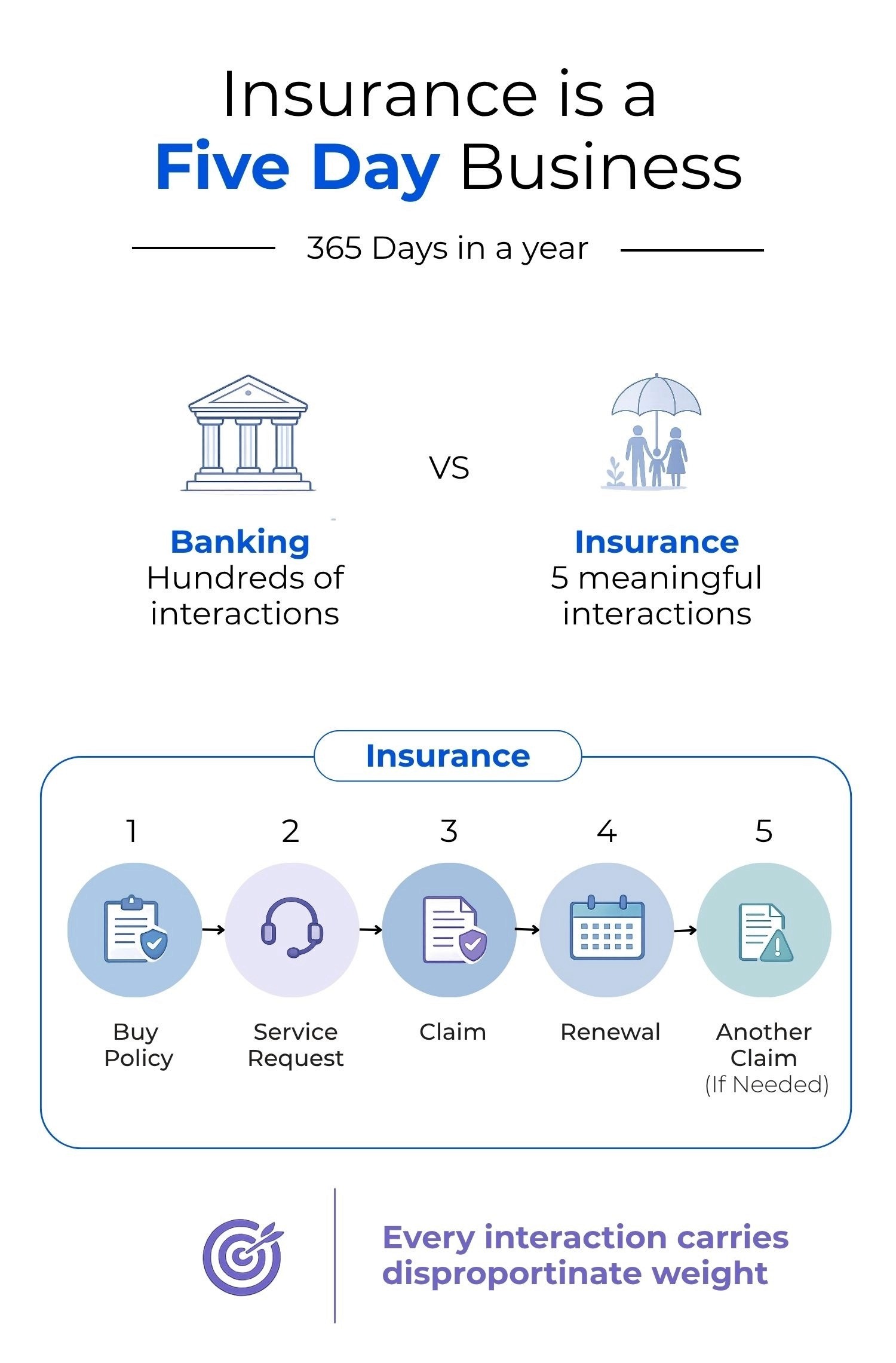
The challenge is not only operational efficiency. It is creating trust during limited opportunities.
Customer expectations have also changed significantly. People no longer compare experiences only within their own industries. A customer filing an insurance claim compares that experience with every digital service they use.
They compare it with tracking a delivery, making an instant payment or accessing services through a mobile application.
As Dipu puts it:
"Customers don't have lockers in their mind. They have apps across various industries."
This shift forced Bajaj Allianz to rethink digital transformation. The objective was not simply to introduce more technology. It was to identify where customers experienced friction and redesign those moments around convenience and transparency.
This approach reflected Bajaj Allianz’s broader philosophy: technology creates value when it is combined with strong processes, operational knowledge and a clear understanding of customer needs.
For Bajaj Allianz, one of the clearest opportunities was motor insurance claims.
Traditionally, motor claims involved several stages. Customers reported accidents, surveyors inspected vehicles, repair estimates were reviewed and approvals were provided before repair work could begin.
Each step served a purpose. However, the process often created uncertainty for customers.
The biggest delay was not always repairing the vehicle. It was the assessment required before repairs could start.
That became the foundation for Bajaj Allianz’s effort to rethink motor claims using artificial intelligence.
Twenty Minutes That Changed Motor Insurance
For most customers, a motor insurance claim begins at the worst possible moment.
A damaged vehicle is not just a repair problem. It can affect daily routines, professional commitments and personal mobility. The customer is already dealing with uncertainty, and the claims process becomes a test of whether the insurer can provide confidence when it matters most.
For years, motor claims followed a process that was familiar across the insurance industry. A customer reported an accident, a surveyor was assigned, the vehicle was inspected, repair estimates were prepared and approvals were completed before the repair process could move forward.
Every step had a purpose. However, the experience often involved waiting.
The customer could see the damage but had little visibility into what was happening next. The vehicle could remain at a garage while inspection and approvals were pending. The uncertainty before repair often became more frustrating than the repair itself.
According to Dipu, the biggest delay was not the physical repair work.
"The waiting time was waiting time for the surveyor."
Bajaj Allianz approached this challenge differently. Instead of asking how surveyors could inspect vehicles faster, the company explored whether technology could help customers participate directly in the assessment process while maintaining the accuracy required for claims decisions.
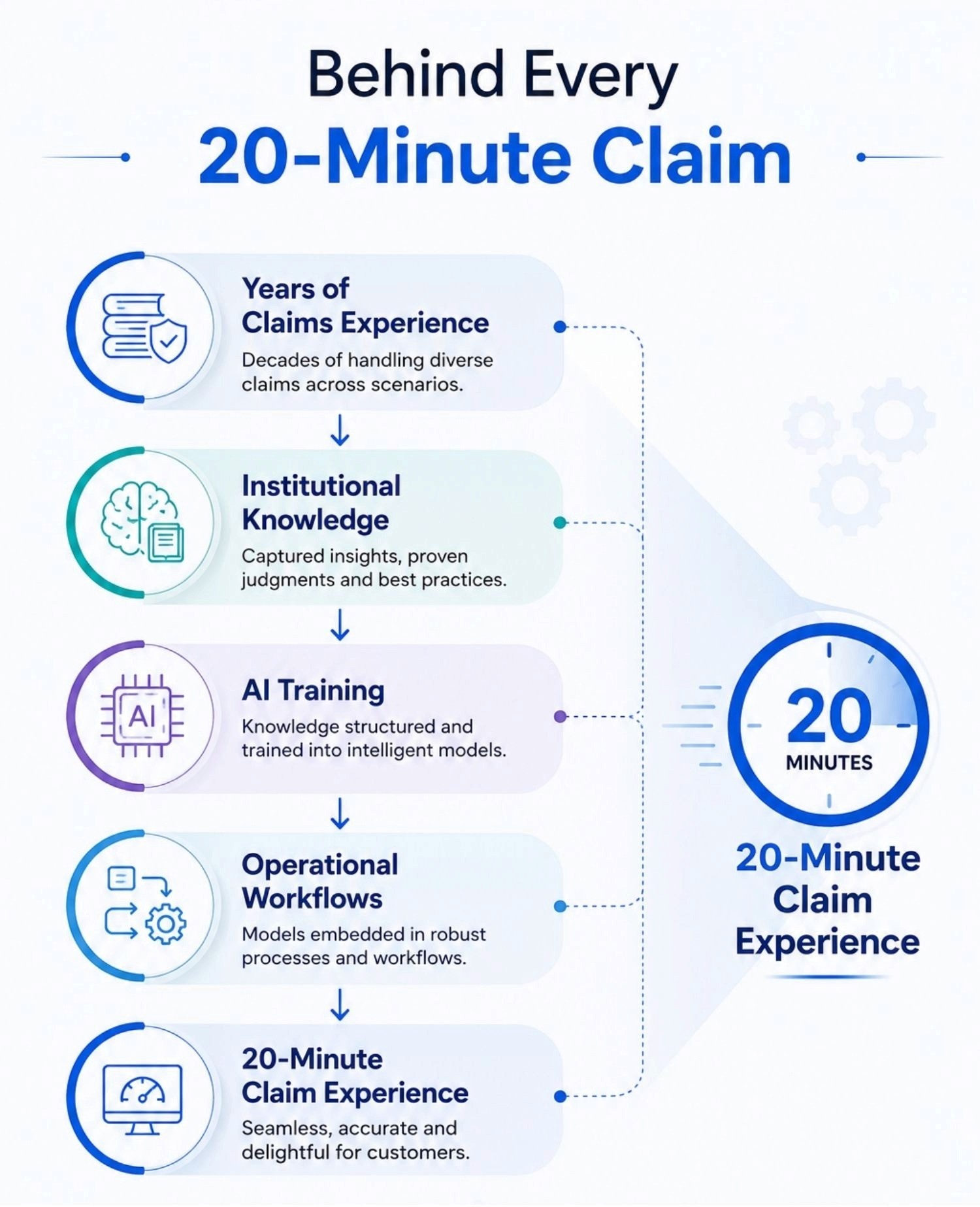
This thinking led to Motor On The Spot, an AI-enabled claims solution designed to simplify eligible motor insurance claims.
From the customer’s perspective, the process became significantly simpler. Customers captured photographs of their damaged vehicle, uploaded them through the mobile application and received an assessment based on the images.
As Dipu explains:
"The first step is to click photographs. The second is to upload them into the mobile app. Just two steps at the end."
The simplicity of the experience hides the complexity behind it.
A human surveyor does not just identify visible damage. They use years of experience to make judgement calls. Is the damaged part repairable or does it require replacement? Is the estimated repair cost reasonable? Are there signs that require additional investigation?
These decisions are based on thousands of previous cases and years of practical understanding.
Before AI could support such decisions, Bajaj Allianz had to convert insurance expertise into structured knowledge.
As Dipu explains:
"We had to go through a history of hundreds of claims and codify them. How does the system understand whether this is a dent? Can this part be repaired or does it need replacement? How do you identify a genuine claim from a fraudulent one?"
This process reveals one of the most important lessons in enterprise AI adoption: technology can accelerate expertise, but it cannot replace expertise that an organisation has not built.
The success of AI systems depends heavily on the quality of knowledge, processes and data behind them.
McKinsey & Company’s The Economic Potential of Generative AI: The Next Productivity Frontier report highlights that while generative AI has the potential to improve productivity across industries, organisations capture the most value when they redesign workflows and combine AI capabilities with human expertise.
This principle is especially important in insurance because decisions are rarely based only on information. They depend on judgement.
Fraud detection provides another example.
Insurance fraud does not always follow obvious patterns. Experienced claims professionals often identify unusual behaviour through small signals developed after reviewing thousands of cases. Capturing that judgement requires learning from historical decisions rather than relying on a fixed set of rules.
Dipu compares training AI systems to human learning:
"When you're born as a kid, you learn to walk, then you learn to run. Bots also need that kind of training. It's garbage in, garbage out. The more specific your input, the more specific your output."
The lesson extends beyond motor claims.
Many organisations approach AI by focusing first on the technology itself. They ask which model, platform or tool they should adopt. However, the more important question is how technology can improve a specific customer or business problem.
Bajaj Allianz did not begin with artificial intelligence and search for a use case. It began with a customer challenge and used technology to redesign the process around that challenge.
That distinction matters because AI tools are becoming increasingly accessible. The technology itself will become easier for competitors to adopt. What will remain difficult to replicate is the organisational knowledge built through years of customer interactions and operational experience.
Motor On The Spot demonstrated how AI could make insurance faster.
But speed alone was not enough.
Insurance is ultimately a business built on trust. Customers do not only need quicker responses. They also need reassurance, clarity and support, especially during uncertain moments.
The next challenge for Bajaj Allianz was understanding how technology could improve efficiency without losing the human connection customers expect from insurers. That became even more important during the COVID-19 pandemic, when customer needs changed from faster service to deeper support and guidance.
When Efficiency Was Not Enough
Motor On The Spot demonstrated that artificial intelligence could transform one of insurance’s most important customer journeys by reducing delays and improving claims experiences. However, Bajaj Allianz soon encountered a different challenge.
Faster service alone was not enough.
During the COVID-19 pandemic, customers were not only looking for quick responses. They were looking for reassurance, guidance and confidence during a period of uncertainty. This raised a larger question for insurers: how could technology improve efficiency without removing the human connection customers valued?
According to K.V. Dipu, the answer was not to replace human interaction but to redesign it.
"While bots may be efficient, customers typically want empathy. They like somebody who listens to them."
This became a key principle in Bajaj Allianz’s approach to AI. The company focused on creating a balance where artificial intelligence handled repetitive and predictable interactions, while human teams remained available for situations requiring judgement, empathy and problem-solving.
One important part of this approach was ensuring that customers could move smoothly from automated support to human assistance whenever required.
"If the customer got stuck, the bot would seamlessly transfer the interaction to a human being, and the transaction would be taken to completion. For the customer, there was no break in service."
This reflects a larger shift in enterprise AI adoption. The objective is no longer simply to automate the maximum number of interactions. Leading organisations are focusing on creating better experiences by allowing technology and people to handle the tasks they perform best.
This distinction is particularly important in insurance. A claim, a health concern or a policy-related question is rarely just a transaction. Customers often approach insurers during moments of stress, uncertainty or financial pressure. In these situations, efficiency matters, but trust matters equally.
Bajaj Allianz applied this thinking beyond customer service automation. Another important challenge was accessibility.
Insurance serves customers across different regions, languages and levels of digital familiarity. A digital experience designed only for English-speaking customers would limit adoption in a diverse market like India. The company therefore explored multilingual conversational capabilities to make insurance services easier to access for customers in languages they were more comfortable using.
The same philosophy influenced Bajaj Allianz’s exploration of voice-based insurance services. Dipu highlighted a future where customers could complete simple tasks through voice commands without navigating complex applications.
"Imagine a customer who is on the treadmill and just gives a voice command, 'Hey Alexa, can I get a copy of my insurance policy?' The command reaches our bot, and the policy is sent to the customer's registered email."
The larger idea was simple: customers should not have to understand internal processes to access basic services. Technology should reduce effort, not add another layer of complexity.
However, one of the biggest challenges Bajaj Allianz addressed was not operational. It was educational.
Insurance remains a complicated financial product for many customers. Policy documents often contain technical terms, exclusions and conditions that can make it difficult for policyholders to understand what their coverage actually provides.
This creates a gap between having insurance and understanding insurance.
To address this challenge, Bajaj Allianz introduced Insurance Samjho, a generative AI solution designed to simplify policy documents and explain them in clearer language. Customers could upload their insurance documents and receive summaries covering important details such as coverage, exclusions and conditions.
From the customer’s perspective, the experience was simple.
Behind the scenes, creating that simplicity required significant engineering effort.
"Very easy at the front end. A lot of complex engineering at the back end."
This philosophy was visible throughout Bajaj Allianz’s AI journey. The best digital experiences often appear effortless because organisations invest heavily in solving complexity behind the scenes.
The pandemic also changed how Bajaj Allianz understood customer relationships.
Traditionally, insurance companies depended heavily on agents, brokers and distribution partners to understand customer needs. Customer feedback often reached insurers indirectly, creating what Dipu described as a secondary understanding of customers.
Digital channels changed that.
"Earlier, insurance was primarily sold through distributors. We had a secondary understanding of customers. Once digital tools happened, customers started coming to us directly. We moved from a secondary understanding to a primary understanding."
Direct customer interactions allowed Bajaj Allianz to understand not only what customers asked for, but also what they needed but did not always express directly.
Dipu refers to these as latent needs.
During the pandemic, for example, many customers were not only seeking insurance support. They needed healthcare guidance. They were uncertain about medical decisions and wanted access to reliable advice before taking action.
Bajaj Allianz used its network of empanelled doctors to provide digital health consultations, allowing customers to seek guidance remotely.
"We asked ourselves, why can't our customers digitally chat with our doctors, share their problems and get guidance? Customers loved it. Our health NPS just zoomed."
This represented a broader shift in the role of insurers. Technology was no longer being used only to process claims after an event occurred. It was helping insurers support customers before risks became larger problems.
The lesson from this phase of Bajaj Allianz’s transformation was clear: AI creates the greatest value when it improves human experiences rather than simply reducing human involvement.
The next challenge was ensuring that this mindset became part of the organisation itself. Sustainable AI adoption required more than digital products. It required a culture that could continuously learn, adapt and improve.
Culture Was The Competitive Advantage
By the time Bajaj Allianz had introduced AI-powered motor claims, multilingual customer support and generative AI solutions for simplifying policy documents, the company had already demonstrated what successful digital transformation could look like.
However, according to K.V. Dipu, technology was never the hardest part.
The bigger challenge was creating an organisation capable of continuously identifying problems, experimenting with solutions and adapting to changing customer expectations.
The organisations that create lasting advantage will not simply be those that adopt the latest tools. They will be the ones that build the ability to learn and apply technology effectively.
This belief shaped Bajaj Allianz’s approach to innovation.
Unlike many organisations that create separate innovation labs to experiment with emerging technologies, Bajaj Allianz focused on keeping innovation close to everyday business challenges.
Dipu believes innovation becomes less effective when it moves away from operational reality.

This approach changed the starting point for innovation. Instead of asking how the company could use a new technology, teams focused on identifying where customers experienced friction and how those problems could be solved.
Claims teams understood delays in the claims journey. Customer service teams understood recurring customer questions. Operations teams identified processes that created unnecessary effort. These insights became the foundation for technology solutions.
Dipu summarises this philosophy through a simple idea:
"The tone at the bottom should have an echo at the top."
The statement reflects an important lesson for large organisations. Innovation cannot remain limited to leadership teams or technology departments. The employees closest to customers often have the clearest understanding of operational challenges, and their insights need to influence business decisions.
This cultural approach also shaped Bajaj Allianz’s handling of employee adoption.
One of the biggest concerns around AI implementation across industries is employee uncertainty. As automation becomes more capable, organisations often face resistance from employees who fear technology may reduce the importance of their roles.
Bajaj Allianz approached this challenge by positioning AI as an enabler rather than a replacement.
"We told people very early that we are inevitably moving towards the era of digital and AI. Take away the insecurity. The more they embrace AI, the better it is for them personally and professionally."
The objective was to remove repetitive work and allow employees to focus on areas where human judgement, problem-solving and customer understanding create greater value.
This aligns with a broader shift in enterprise AI adoption. Successful transformation depends not only on technology but also on workflow redesign, organisational change and building employee capabilities..
Bajaj Allianz’s customer service transformation reflects this principle. Every interaction handled by AI created an opportunity to improve future experiences. Customer queries were analysed, patterns were identified and the system continued learning from real-world usage.
According to Dipu, Bajaj Allianz now resolves 99.5% of routine customer service requests through AI. However, the bigger achievement is not only the automation percentage. It is the organisation’s ability to convert customer interactions into institutional knowledge.
The same thinking influences Bajaj Allianz’s approach to large language models. Instead of applying one AI model across every business function, the company uses different models depending on the requirement.
"It doesn't make sense to use one LLM for every use case. Hallucinations can go up. We use different LLMs for different points of the value chain."
This reflects a broader enterprise AI principle. Different business functions require different levels of accuracy, reliability and control. The right technology approach depends on the business problem being solved.
Looking at Bajaj Allianz’s journey, it may appear to be a story about artificial intelligence. But technology alone does not explain the transformation.
The real advantage comes from the invisible work behind the scenes: years of operational learning, customer understanding, process improvement and a culture that encourages experimentation.
Dipu captures this through his swan analogy:
"You see a swan or a duck on a lake. Above the water, it's moving gracefully. But below the water, the legs are moving furiously. If you do a lot of heavy lifting at the back end, the front end becomes very smooth."
Customers see the smooth experience. They see faster claims, simpler explanations and quicker responses.
They do not see the organisational effort required to make those experiences possible.
That invisible foundation is what creates sustainable advantage in the AI era.
Lessons for CXOs: Five Principles Behind Bajaj Allianz’s Transformation
Bajaj Allianz’s AI journey shows that transformation comes from combining technology with customer understanding, operational expertise and a culture of continuous improvement.
For CXOs, five principles stand out.
1. Start with customer problems, not technology
The strongest AI initiatives begin with a business challenge, not a technology trend.
Motor On The Spot was not created because computer vision became available. It was created because customers faced delays during the claims process. Insurance Samjho was not developed simply because generative AI gained popularity. It addressed a long-standing challenge: helping customers understand complex insurance documents.
The lesson is simple. Organisations should not begin by asking, "Where can we use AI?" They should begin by asking, "Where are customers experiencing friction, and how can technology remove it?"
McKinsey & Company’s The State of AI report highlights that organisations creating meaningful value from AI are those that connect technology investments with measurable business outcomes.
2. Domain expertise remains the real advantage
AI systems are only as valuable as the knowledge behind them.
Bajaj Allianz’s claims transformation succeeded because years of insurance expertise were converted into structured knowledge that AI systems could learn from.
As AI tools become more accessible, the technology itself will become easier to replicate. The harder advantage to build is institutional knowledge created through years of customer interactions, operational decisions and industry experience.
Companies that understand their own processes deeply will be better positioned to use AI effectively.
3. Automation should improve human experiences
The purpose of automation should not be reducing human involvement. It should be improving where human involvement matters most.
AI can handle repetitive requests, analyse information and accelerate processes. People remain essential for situations requiring empathy, judgement and complex decision-making.
For industries like insurance, where customers often interact during stressful moments, the combination of technology and human support becomes critical.
4. Innovation should remain connected to operations
Innovation creates the most value when it stays close to real business challenges.
Bajaj Allianz did not treat innovation as a separate activity owned only by technology teams. Instead, customer-facing teams and operational employees played an important role in identifying problems worth solving.
The employees closest to customers often understand friction points before they appear in reports. Creating systems where those insights reach decision-makers can make innovation more practical and effective.
5. Culture will determine long-term AI success
Technology changes quickly. Models improve, platforms evolve and new capabilities become widely available.
Culture develops differently.
An organisation that learns continuously, captures knowledge and encourages experimentation builds capabilities that cannot simply be purchased.
Bajaj Allianz’s transformation was not created through one AI project. It evolved through years of learning, process improvement and customer understanding.
As Dipu summarises:
"It's not about being a know-it-all. It's about being a learn-it-all. You have to constantly keep learning and unlearning."
For CXOs, this may be the most important lesson from the AI era.
The winners will not be organisations that know everything today. They will be organisations that build the ability to learn faster than the world changes.
Where SubVerse AI Fits Into This Story
Bajaj Allianz’s transformation highlights a larger reality about insurance: customers experience the final outcome, but they rarely see the operational complexity behind it.
A faster claim settlement, smoother repair journey or simpler customer interaction depends on coordination between insurers, surveyors, garages, repair networks and internal teams.
The next phase of insurance innovation will not only come from creating more customer-facing applications. It will come from improving the operational systems that make those experiences possible.
This is where SubVerse AI aligns with the evolving InsurTech landscape.
SubVerse AI focuses on applying artificial intelligence to operational challenges across the insurance value chain, including workflow intelligence, damage assessment and improving coordination between stakeholders involved in claims processing.
The broader lesson from Bajaj Allianz’s journey applies here as well: technology creates meaningful impact when it solves real operational problems.
The future of insurance will not be defined only by the number of AI features organisations launch. It will be defined by how effectively technology removes friction from complex processes that customers depend on.
The companies leading this transformation will be those that make insurance feel effortless on the outside because they have solved complexity on the inside.
That is the promise of AI in insurance: strengthening the systems that help organisations deliver trust at scale.
More Insights