Jul 14, 2026

Building a Voice AI demo has never been easier. With readily available speech recognition models, large language models, and text-to-speech engines, teams can assemble a working voice agent in a matter of days. The real challenge begins after the demo, when that system is expected to handle thousands of customer conversations, integrate with business workflows, and perform reliably under real-world conditions.
Production environments are far less predictable than controlled demos. Customers switch between languages without warning, speak through noisy phone lines, share names, addresses, policy numbers, and other information that cannot be misheard, and expect responses that feel immediate. A delay of a few hundred milliseconds or a single transcription error can interrupt the conversation, reduce customer trust, or trigger mistakes in downstream systems.
This is why the conversation around Voice AI is changing. Enterprises are no longer asking whether a voice agent can hold a conversation. They want to know whether it can complete a task accurately, integrate with existing systems, and continue performing reliably as usage grows. That shift has pushed engineering teams to focus on orchestration, multilingual speech recognition, latency, evaluation, and workflow intelligence rather than individual model performance.
This article explores the engineering decisions behind production-ready Voice AI using insights from a discussion with Utkarsh Shukla, Co-Founder and Head of AI at Ringg AI, hosted by the Unio Voice AI Community. Rather than focusing on one company's technology, it examines the broader lessons enterprise teams can apply when moving from prototypes to production.
The Demo Is Easy. Production Is the Real Challenge
Voice AI has become one of the fastest-growing areas of enterprise AI. Open-source models, commercial APIs, and managed cloud services have lowered the barrier to entry, making it possible to build conversational applications much faster than even a few years ago.
The basic architecture is now familiar. Speech is converted into text using Automatic Speech Recognition (ASR), processed by a Large Language Model (LLM), and converted back into speech through a Text-to-Speech (TTS) engine. Add a few business integrations, and a functional voice assistant can be built in days instead of months.
According to Grand View Research's Conversational AI Market report, enterprise adoption continues to accelerate as organizations invest in AI-powered customer support, virtual assistants, and automated engagement across industries such as healthcare, banking, retail, and e-commerce.
Technology, however, is only one part of the equation.
Production conversations rarely happen in ideal conditions. Customers answer calls while commuting, working, or moving through crowded environments. They switch between English and regional languages naturally, interrupt responses, change topics midway through a conversation, and expect the system to keep up without losing context. At the same time, businesses expect every customer name, address, policy number, appointment date, or account detail to be captured accurately because those conversations feed directly into operational systems.
This is where many Voice AI deployments begin to struggle. A workflow that performs well in a controlled demo can break down once it encounters noisy audio, multilingual conversations, telephony compression, network latency, or business-critical information that leaves little room for error. Building the pipeline is relatively straightforward. Operating it reliably at enterprise scale is considerably harder.
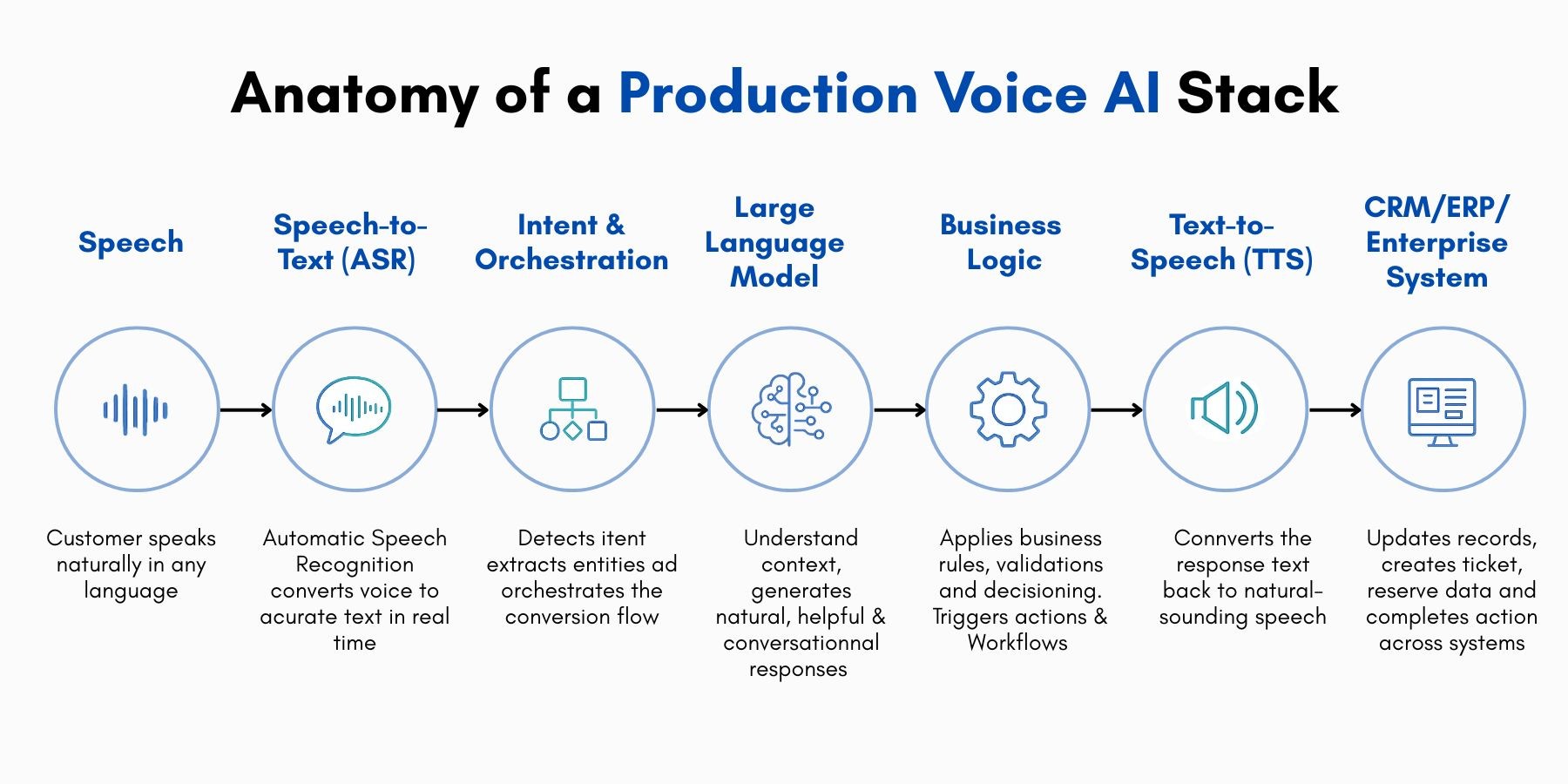
This gap between prototype performance and production reliability has become one of the defining engineering challenges in enterprise Voice AI.
During a recent discussion hosted by the Unio Voice AI Community, Utkarsh Shukla explained that his team's objective was never to become another foundation model company. The focus was on building systems that consistently solve business problems in production.
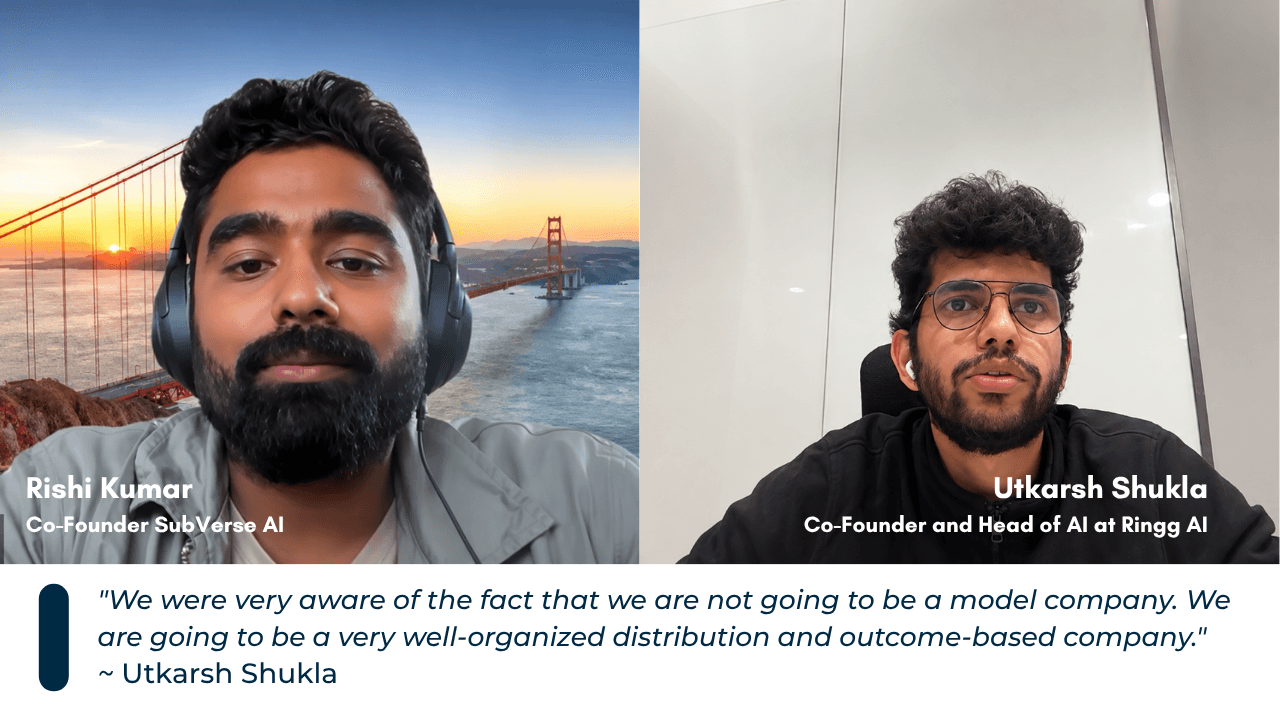
That perspective reflects a broader shift taking place across the industry. Instead of asking which model performs best on a benchmark, engineering teams are increasingly asking a different question:
What prevents Voice AI from succeeding once it reaches production?
The answers are rarely found on benchmark leaderboards. They come from real customer conversations where multilingual speech, telephony quality, latency, workflow integration, and accurate entity recognition determine whether an interaction succeeds or fails.
Those production realities shape every engineering decision that follows, from speech recognition and latency optimization to evaluation frameworks and customer journey design. The rest of this article explores the technical and product choices that help bridge the gap between an impressive demo and a system that enterprises can depend on every day.
When Off-the-Shelf Speech Models Aren't Enough
For most Voice AI teams, building a speech recognition model from scratch is rarely the first choice.
Today's ecosystem already offers capable speech recognition systems, from open-source models like Whisper to commercial platforms such as Deepgram and Google Cloud Speech-to-Text. These tools make it possible to launch voice applications quickly without investing years in model development.
That approach works well until production introduces conditions that benchmark datasets rarely capture.
Enterprise conversations are messy. Audio travels through compressed phone networks, background noise is common, and customers frequently switch between English and regional languages within the same sentence. A model that performs well in controlled evaluations can struggle when deployed in real customer interactions.
The challenge goes beyond transcription accuracy.
Businesses depend on Voice AI to capture information that drives downstream workflows. A misheard customer name can create duplicate CRM records. An incorrect address can disrupt deliveries. A missed policy number or appointment date can affect an entire customer journey. In these situations, a single recognition error becomes a business problem rather than just a model error.
This is a challenge discussed during the conversation with Utkarsh Shukla, who explained that their team eventually concluded the bottleneck wasn't prompting or orchestration. The underlying speech recognition itself needed to be optimised for the environments where customers actually interacted with the system.
"Benchmark performance is not enough. Production environments require models optimized for specific business realities."
Rather than pursuing the lowest possible Word Error Rate across generic datasets, the discussion highlighted a different design philosophy: optimise speech recognition for the environments where it will actually operate. That means accounting for telephony audio, multilingual conversations, noisy conditions, and the accurate capture of business-critical information.
Across the industry, teams are making similar trade-offs. Instead of relying entirely on general-purpose foundation models, they're building specialised layers or domain-specific models where reliability has a direct impact on customer experience and business outcomes.
The broader lesson is clear: enterprise AI isn't always about choosing the biggest or newest model. Sometimes it's about recognising where general-purpose technology reaches its limits and investing in systems designed for a specific production environment.

Why Building Your Own AI Model Should Be a Business Decision, Not an Engineering Goal
Most AI teams begin with the same assumption: use the best available models and focus on building the product around them. With high-quality speech recognition models already available, building an in-house model often seems unnecessary.
In many cases, that assumption is correct.
Foundation models have made it possible to build capable Voice AI systems without investing years in model research. For startups especially, buying existing capabilities is usually faster, cheaper, and easier than building them from scratch.
The equation changes when production requirements begin exposing problems that general-purpose models were never designed to solve.
Enterprise phone conversations rarely resemble benchmark datasets. Customers speak over compressed mobile networks, switch between languages mid-sentence, call from noisy environments, and share names, addresses, policy numbers, and other information that must be captured accurately. Under these conditions, even small transcription errors can create downstream business problems.
This was one of the themes that emerged during the discussion. Rather than trying to outperform every speech recognition model on public benchmarks, the focus shifted to optimizing speech recognition for the environments where enterprise systems actually operate. For Ringg AI, that led to the development of Parrot, its in-house speech-to-text system designed for Indian telephony, multilingual conversations, and accurate extraction of business-critical information.
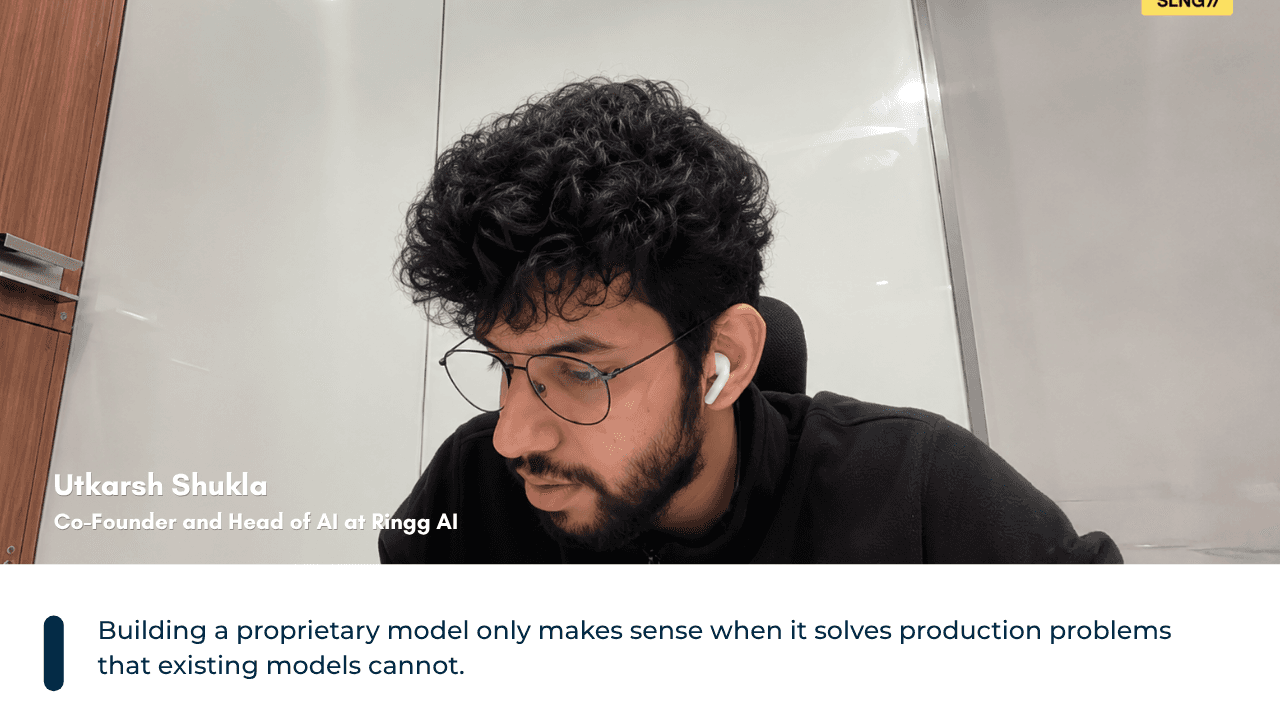
The broader lesson extends beyond speech recognition.
Building proprietary AI infrastructure is rarely a competitive advantage by itself. It becomes valuable only when it addresses a specific business constraint that off-the-shelf models cannot solve consistently. Whether the challenge is latency, multilingual support, compliance, cost, or domain-specific accuracy, the decision to build should be driven by customer outcomes rather than engineering ambition.
For most organizations, buying existing models will remain the right choice. The companies that build their own models successfully tend to do so only after identifying a clear production bottleneck that no existing solution adequately addresses.
Latency Shapes Every Conversation
A Voice AI system can understand every customer correctly and still deliver a poor experience if it responds too slowly.
Human conversations depend on rhythm. People naturally expect responses within a fraction of a second, and even brief pauses can make an interaction feel awkward or scripted. Unlike chat interfaces, voice conversations leave little room for delay. Every additional millisecond changes how natural the conversation feels.
That makes latency one of the biggest engineering challenges in production Voice AI.
Reducing latency is rarely about making a single model faster. Every customer interaction passes through multiple stages before a response is heard. Speech must be transcribed, interpreted by a language model, checked against business logic, converted back into speech, and delivered through the phone network. Even small delays at each stage quickly add up.
One point from the discussion stood out. For conversations to feel natural, the first audible response should ideally arrive within 500 to 600 milliseconds. As response times approach 800 to 900 milliseconds, users begin noticing the delay, making interactions feel less conversational even when the answers remain accurate.
This is why enterprise teams increasingly optimise the entire Voice AI pipeline instead of focusing on individual models. Infrastructure placement, streaming, orchestration, inference, and network performance all contribute to how responsive a system feels.
Ultimately, latency is not just an engineering metric. It is a customer experience metric. In production Voice AI, trust is often earned or lost in the first few hundred milliseconds of every conversation.
When Accuracy Isn't Enough
Word Error Rate (WER) has long been the standard benchmark for evaluating speech recognition systems. By comparing a transcript against a reference, it measures how many words were substituted, omitted, or inserted. Lower WER generally indicates better transcription accuracy.
For comparing speech models, WER remains a useful benchmark.
Enterprise Voice AI, however, demands a different measure of success.
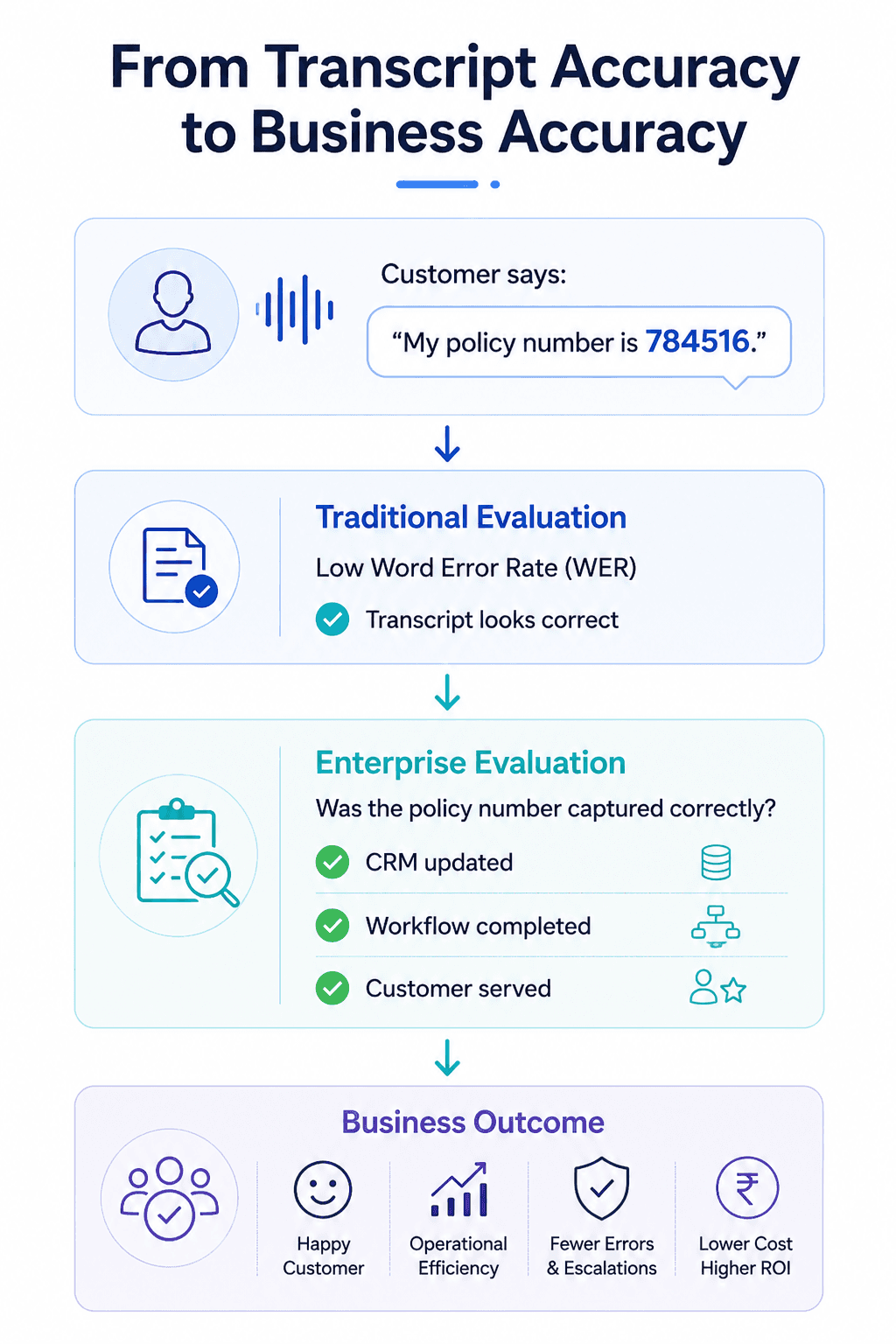
A transcript can achieve an excellent Word Error Rate while still failing the business task it was meant to support. If a customer name, address, policy number, appointment date, or account ID is captured incorrectly, the transcript may appear largely accurate, but the workflow that depends on that information can still fail.
That changes the question enterprises ask.
Instead of asking, "Did the AI transcribe every word correctly?", they increasingly ask, "Did the AI capture the information required to complete the task?"
This perspective also emerged during the discussion with Utkarsh Shukla, where he explained that production systems are evaluated beyond traditional benchmark scores. The focus is on correctly identifying business-critical entities because those details determine whether downstream workflows succeed.
Many enterprise teams now complement benchmark testing with continuous evaluation pipelines that measure how AI performs in real customer conversations rather than controlled datasets. The goal is not simply to produce cleaner transcripts but to ensure the right information reaches the right business systems.
As Voice AI continues to mature, success is being measured less by technical benchmarks and more by business outcomes. A model that extracts the right information and enables the next action ultimately delivers more value than one that simply produces the most accurate transcript.
Solving Voice AI for India Starts with Understanding How People Actually Speak
Many multilingual Voice AI projects fail because they treat language as a translation problem instead of a language understanding problem.
India presents one of the most challenging environments for conversational AI. Customers rarely speak in a single language from start to finish. Conversations naturally shift between Hindi, English, and regional languages, often within the same sentence. A customer may describe a problem in Hindi, mention a product name in English, provide an address using a regional pronunciation, and switch back again without thinking about it.
This kind of code-switching makes speech recognition far more complex than benchmark datasets suggest. Add telephone compression, background noise, regional accents, and inconsistent audio quality, and production environments become even harder to navigate.
These challenges were a recurring theme during the discussion with Utkarsh Shukla. One of the key observations was that understanding the overall conversation is rarely enough. Errors introduced during speech recognition affect everything that follows, from language model reasoning to workflow execution.
The conversation also highlighted why many existing speech models struggle with Indic languages. Tokenization methods designed primarily for English and other Western languages do not always represent the phonetic structure of Indian languages effectively. Improving recognition therefore requires more than adding language support. It demands better linguistic representation, training data that reflects how people actually speak, and evaluation on real production conversations rather than clean benchmark datasets.
The challenge extends beyond language itself. Enterprise calls include background conversations, traffic noise, poor network quality, and multiple speakers talking at the same time. Systems must identify the primary speaker, ignore irrelevant audio, and continue extracting the information that matters to the business.
The broader lesson applies well beyond India. Building Voice AI for any market requires understanding how people naturally communicate rather than how they are expected to speak. The closer training data reflects real customer behaviour, the more reliable production systems become.
Voice AI Creates More Value After the Conversation Ends
Many organizations still evaluate Voice AI by the number of calls it can automate. While automation reduces manual effort, the conversation itself is rarely the end goal.
The real value lies in everything that happens after the call.
Every customer interaction generates information that can improve future decisions. Appointment reminders become follow-up opportunities. Service conversations create context for future support requests. Sales calls reveal buying intent that can shape the next customer interaction. Instead of treating every conversation as an isolated event, enterprises are beginning to view Voice AI as a continuous source of customer intelligence.
This idea emerged clearly during the discussion with Utkarsh Shukla, where the focus extended beyond voice automation to preserving context across customer journeys. Rather than optimising individual calls, the objective is to connect conversations with business systems so every interaction makes the next one more relevant.
This shift is changing how organizations evaluate Voice AI investments. Success is no longer measured simply by call volumes or automation rates. It is measured by business outcomes such as higher conversion rates, faster issue resolution, improved customer retention, and more personalised experiences.
As Voice AI becomes more deeply integrated with enterprise workflows, the conversation itself becomes only one step in a much larger process. The organizations creating long-term value are those using every interaction to build context, improve decisions, and strengthen customer relationships over time.
Beyond Voice AI: Building Enterprise Intelligence That Lasts
Building a Voice AI demo is no longer the hard part. The real challenge is deploying systems that continue to perform in unpredictable environments, integrate with existing business processes, and deliver measurable outcomes over time.
Across industries, organizations are discovering that production success depends on far more than choosing the right foundation model. It requires speech systems that can handle real-world audio, multilingual conversations, low-latency interactions, accurate information extraction, and continuous evaluation after deployment. These operational challenges are increasingly becoming the differentiator between pilots that impress and platforms that scale.
The discussion with Ringg AI reinforced this broader shift. While the examples came from one company's experience, the underlying lessons apply across the Voice AI industry. Teams building production systems are placing greater emphasis on infrastructure, orchestration, evaluation pipelines, and workflow integration rather than treating model performance alone as the measure of success.
The same trend is reflected across enterprise AI adoption. Organizations are moving beyond experimentation and focusing on how AI can be embedded into business operations with clear governance, measurable ROI, and long-term scalability. Deloitte's State of AI in the Enterprise 2026 report highlights this transition, noting that the challenge has shifted from identifying AI opportunities to successfully implementing and scaling them across the business.
That is the perspective SubVerse AI aims to bring to these conversations. Rather than focusing only on product launches or benchmark scores, we explore the engineering decisions, architectural trade-offs, and implementation strategies that shape production-ready AI systems.
The biggest takeaway from this discussion is simple. As foundation models become increasingly accessible, competitive advantage will come less from the models themselves and more from how effectively they are deployed. The companies that create lasting value won't necessarily be the ones with the biggest models, but the ones that build systems people can trust in real-world environments.
About Subverse AI
This article draws on insights from a conversation with Utkarsh Shukla, Co-Founder and Head of AI at Ringg AI, hosted by the Unio Voice AI Community. To explore more conversations on Voice AI and enterprise AI, follow SubVerse AI on LinkedIn and join a growing community of founders, builders, and enterprise leaders shaping the future of AI.
Table of Content
More Insights


