Sep 3, 2026
Transform complex invoice workflows, multi-format IDP, SAP ERP integration, and vendor communication into an end-to-end autonomous AI pipeline.

A leading US industrial goods manufacturer processing over 80,000 monthly invoices from 200+ vendors eliminated accounts payable bottlenecks using Subverse AI. By deploying Subverse AI’s multi-agent orchestration platform, the enterprise connected its Microsoft Exchange mailboxes, custom vendor database, and SAP ERP system. Subverse AI automated document parsing across disparate formats, authorization verification, contract compliance, internal finance approvals, and proactive vendor communication. The platform achieved a 92% Straight-Through Processing (STP) rate, reduced invoice processing time from 14 days to under 3 minutes, and saved over $3.8M annually.
What Operational Challenges Was the Enterprise Facing?
A top-tier US industrial goods manufacturer faced severe operational drag within its Accounts Payable (AP) department. Managing a network of over 200 suppliers, the company ingested more than 80,000 invoices every month, all arriving via unstructured email channels.
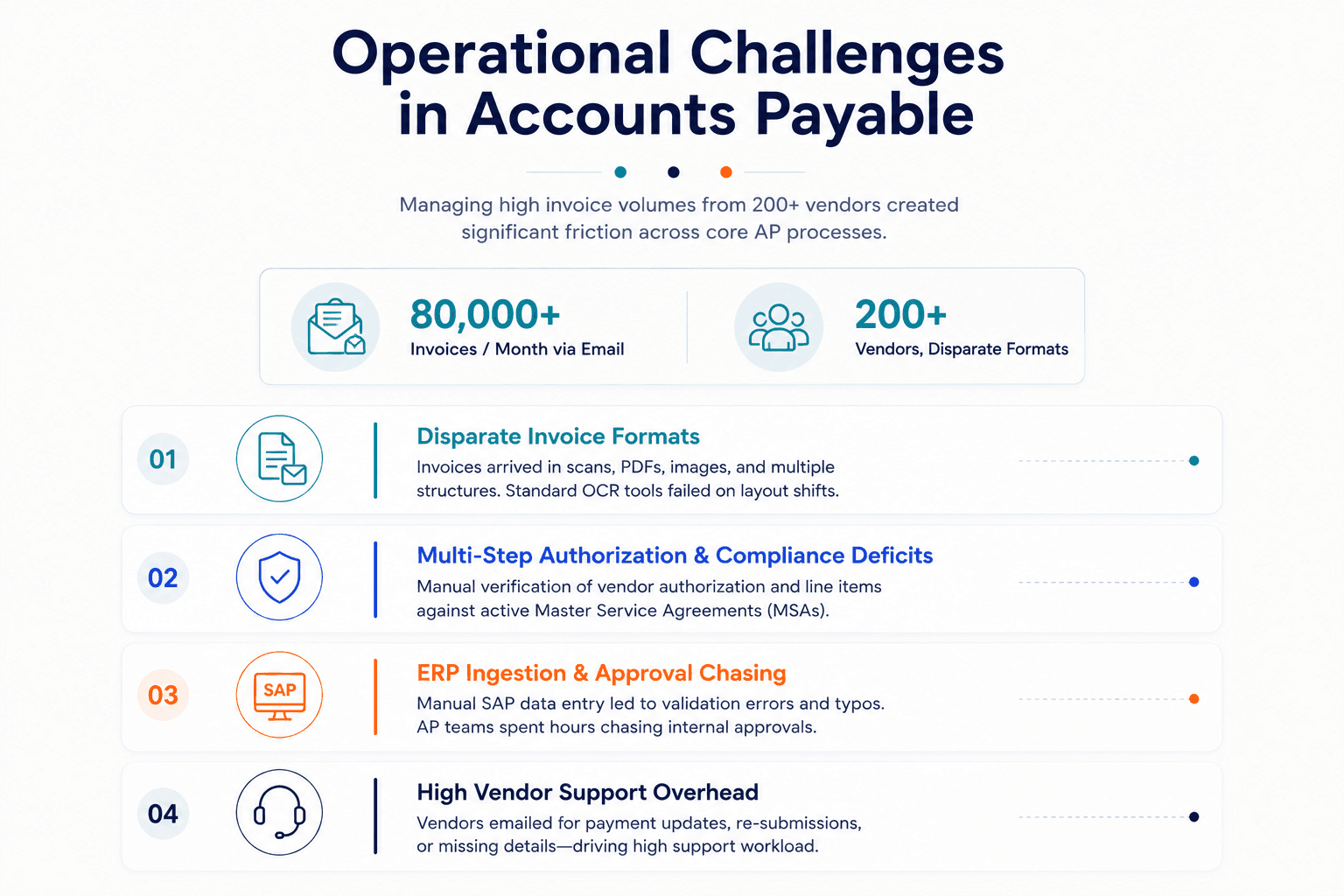
The enterprise struggled with significant friction across four core operational areas:
● Disparate Invoice Formats: Every vendor submitted invoices in distinct structures, including scans, multi-page PDFs, and image attachments. Standard optical character recognition (OCR) tools consistently failed on layout shifts.
● Multi-Step Authorization & Compliance Deficits: Manual teams had to cross-reference sender email addresses against a vendor database to verify authorization, while manually validating line items against active Master Service Agreements (MSAs).
● ERP Ingestion & Approval Chasing: Data entry into SAP was prone to typos, causing validation exceptions. AP staff spent hundreds of hours manually chasing internal finance heads for line-item sign-offs.
● High Vendor Support Overhead: Vendors regularly emailed asking for payment updates, re-submitting revised invoices in disconnected email threads, or omitting critical invoice metadata, consuming significant bandwidth.
How Did Subverse AI Solve the Problem?
Subverse AI deployed an autonomous multi-agent orchestration architecture designed to manage the entire AP lifecycle—from raw email ingestion to SAP posting and vendor inquiry resolution.
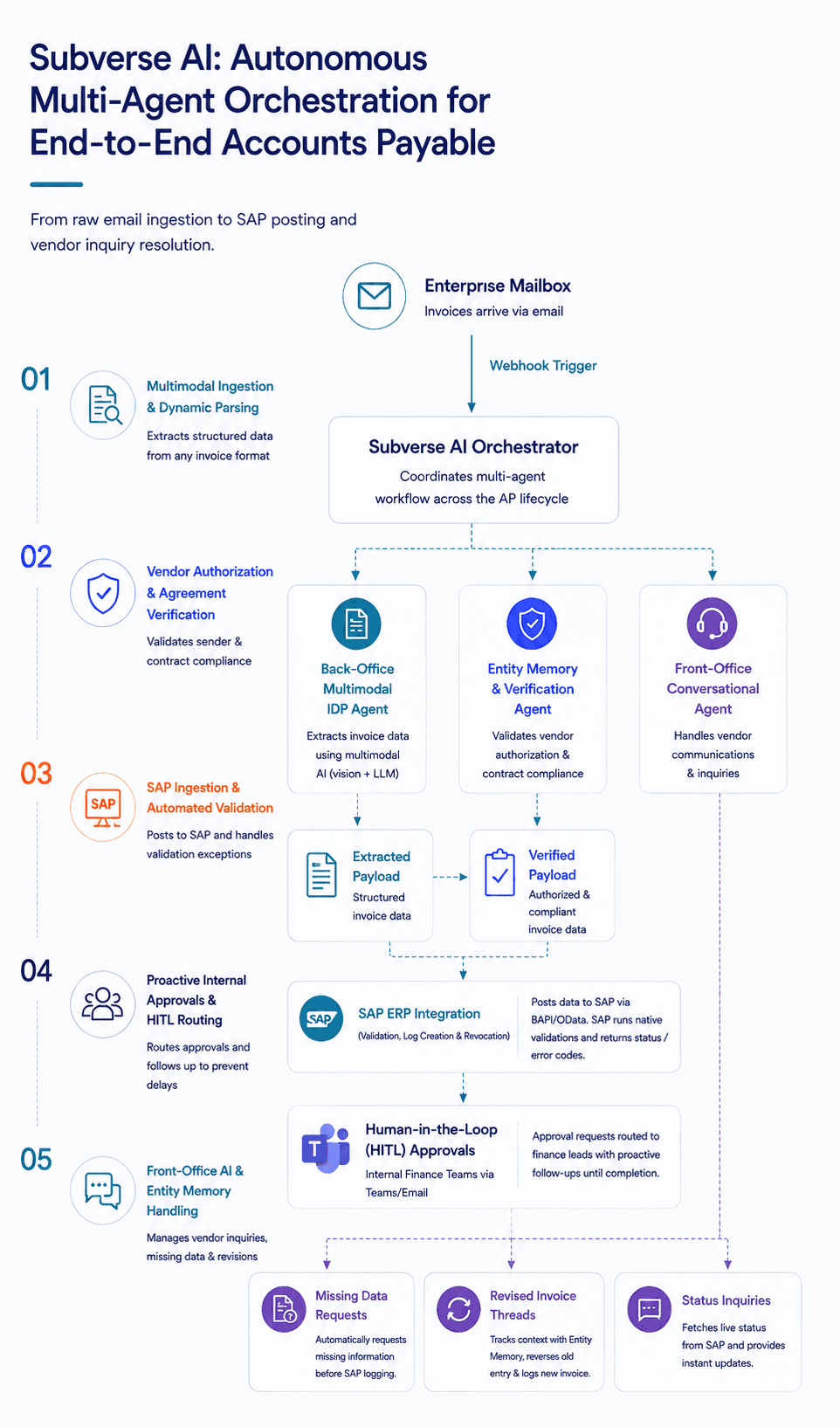
Step 1: Multimodal Ingestion & Dynamic Parsing
When an email arrives in the enterprise inbox, a Subverse AI webhook triggers a Back-Office Intelligent Document Processing (IDP) Agent.
Using multimodal vision-language models, the agent extracts structured metadata—such as PO numbers, line items, taxes, unit prices, and bank details—regardless of template layout variations.
Step 2: Vendor Authorization & Agreement Verification
Before touching the ERP, Subverse AI routes the payload through two verification checks:
1. Authorization Check: An agent queries the internal Vendor Database to confirm that the sender's identity and domain match authorized representative records.
2. Contract Compliance Check: An agent cross-references invoice line items against negotiated contract terms stored in the database to catch overcharges or unapproved rate hikes.
Step 3: SAP Ingestion & Automated Validation
Once verified, the SAP Connector Agent passes the structured JSON payload directly into SAP via BAPI/OData interfaces.
SAP runs its native validation checks (such as duplicate checks and general ledger allocation). If SAP flags an anomaly, Subverse AI captures the exact error code to determine the next action.
Step 4: Proactive Internal Approvals & HITL Routing
For invoices requiring managerial sign-off, Subverse AI acts as an automated internal coordinator. It routes approval cards to the appropriate finance lead over Email or Microsoft Teams.
If an approval stalls, the platform schedules proactive follow-ups based on predefined internal SLAs.
Step 5: Front-Office Conversational AI & Entity Memory Handling
Subverse AI’s Front-Office Agent continuously manages vendor interactions across multiple edge cases:
● Missing Data Requests: If an invoice lacks crucial information (such as a missing PO number or tax ID), the agent automatically replies to the vendor, specifying the exact missing details before SAP logging.
● Revised Invoice Threads: Vendors often email revised invoices in separate, unlinked threads. Subverse AI utilizes Entity Memory to track context across individual vendors and PO numbers over time. The platform identifies the revised invoice, cancels or reverses the legacy entry in SAP, logs the updated invoice, and informs the vendor.
● Status Inquiries: When vendors email or call asking for payment updates, the Front-Office Agent fetches live status data directly from SAP and provides an instant context-aware update.
What System Integrations & Multimodal Architecture Were Implemented?
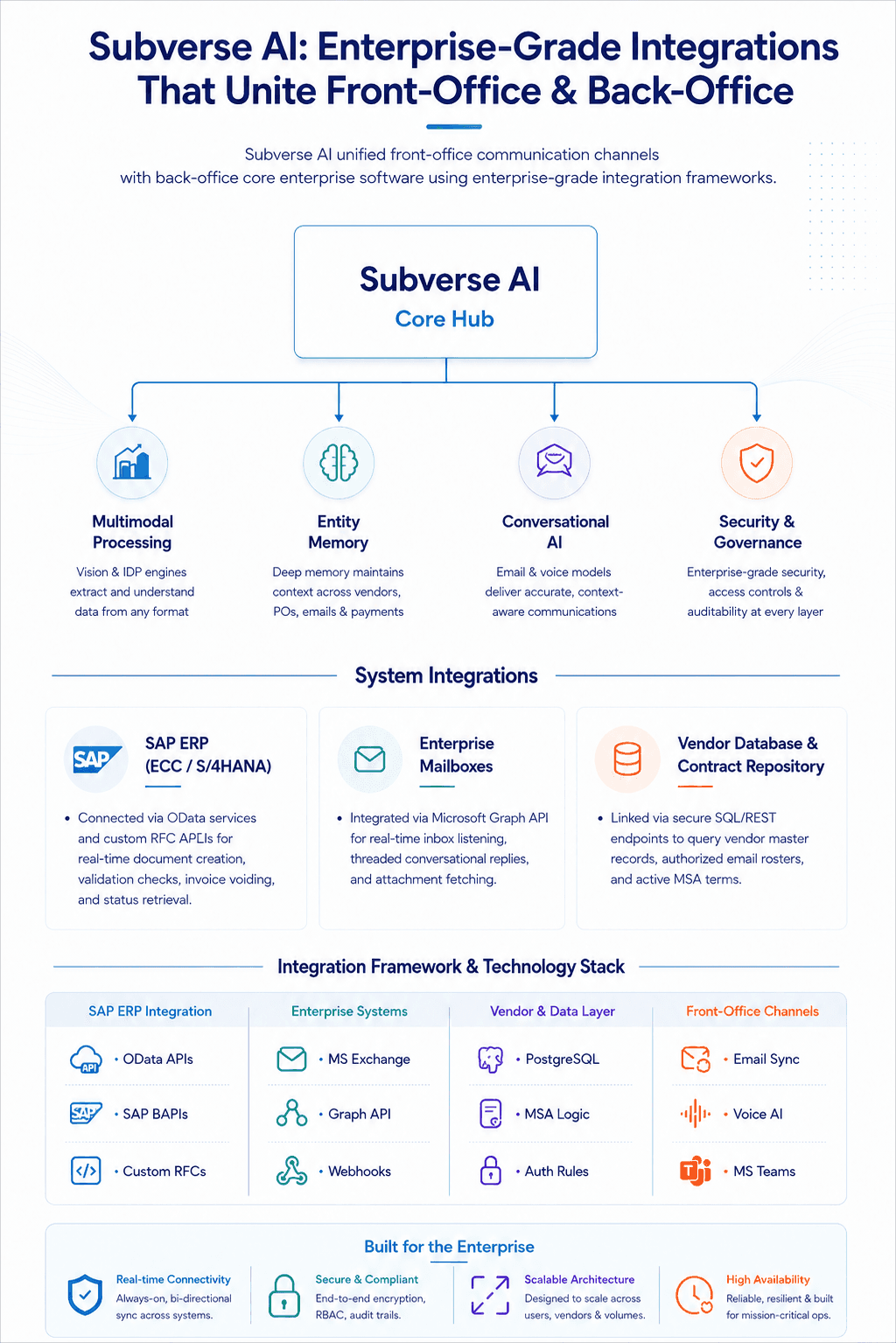
Subverse AI unified front-office communication channels with back-office core enterprise software using enterprise-grade integration frameworks.
System Integrations
● SAP ERP (ECC / S/4HANA): Connected via OData services and custom RFC BAPIs for real-time document creation, validation checks, invoice voiding, and status retrieval.
● Enterprise Mailboxes: Integrated via Microsoft Graph API for real-time inbox listening, threaded conversational replies, and attachment fetching.
● Vendor Database & Contract Repository: Linked via secure SQL/REST endpoints to query vendor master records, authorized email rosters, and active MSA terms.
Multimodal Processing Capabilities
● Vision & IDP Engines: Process complex, multi-page PDFs, low-resolution scans, and embedded invoice images without requiring rigid spatial templates.
● Deep Entity Memory: Maintains context across historical emails, vendor interactions, purchase orders, and payment records over time.
● Conversational Email & Voice Models: Generates polite, accurate, and contextually aware vendor communications regarding status updates, missing data, or revised submission confirmations.
Traditional Approach vs. Subverse Autonomous AI Workflow
Operational Parameter | Traditional / Legacy AP Workflow | Subverse AI Autonomous Workflow |
Invoice Processing Time | 10 to 14 Business Days | Under 3 Minutes (End-to-End) |
Format Handling Capability | Rigid OCR templates requiring manual correction for new layouts | Zero-shot Multimodal IDP handling 200+ vendor formats natively |
Vendor Verification | Manual lookup in vendor database and contract spreadsheets | Automated dual-tier verification (Database + MSA compliance) |
ERP Data Entry | Manual keying prone to typos and human errors | Direct SAP BAPI/OData injection with zero manual entry |
Revised Invoices Handling | Risk of double payments; manual effort to void old SAP entries | Entity Memory links revised invoices, revokes old entries, updates SAP |
Vendor Inquiry Handling | AP team spends 30%+ of time answering status emails | Front-Office Agent answers inquiries instantly with live SAP data |
Internal Approvals | Stalled emails requiring manual chasing by AP staff | Proactive AI follow-ups across Teams and Email based on SLAs |
What Was the Business Impact and KPI Improvement?
Deploying Subverse AI transformed the manufacturer's accounts payable unit from a labor-intensive cost center into an efficient, automated operation.
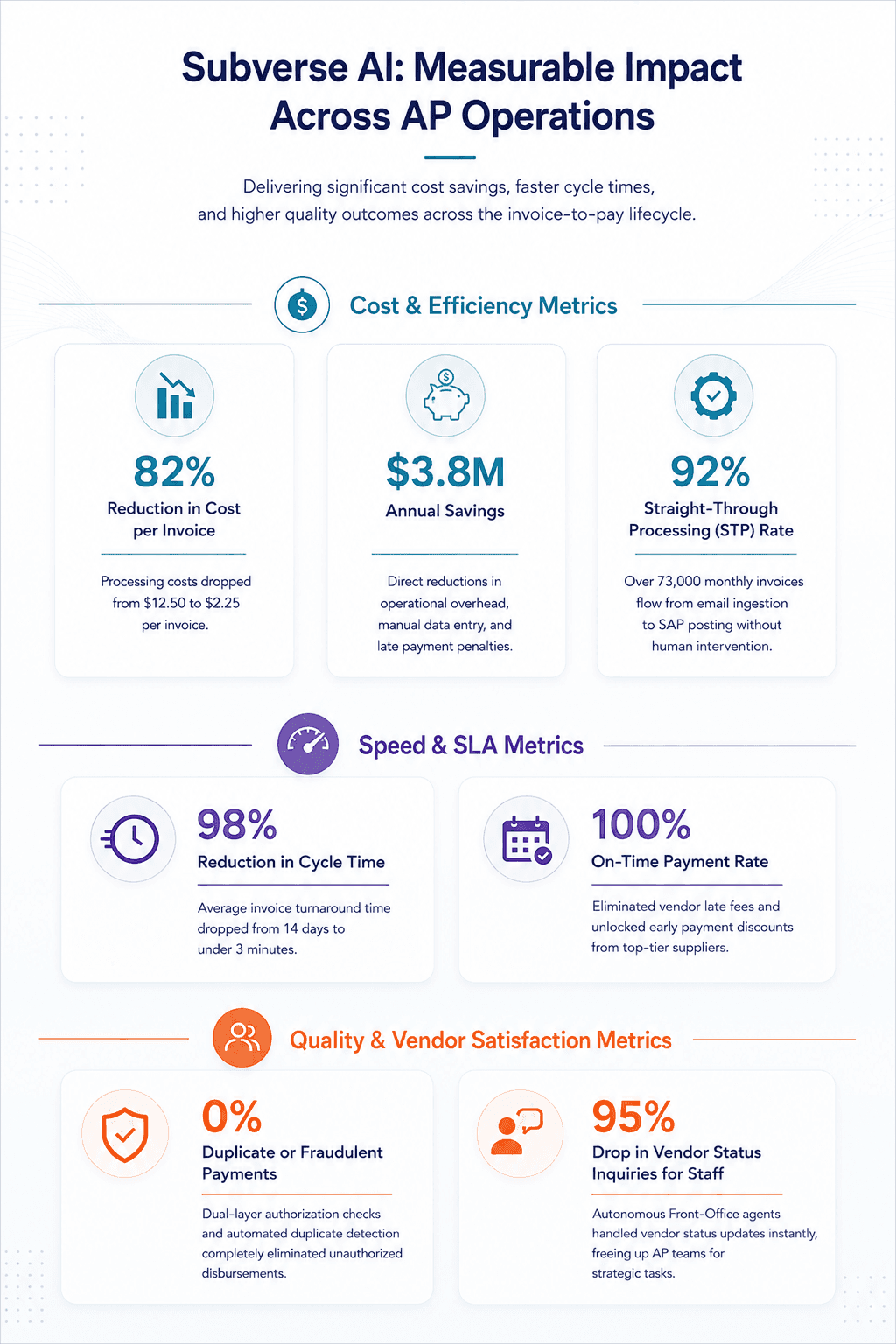
Cost & Efficiency Metrics
● 82% Reduction in Cost per Invoice: Processing costs dropped from $12.50 to $2.25 per invoice.
● $3.8M Annual Savings: Direct reductions in operational overhead, manual data entry, and late payment penalties.
● 92% Straight-Through Processing (STP) Rate: Over 73,000 monthly invoices flow from email ingestion to SAP posting without human intervention.
Speed & SLA Metrics
● 98% Reduction in Cycle Time: Average invoice turnaround time dropped from 14 days to under 3 minutes.
● 100% On-Time Payment Rate: Eliminated vendor late fees and unlocked early payment discounts from top-tier suppliers.
Quality & Vendor Satisfaction Metrics
● Zero Duplicate or Fraudulent Payments: Dual-layer authorization checks and automated duplicate detection completely eliminated unauthorized disbursements.
● 95% Drop in Vendor Status Inquiries for Staff: Autonomous Front-Office agents handled vendor status updates instantly, freeing up AP teams for strategic tasks.
Frequently Asked Questions (FAQ)
How does Subverse AI handle revised invoices sent in separate email threads?
Subverse AI uses deep Entity Memory to track vendors and purchase order numbers across disconnected channels. When a revised invoice arrives, the agent matches it to the existing context, cancels or reverses the legacy entry in SAP via API, logs the updated invoice, and notifies the vendor.
Can Subverse AI handle unexpected changes in invoice layouts across 200+ vendors?
Yes. Subverse AI utilizes multimodal vision-language models that do not rely on rigid coordinates or template rules. It dynamically interprets structured fields—such as line items, taxes, and vendor details—from any complex or unformatted PDF, image, or scan.
How does the platform verify if an invoice sender is authorized?
Before logging data into SAP, Subverse AI cross-references the sender's email address and domain against your enterprise Vendor Database. It simultaneously validates that the invoice terms match negotiated Master Service Agreements (MSAs) to ensure contract compliance.
What happens if an invoice is missing crucial details like a PO number?
If required metadata is missing, Subverse AI’s Front-Office Agent halts SAP entry and automatically emails the vendor. The agent clearly identifies the missing information (e.g., tax ID or PO number) and continues processing once the vendor replies with the required details.
Table of Content
More Insights


