Sep 1, 2026
Streamline intake, automate clinical cross-referencing, and eliminate manual adjudication bottlenecks with Subverse AI’s multi-agent workflow platform.

Subverse AI transformed health insurance claim adjudication for a leading nationwide health payer handling over 4 million policyholders. Facing severe adjudication delays, high claim denial rates from ICD-10/CPT coding mismatches, and massive back-office manual overhead, the enterprise deployed Subverse AI's multi-agent orchestration platform. Subverse AI automated end-to-end processing across EDI 837 feeds, unstructured clinical notes, and legacy core systems. The enterprise achieved an 82% reduction in claim processing cycle time, boosted Straight-Through Processing (STP) rates from 14% to 76%, and realized $6.4M in annual operational savings while remaining 100% HIPAA and CMS compliant.
What Operational Challenges Was the Enterprise Facing?
A leading Tier-1 US health insurance provider managing over 4 million policyholders and processing more than 120,000 health claims monthly was bottlenecked by legacy processing architecture. The organization relied heavily on manual data entry, human verification, and fragmented adjudication rule engines.
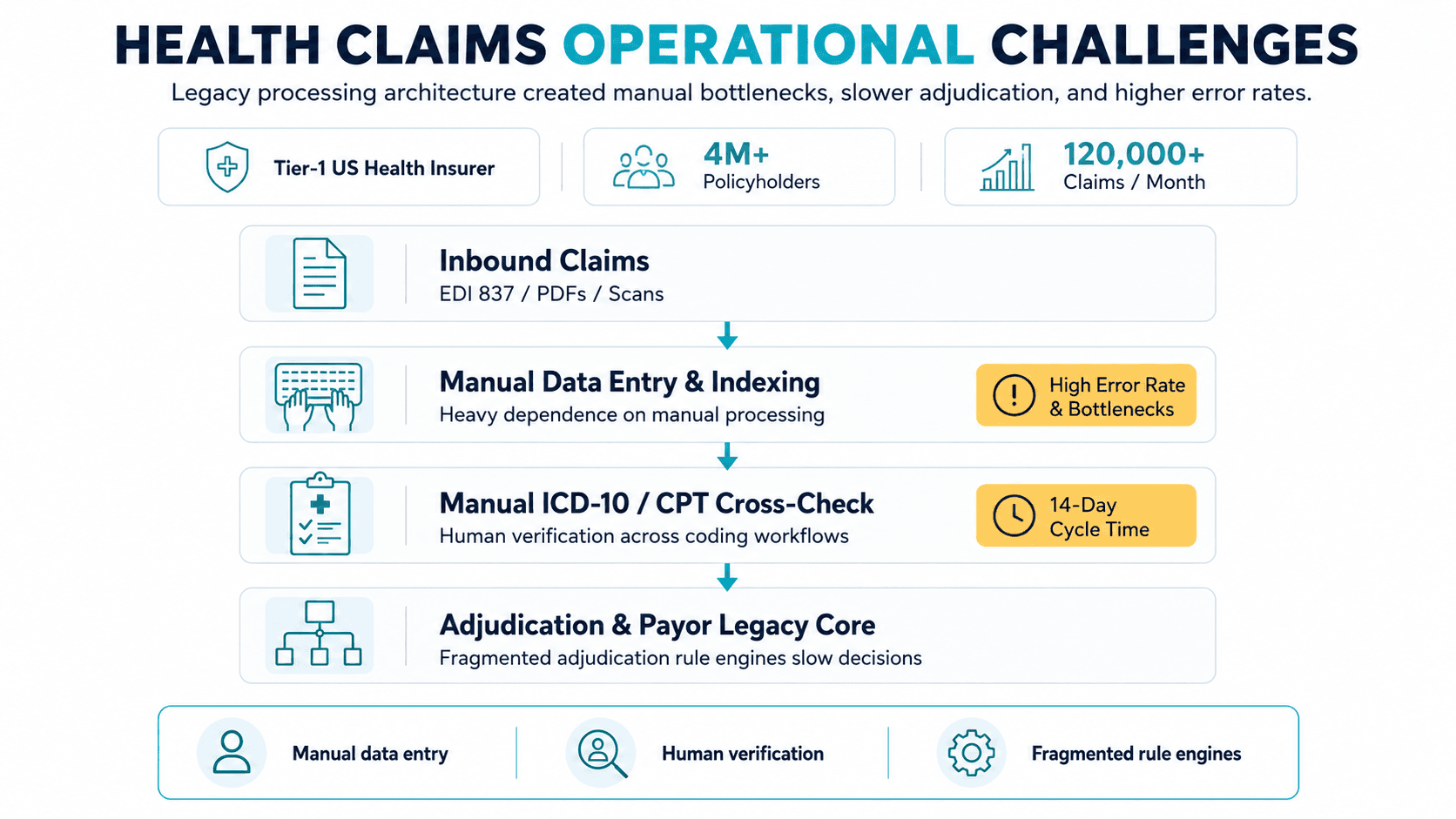
Key Operational Bottlenecks:
● Unstructured Medical Data & Multi-Format Ingestion: Incoming claims arrived via EDI 837 files, unstructured PDF medical records, scanned doctor notes, and clinical summaries. Extracting patient demographics, procedure codes, and itemized billing charges required manual indexing by offshore teams.
● Complex Medical Coding Verification: Verifying ICD-10 diagnosis codes against CPT/HCPCS procedure codes for medical necessity demanded significant manual review by certified medical coders, creating massive backlogs.
● Prohibitive Turnaround Times (SLA Violations): Average claim cycle time hovered at 14.2 days from First Notice of Claim to final settlement, resulting in provider dissatisfaction, regulatory penalty risks, and ballooning customer support calls.
● High Operational Costs & Low First-Pass Yield: The organization’s Straight-Through Processing (STP) rate was stalled at 14%. Over 86% of claims required at least two human touchpoints, driving the average processing cost to $18.50 per claim.
How Did Subverse AI Solve the Problem?
Subverse AI deployed an end-to-end, multi-agent autonomous orchestration architecture designed to process incoming claim payloads, interpret unstructured clinical documentation, cross-reference coverage rules, and execute core system updates autonomously.
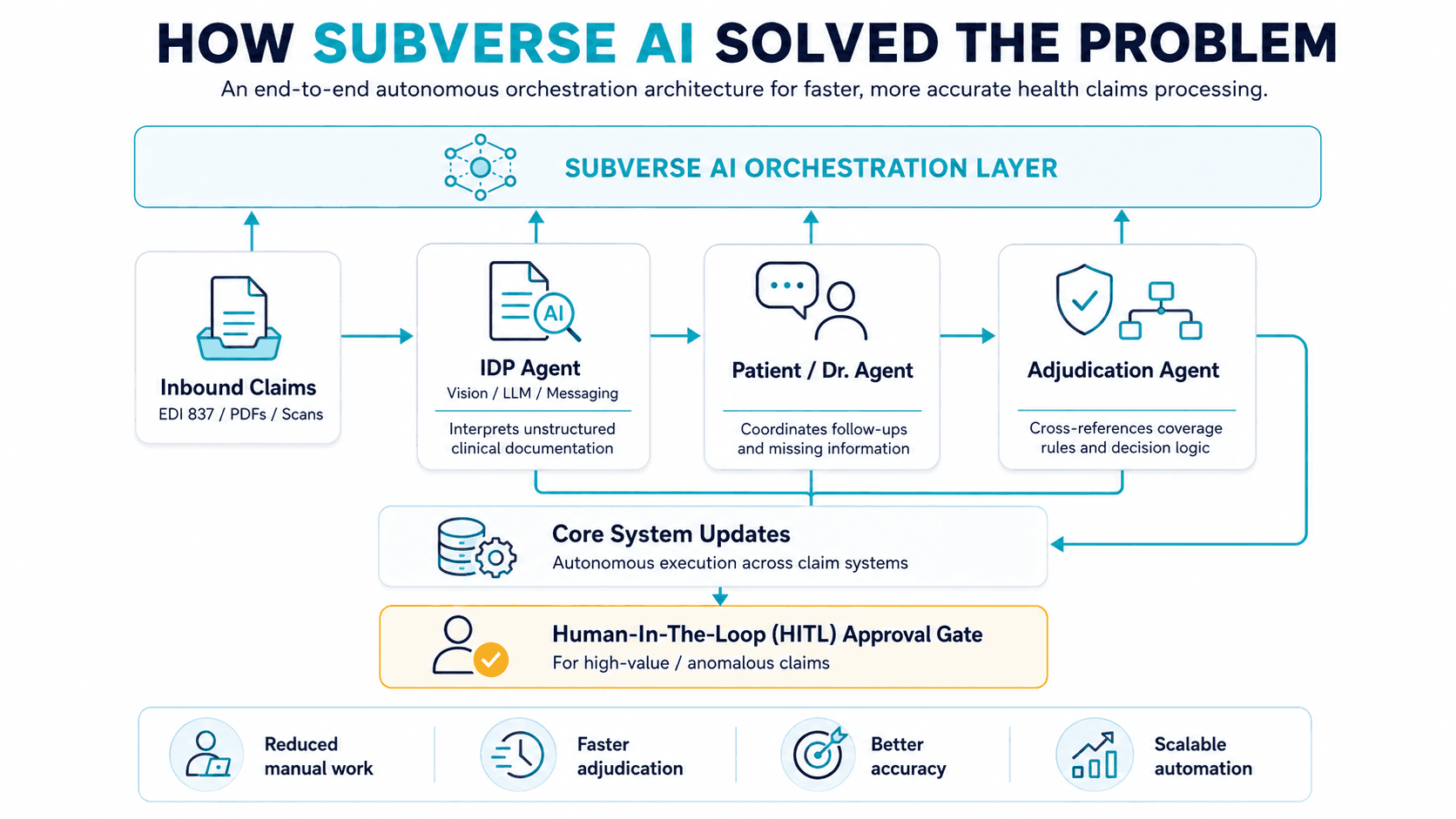
1. Ingestion & Intelligent Document Processing (IDP Agent)
The Subverse Back-Office Vision/IDP Agent automatically ingests multi-format claim files via webhook triggers and SFTP feeds. Utilizing multimodal models, the agent parses:
● Standard EDI 837 I/P/D transaction sets.
● Scanned CMS-1500 and UB-04 claim forms.
● Unstructured physician notes, lab reports, and discharge summaries.
The agent validates data completeness, standardizes patient identifiers, and extracts procedure details into clean JSON structures.
2. Clinical Validation & Rules Engine Agent
The Clinical Adjudication Agent ingests the parsed claim data and evaluates it against the payer's policy rules, medical necessity guidelines, and the policyholder’s real-time benefits.
● Entity Memory Tracking: The agent queries Subverse’s Entity Memory to pull historical claims, pre-authorization approvals, deductible tracking, and provider network status for that specific patient.
● Automated Code Matching: Uses semantic NLP to cross-examine ICD-10 diagnosis codes against CPT procedure codes, detecting discrepancies, duplicate billing, or unbundling attempts automatically.
3. Human-In-The-Loop (HITL) Safety & Exception Routing
To maintain clinical rigor and regulatory compliance, Subverse AI enforces conditional HITL Approval Gates:
● Confidence Thresholding: Claims with an extraction or clinical coding confidence score below 95% are automatically routed to a human claims adjuster interface.
● High-Value Triage: Claims exceeding $15,000 or flagged with high fraud probability scores by the anomaly detector are routed directly to Special Investigation Units (SIU).
4. Automated Communication & Settlement (Front-Office Agents)
Once adjudicated:
● The system constructs EDI 835 payment/remittance advice payloads and pushes them directly into the core administrative platform.
● Subverse Front-Office Voice and Messaging Agents proactively notify policyholders via WhatsApp, SMS, or Email with itemized Explanation of Benefits (EOB) summaries.
What System Integrations & Multimodal Architecture Were Implemented?
Subverse AI functioned as the intelligent orchestration overlay across the payer’s existing tech stack without requiring a full rip-and-replace of legacy infrastructure.

Core Architecture & Integration Matrix
Integration Category | Systems / Protocols Integrated | Subverse Agent Role |
Core Adjudication Systems | TriZetto Facets, Cognizant QNXT, Custom Legacy DBs | Pushes automated adjudication outcomes, updates claim status codes, and triggers payout workflows via REST APIs and DB connectors. |
Document & Data Feeds | Secure SFTP, AWS S3, Electronic Health Record (EHR) APIs | Listens for incoming claim batches, fetches medical charts, and ingests EDI 837/835 streams. |
CRM & Member Data | Salesforce Health Cloud, Microsoft Dynamics 365 | Syncs real-time member records, updates accumulators (deductibles/OOP max), and populates interaction history. |
Communication Layer | Webhook Triggers, WhatsApp Business API, Twilio Voice, SendGrid | Executes outbound proactive status updates, requests missing clinical documentation, and responds to inbound status inquiries. |
Traditional Approach vs. Subverse Autonomous AI Workflow
Operational Parameter | Legacy Manual Workflow | Subverse AI Autonomous Workflow |
Claim Processing Time | 10 to 14 Business Days | Under 3 Minutes (for STP claims) |
Straight-Through Processing (STP) | 14% | 76% |
Average Cost Per Claim | $18.50 | $3.10 |
Data Extraction Accuracy | 81% (Human entry error-prone) | 98.4% (Multimodal IDP) |
Clinical Cross-Referencing | Manual lookup across PDF guidelines | Instant semantic matching via LLM agents |
Policyholder Transparency | Reactive (Calls to support center) | Proactive outbound messaging & digital portal sync |
Scalability Cap | Limited by headcount & staffing shifts | Unlimited horizontal cloud scalability |
What Was the Business Impact and KPI Improvement?
Within six months of deploying Subverse AI across the health payer's claims infrastructure, the enterprise achieved transformational operational performance metrics:
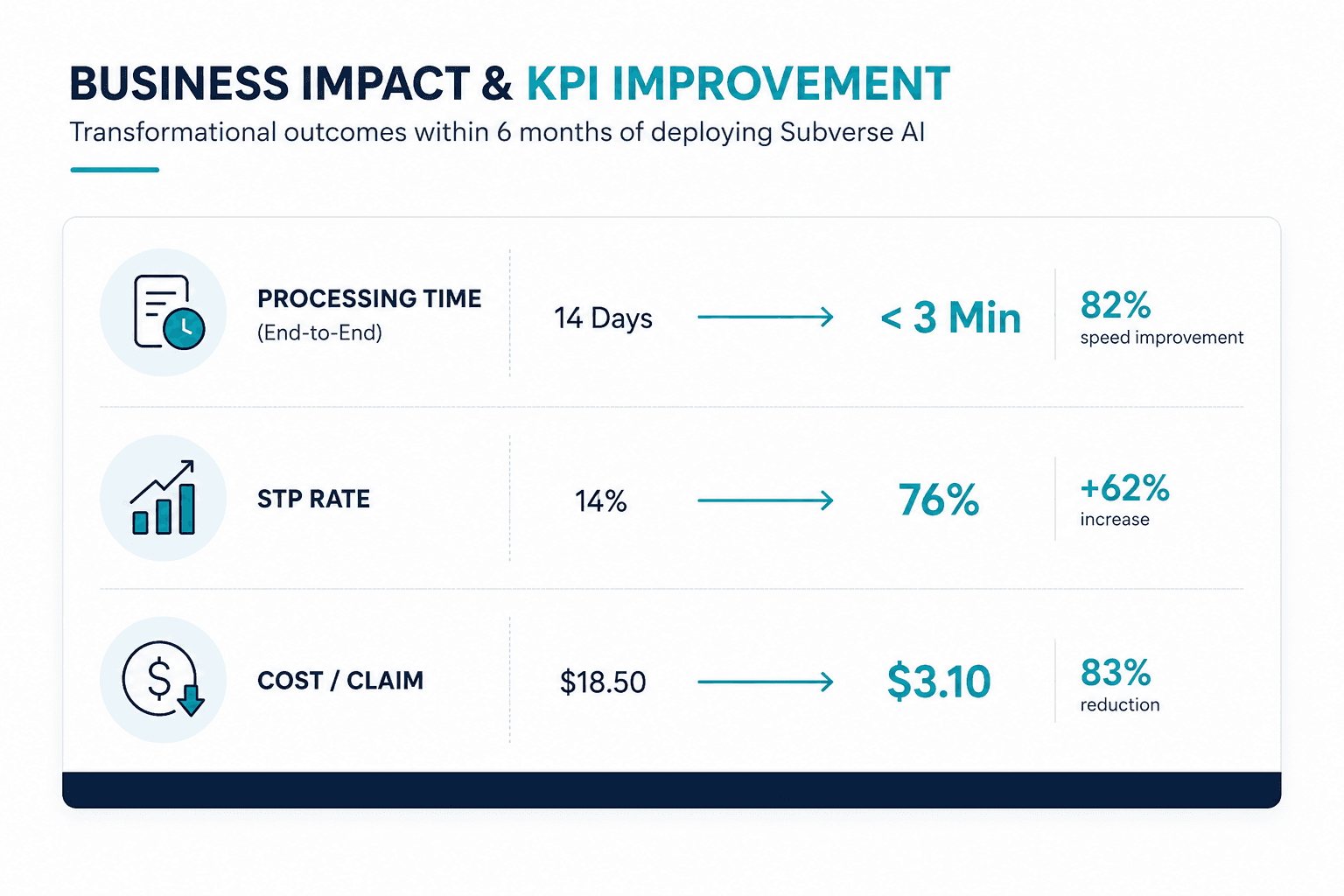
Cost & Efficiency Metrics
● $6.4 Million Annualized Savings: Reduced back-office processing overhead by 83%, lowering the cost per processed claim from $18.50 down to $3.10.
● 62% Increase in STP Rate: Straight-Through Processing surged from 14% to 76%, allowing the payer to handle peak seasonal claim spikes without hiring temporary staff.
Speed & SLA Metrics
● 82% Reduction in Processing Cycle Time: Average claim turnaround dropped from 14.2 days to under 3 minutes for automated claims, and under 4 hours for claims requiring human review.
● 99.1% SLA Compliance: Eliminated regulatory fines associated with delayed claim adjudications under state prompt-pay mandates.
Quality, Compliance & CSAT
● 38-Point Increase in CSAT: Member satisfaction scores improved significantly due to rapid payouts and transparent, proactive EOB communications.
● Zero Audit Non-Compliance: Every agent action, decision tree, and human override was logged in Subverse AI's immutable audit trail, ensuring full HIPAA and CMS audit readiness.
Frequently Asked Questions (FAQ)
How does Subverse AI ensure HIPAA compliance during claim processing?
Subverse AI operates with enterprise-grade security protocols, including end-to-end encryption for Protected Health Information (PHI), role-based access controls (RBAC), zero data retention option for LLMs, and complete audit logging to ensure full compliance with HIPAA and CMS regulations.
Can Subverse AI integrate with legacy core administration systems like Facets or QNXT?
Yes. Subverse AI connects seamlessly to legacy health core systems through secure REST APIs, direct database connectors, secure file transfers (SFTP), or Robotic Process Automation (RPA) adapters, enabling automated processing without disrupting existing IT infrastructure.
What happens when an incoming medical claim has missing or ambiguous documentation?
When required information is missing or unclear, Subverse AI’s Back-Office Agent automatically triggers an outbound notification to the healthcare provider or member requesting the specific document. The claim is paused in Entity Memory and resumes automatically upon receipt.
How does human-in-the-loop (HITL) work within the autonomous claims workflow?
Subverse AI utilizes confidence scoring and business rules to route edge cases—such as high-dollar claims or low-confidence medical coding matches—to human adjusters via an intuitive dashboard. Human approvals continuously train and improve the platform’s underlying agents.
Table of Content
More Insights

