Sep 11, 2026
Scale contact rates, negotiate compliant promise-to-pay commitments, and reduce operational collection costs with Subverse AI's multi-agent workflows.

Facing high operational overhead, low right-party contact (RPC) rates, and rigid legacy call workflows across early-stage delinquency buckets, a Tier-1 retail bank deployed Subverse AI to automate its end-to-end debt collection and recovery operations. Subverse AI orchestrated front-office Voice AI agents and back-office intelligence pipelines using deep entity memory to dynamically negotiate structured repayments and instantly process settlements. The implementation increased promise-to-pay (PTP) conversions by 42%, boosted right-party contact rates by 58%, and reduced overall collection costs per dollar recovered by 68%.
What Operational Challenges Was the Enterprise Facing?
A leading Tier-1 retail bank managing over 8 million active credit card and personal loan accounts was encountering severe operational bottlenecks in its early-to-mid stage delinquency management (15–90 Days Past Due). The bank’s legacy collections infrastructure was constrained by structural inefficiencies:

1. Depressed Right-Party Contact (RPC) Rates
Standard predictive dialers were frequently flagged by telecommunications carriers as spam. Outbound calling cadences failed to adapt to individual customer behavioral patterns, resulting in answer rates dropping below 12% across early-stage delinquency buckets.
2. Rigid Scripting and Inflexible Negotiations
Human agents and legacy IVRs relied on static call scripts. Representatives lacked real-time decision support to offer personalized payment plans based on historical payment behavior, credit risk changes, or micro-segment profile dynamics.
3. High Operational Cost Per Dollar Recovered
Scaling contact capacity required linearly increasing call center headcount. High agent turnover, long training cycles, and rising labor expenses drove collection costs up, eating into net recovery margins.
4. Broken Promise-to-Pay (PTP) Tracking Loops
When a customer verbally committed to a payment date, agents manually entered disposition codes into the CRM. Manual tracking led to delayed follow-up reminders, unfulfilled payment links, and elevated rollover rates into late-stage default (90+ DPD).
How Did Subverse AI Solve the Problem?
Subverse AI deployed an autonomous multi-agent collections orchestration architecture designed to manage the entire debt recovery lifecycle—from initial intelligence gathering to voice negotiation, payment processing, and ledger synchronization.
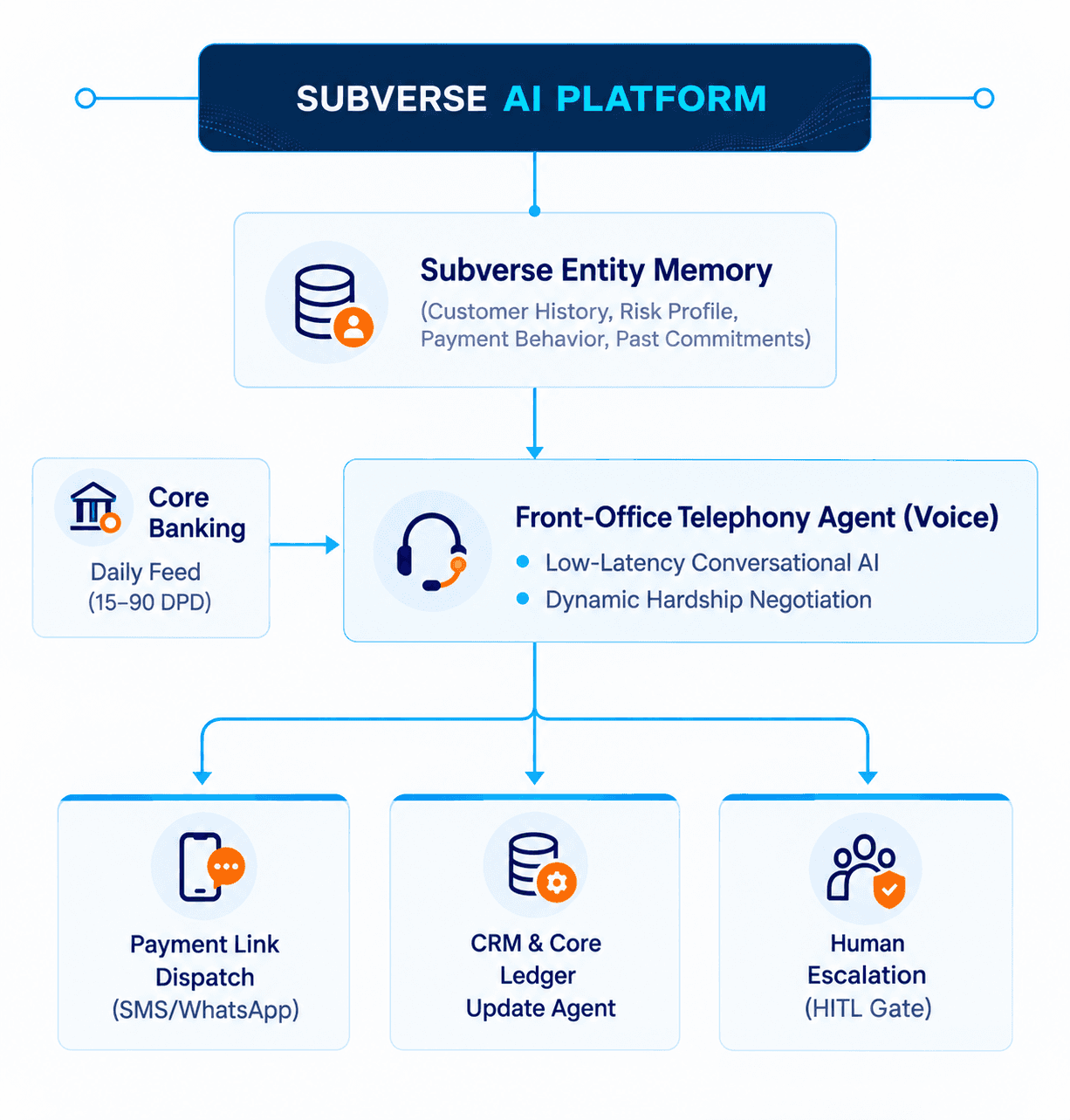
The Autonomous Multi-Agent Workflow
1. Trigger & Data Ingestion: The bank’s core processing ledger pushes a daily delta feed of delinquent accounts to Subverse AI via secure webhook triggers.
2. Context Retrieval via Subverse Entity Memory: Before initiating outreach, Subverse AI queries its Entity Memory store for the specific borrower. It synthesizes account balance, past-due days, historic communication preferences, previous promise-to-pay compliance, and approved negotiation parameters.
3. Outbound Conversational Voice AI Outreach: A Subverse Front-Office Voice Agent places an outbound call using adaptive local caller ID profiles. Upon establishing contact with the verified account holder, the agent conducts a natural, low-latency voice dialogue.
4. Dynamic Settlement Negotiation: The Voice AI agent uses contextual reasoning to negotiate within pre-approved parameters set by the bank's risk committee:
○ Option A: Full immediate payment with fee waivers.
○ Option B: Split payments scheduled across upcoming paydays.
○ Option C: Restructured monthly installment plans.
5. Real-time Payment Dispatch & Commitment Recording: Once an agreement is reached, the agent triggers an automated Back-Office Payment Agent to dispatch a unique, tokenized payment link via WhatsApp or SMS while remaining on the call to assist the customer.
6. Ledger Update & Proactive Scheduling: The platform logs the disposition code, updates the CRM, posts commitment dates to the core ledger, and schedules automated SMS/Voice reminders 24 hours prior to the commitment date.
7. Human-in-the-Loop (HITL) Guardrails: If the customer expresses financial hardship outside approved negotiation limits, flags legal disputes, or requests human intervention, Subverse AI seamlessly transfers the call and full transcript context to a specialist human recovery team.
What System Integrations & Multimodal Architecture Were Implemented?
The deployment integrated Subverse AI directly into the bank's enterprise software stack, combining real-time communication channels with back-office transactional engines.
Enterprise Integrations
● Core Banking Ledger (FIS / Fiserv): Direct REST API connections to query real-time account balances, apply fee credits, and update DPD account statuses.
● Enterprise CRM (Salesforce Financial Services Cloud): Automatic real-time synchronization of contact notes, disposition codes, call transcripts, and audit logs.
● Payment Gateways (ACI Worldwide / Stripe Enterprise): Tokenized payment link generation supporting instant ACH, debit card processing, and digital wallets.
Multimodal Processing Pipelines
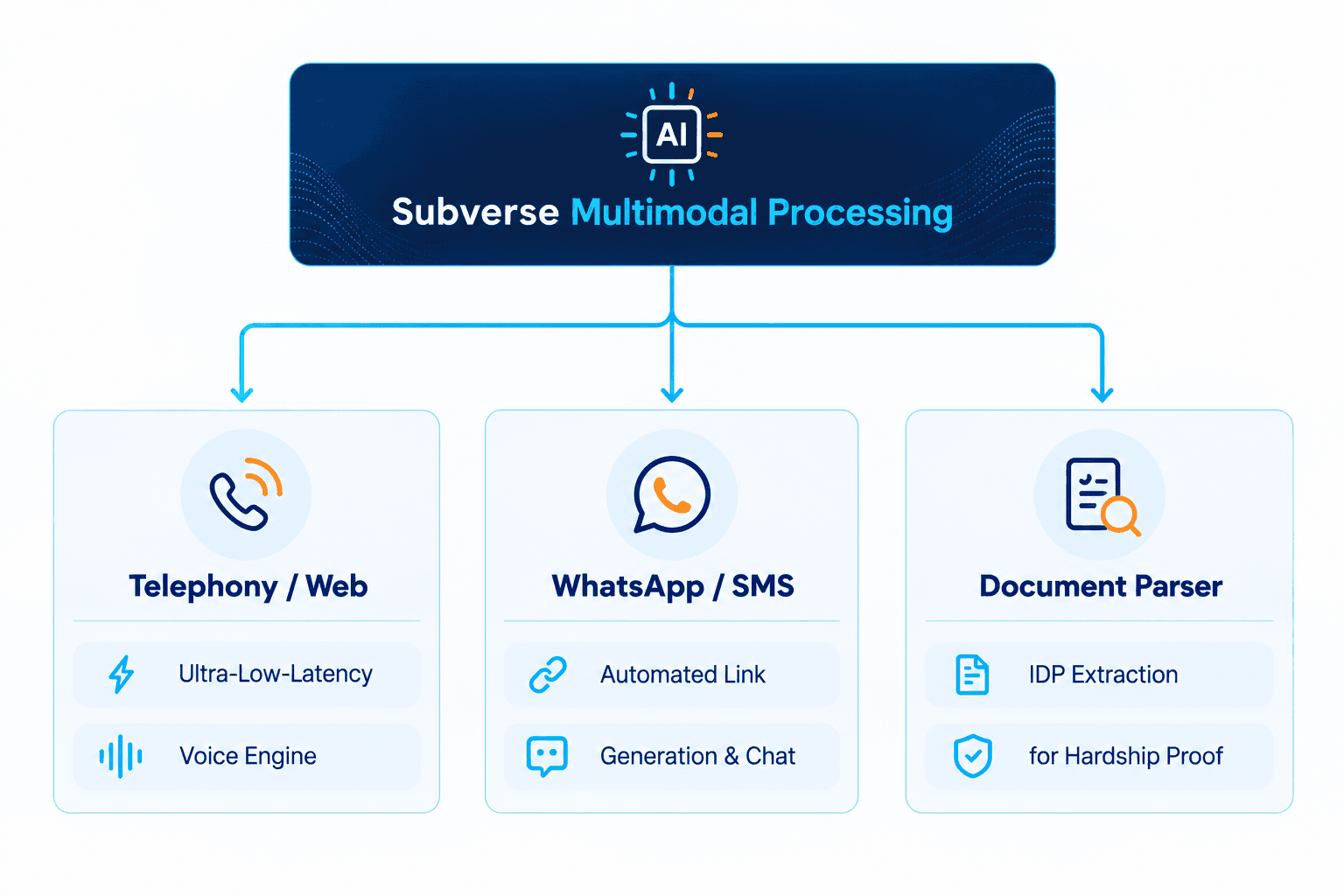
● Telephony Infrastructure: SIP trunking integration with custom ultra-low-latency speech-to-text (STT) and text-to-speech (TTS) engines tuned for financial terminology.
● Multimodal Messaging: Automated orchestration across WhatsApp Business API and SMS channels for immediate, interactive payment link delivery during call sessions.
● Intelligent Document Processing (IDP): Back-office vision models process incoming borrower hardship forms, pay stubs, or bank statements uploaded via mobile chat links to validate restructuring eligibility.
Traditional Approach vs. Subverse Autonomous AI Workflow
Performance Parameter | Legacy Manual / Predictive Dialer | Subverse Autonomous AI Workflow |
Right-Party Contact Rate | 11.4% (Subject to spam blocks) | 28.6% (Dynamic timing & multi-channel) |
Cost Per Recovered Dollar | $0.28 per dollar recovered | $0.09 per dollar recovered |
Average Call Handle Time | 8.5 minutes (Manual data entry) | 2.2 minutes (Instant automation) |
Negotiation Flexibility | Static rigid scripts; high escalation rate | Dynamic AI negotiation within risk bounds |
PTP Follow-up Execution | Manual reminder tasks (frequently missed) | 100% automated multi-channel scheduling |
Audit & Compliance | Spot-check auditing (5–10% of calls) | 100% real-time automated compliance checks |
What Was the Business Impact and KPI Improvement?
Within 90 days of full deployment across the bank’s 15–90 DPD credit card and personal loan portfolios, Subverse AI yielded measurable financial and operational gains:
Cost & Efficiency Metrics
● 68% Reduction in Cost Per Collection: Decreased reliance on third-party collection agencies and reduced manual call center overhead.
● 4.5x Operational Capacity Expansion: Handled over 450,000 delinquent account interactions monthly without increasing FTE headcount.
● $14.2M Additional Annualized Recovery: Recovered significant capital from accounts that previously rolled into late-stage default.
Speed & SLA Metrics
● Instant Payment Resolution: Reduced the average time-to-promise execution from 4 days to less than 12 minutes via live voice-to-SMS payment link dispatch.
● Zero System Update Lag: 100% real-time synchronization between Voice AI dispositions, Salesforce records, and core banking ledgers.
Quality & CSAT Metrics
● 42% Increase in Promise-to-Pay (PTP) Conversion: Personalized negotiation strategies drove higher commitment rates among borrowers.
● 58% Increase in Right-Party Contact Rates: Machine-learning-driven call timing optimized contact success.
● 99.9% Regulatory Compliance Rate: Complete adherence to FDCPA, TCPA, and internal bank consumer protection policies verified by automated speech auditing.
Frequently Asked Questions (FAQ)
How does Subverse AI ensure compliance with FDCPA and TCPA rules?
Subverse AI enforces system-level guardrails regulating call timing, daily attempt caps, dynamic consent verification, and required disclosure language. Every call is automatically transcribed, evaluated against compliance rulebooks, and stored in an immutable audit log.
What happens when a borrower asks to speak with a human agent?
Subverse AI utilizes real-time intent recognition. If a customer requests a human representative or expresses severe hardship, the system executes an immediate warm transfer to a specialized collections agent, passing full conversation transcripts and Entity Memory context.
How does the Voice AI handle dynamic payment negotiations safely?
The bank defines strict policy matrices within Subverse AI's orchestration layer. The AI negotiates payment plans, settlement discounts, or fee waivers dynamically based on borrower risk profiles, but cannot exceed pre-approved policy parameters without Human-in-the-Loop authorization.
Can Subverse AI integrate with proprietary or legacy core banking platforms?
Yes. Subverse AI supports cloud and hybrid deployments. It connects to legacy enterprise architecture using secure REST APIs, webhooks, database connectors, or RPA bots, requiring no overhaul of underlying core banking systems.
Table of Content
More Insights