Sep 1, 2026
Scale proactive policyholder retention with multi-agent voice AI, dynamic channel orchestration, and real-time core system integration.

A Tier-1 personal lines auto and property insurer was losing over $18M annually due to policy lapses caused by manual call center bottlenecks and static email campaigns. By deploying Subverse AI, an autonomous multi-agent orchestration platform, the carrier automated proactive lapse-risk detection, personalized voice outreach, dynamic coverage Q&A, and payment link distribution. This end-to-end workflow increased overall policy renewal conversions by 38%, boosted contact reach rates to 82%, and reduced the cost per renewal from $45 to under $6, while routing high-value accounts directly to licensed agents.
What Operational Challenges Was the Enterprise Facing?
The client, a leading Tier-1 personal and commercial lines carrier managing over 4.5 million active policyholders, faced mounting retention pressures. Legacy renewal workflows relied heavily on outbound call centers, physical mailers, and generic email blasts.
These legacy methods generated major operational bottlenecks across three main areas:
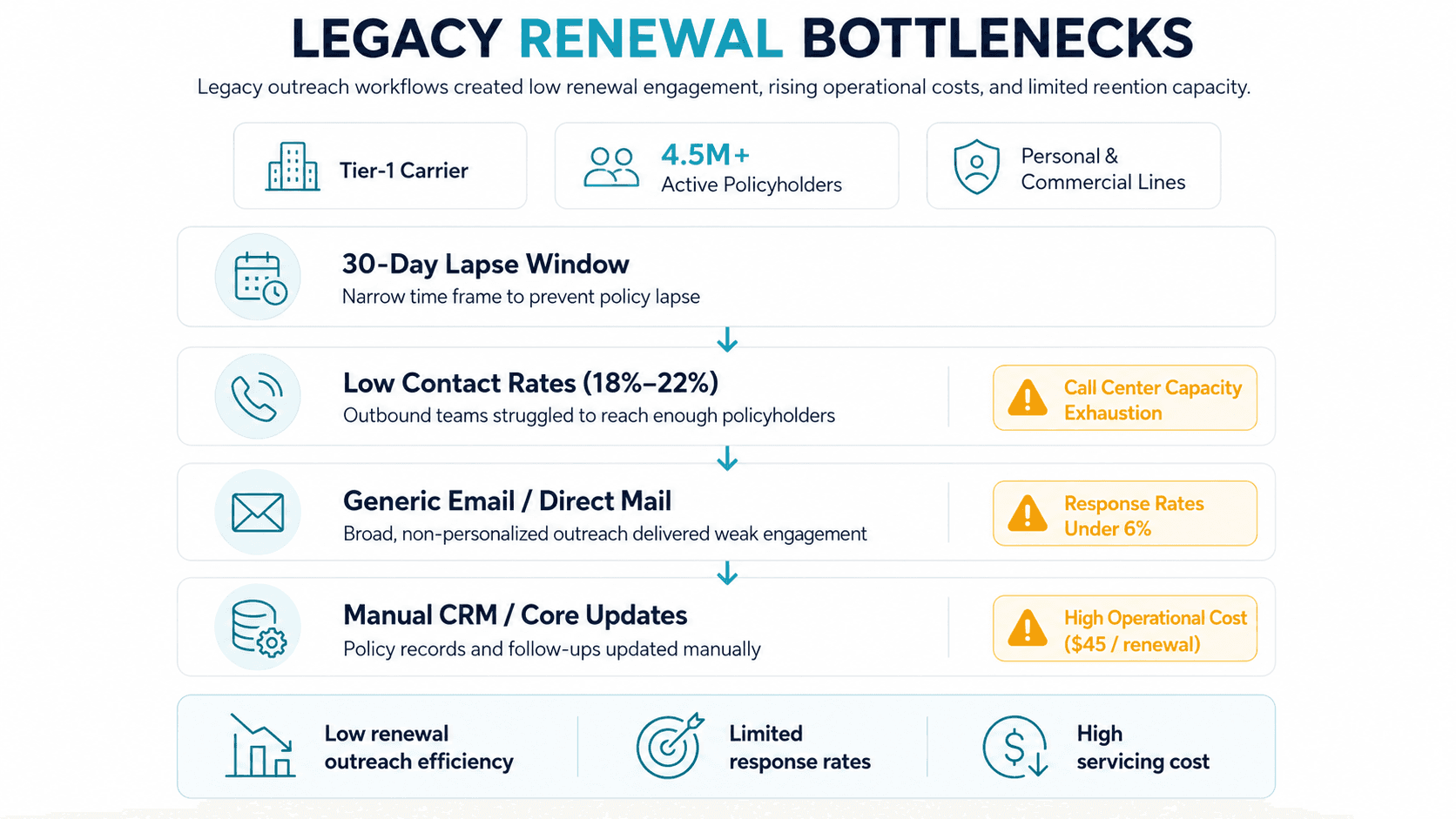
High Cost and Limited Outreach Capacity
Outbound human agents could only reach 18% to 22% of policyholders approaching their 30-day renewal window. Escalating labor costs pushed the average manual cost per renewal to $45, limiting high-touch outreach to top-tier policyholders while leaving mid-tier accounts underserved.
Ineffective Channel Conversion
Generic batch email blasts and physical notices produced response rates below 6%. Policyholders frequently missed payment deadlines not due to intent to cancel, but due to friction in reaching an agent to address minor premium or coverage adjustments.
Disconnected Customer Context and Delayed CRM Updates
When policyholders did call back, agents lacked unified interaction history across billing, claims, and policy administrative systems. Repetitive questioning frustrated policyholders, driving preventable cancellations and increasing overall customer churn.
How Did Subverse AI Solve the Problem? (The Solution & Agent Flow)
Subverse AI deployed an autonomous multi-agent workflow that actively manages policy renewals from lapse-risk identification to post-payment confirmation. The platform orchestrated specialized Front-Office and Back-Office AI Agents while maintaining unified Entity Memory for every policyholder.
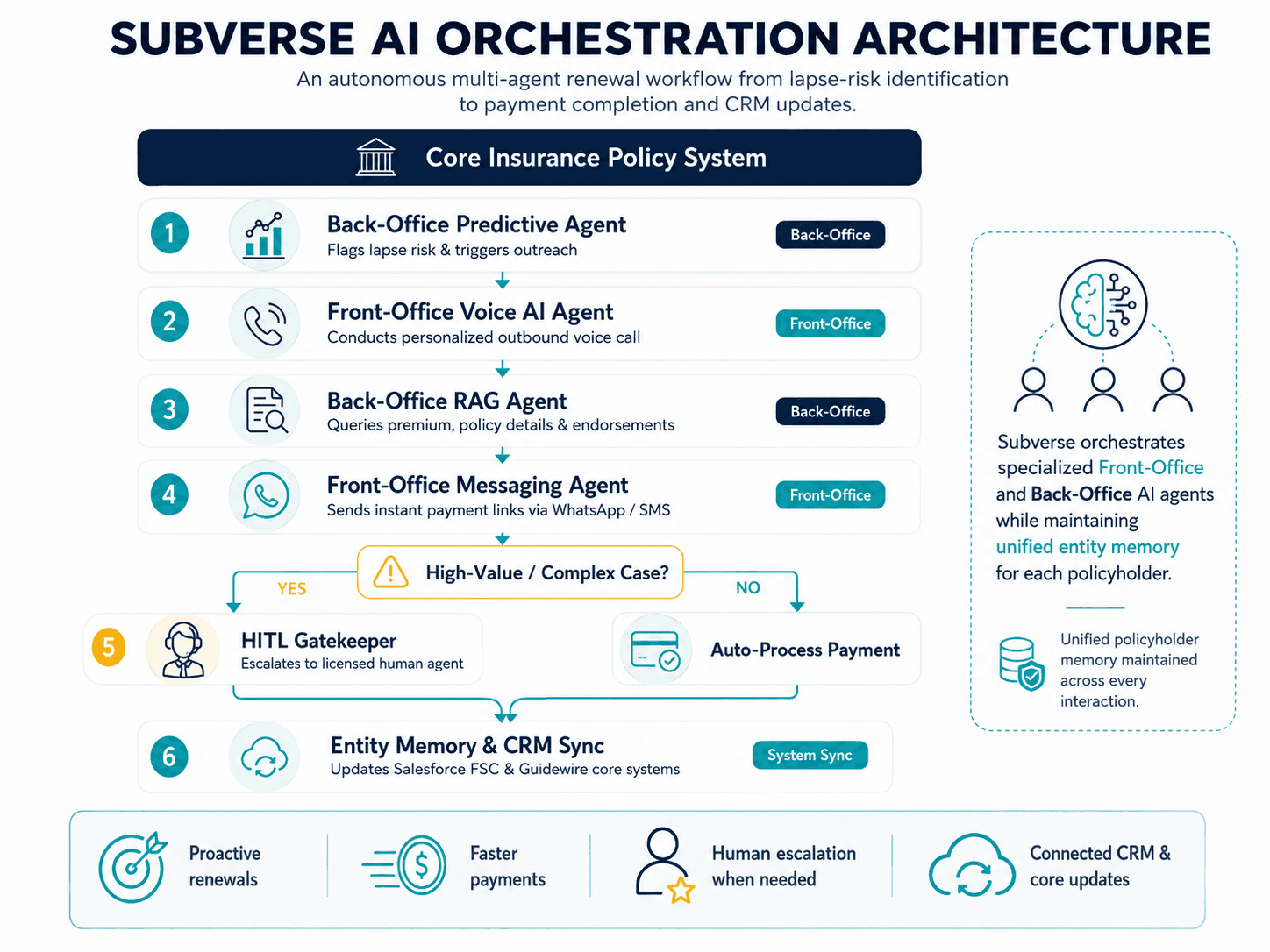
1. Predictive Lapse Risk Triggering (Back-Office Risk Agent)
60 days prior to policy expiration, a Back-Office Predictive Agent analyzes policyholder activity, billing preferences, historical claims, and interaction frequency. Customers identified as medium-to-high lapse risks are queued for proactive engagement through Subverse's scheduling engine.
2. Proactive Voice Outreach (Front-Office Voice AI Agent)
Subverse's Front-Office Voice AI initiates personalized, TCPA-compliant outbound phone calls. The agent speaks in natural language, introduces itself, informs the policyholder of the upcoming renewal date, and offers to review updated rate breakdowns or address coverage concerns.
3. Dynamic Knowledge Retrieval & Policy Verification (Back-Office RAG Agent)
When policyholders ask specific questions (e.g., "Why did my auto premium increase by $12?"), the Voice Agent prompts a Back-Office RAG Agent. This agent queries the underlying core policy administration system (e.g., Guidewire PolicyCenter) to retrieve endorsement details and explain rate changes instantly.
4. Omnichannel Renewal Intent Capture & Payment Link Delivery
Once the customer confirms intent to renew, the Front-Office Agent generates a secure, localized payment link via webhook integrations. The link is dispatched mid-call or immediately post-call through WhatsApp or SMS based on the policyholder's preferred communication channel.
5. Human-in-the-Loop (HITL) Escalation for High-Value Accounts
If the policyholder holds a high-net-worth commercial account, requests a policy endorsement beyond autonomous bounds, or exhibits high churn risk during the call, the workflow triggers a Human-in-the-Loop (HITL) safety gate. The platform transfers the call live or schedules an immediate task for a licensed account manager.
6. Stateful Entity Memory & Core CRM Synchronization
Throughout the interaction, Subverse’s Entity Memory updates the policyholder's persistent profile. Full voice transcripts, intent scores, payment status, and updated communication preferences are automatically synced back to Salesforce Financial Services Cloud and Guidewire.
What System Integrations & Multimodal Architecture Were Implemented?
Subverse AI acted as the central orchestration layer, integrating legacy insurance core systems with modern communication endpoints.

Core Enterprise Integrations
● Policy Administration Systems (PAS): Guidewire PolicyCenter and Duck Creek APIs for fetching live coverage data, premium variations, and policy status updates.
● Customer Relationship Management (CRM): Salesforce Financial Services Cloud (FSC) for real-time contact creation, activity logging, and agent task assignment.
● Telephony & Messaging Gateways: Twilio Programmable Voice with custom SIP trunking for low-latency audio processing, alongside WhatsApp Business API and SMS gateways.
● Payment Processors: PCI-compliant integrations with Stripe and BillingTree for instant mobile premium collection.
Multimodal Data Processing
● Voice Audio Streaming: Real-time speech-to-text (STT) and text-to-speech (TTS) pipelines achieving sub-600ms latency for seamless voice conversations.
● Intelligent Document Processing (IDP): Automated generation and parsing of renewal schedules, endorsement forms, and dynamic PDF declaration pages sent directly to policyholders during messaging interactions.
Traditional Approach vs. Subverse Autonomous AI Workflow
Process Parameter | Traditional Manual/Batch Workflow | Subverse Autonomous AI Workflow |
Outreach Capacity | Limited by call center staff capacity (~200 calls/agent/day) | Fully scalable (100,000+ simultaneous voice interactions) |
Policyholder Reach Rate | 18% – 22% (Static dialing lists and batch emails) | 82% (Proactive scheduling across Voice, WhatsApp, and SMS) |
Response Latency | 24 – 48 hours for agent follow-ups | Immediate (Sub-second RAG retrieval during live voice calls) |
Average Cost per Renewal | $45.00 (High human labor and agent overhead) | $6.20 (Fully orchestrated autonomous execution) |
Context Retention | Fragmented across legacy systems and siloed notes | Continuous, stateful Entity Memory across all touchpoints |
Human Agent Involvement | 100% of renewal calls handled manually | Targeted HITL routing only for high-value/complex accounts |
Data Synchronization | Manual batch updates to core CRM (24-hour lag) | Instant, event-driven sync via webhooks and REST APIs |
What Was the Business Impact and KPI Improvement? (Impact & Metrics)
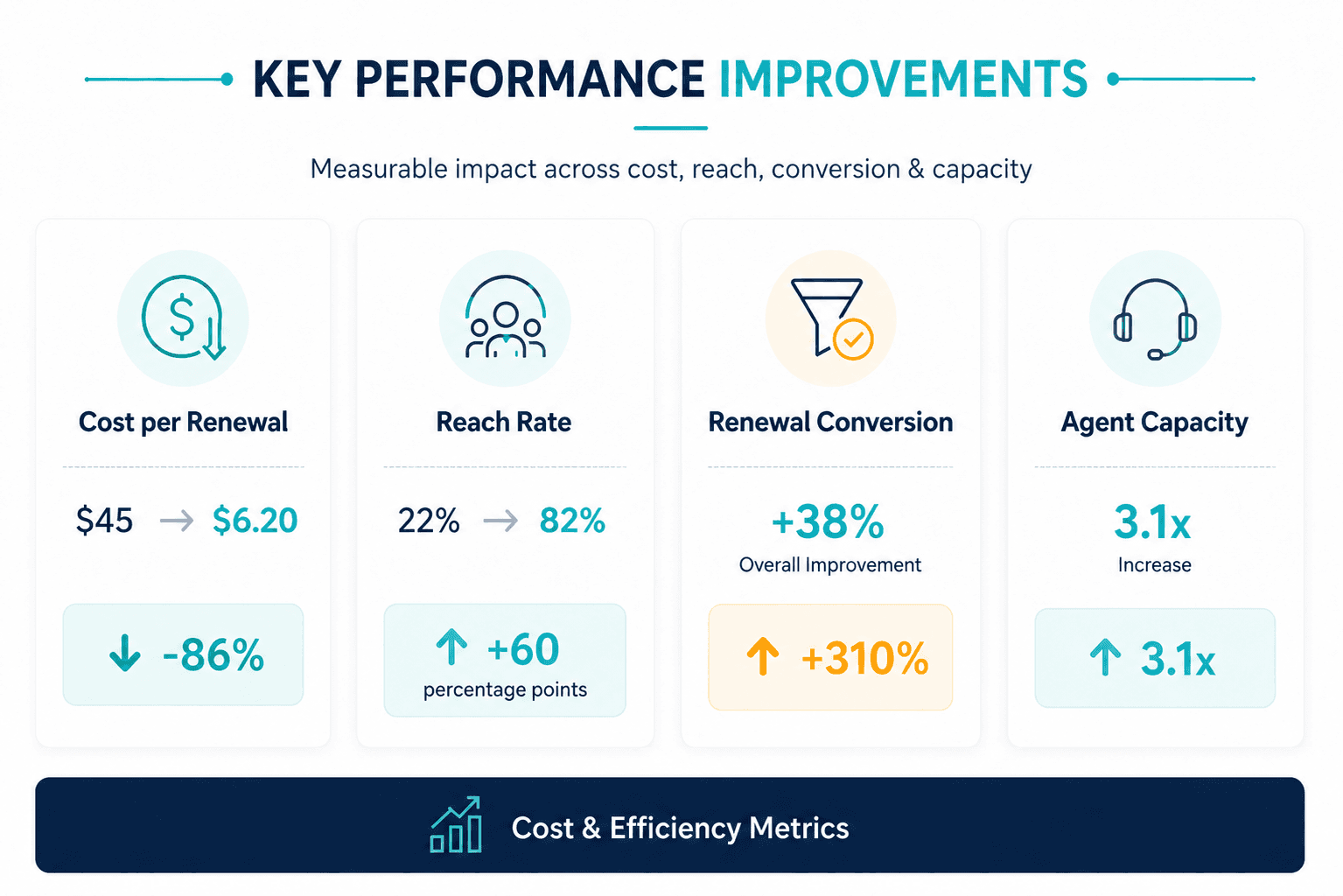
Deploying Subverse AI transformed the carrier’s renewal retention rates, operational overhead, and overall agent productivity within 90 days of implementation.
Cost & Efficiency Metrics
● 86% Reduction in Cost per Renewal: Decreased average retention execution costs from $45.00 to $6.20 per renewed policy.
● 310% Increase in Licensed Agent Productivity: Human agents spent 100% of their time on high-margin, complex commercial policies and retention escalations rather than routine reminders.
Speed & SLA Metrics
● 82% Policyholder Contact Rate: Reached policyholders within 5 days of their renewal window across voice and messaging channels.
● 3-Minute Renewal Processing Time: Reduced average renewal completion time from 4 days to under 3 minutes for policyholders using automated payment links.
Quality & Customer Experience Metrics
● 38% Lift in Renewal Conversions: Overall policy retention increased by 38% across the targeted mid-market auto and home segments.
● 4.7/5 CSAT Score: Policyholders highlighted the convenience of resolving renewal questions during a single short call and completing payment via WhatsApp.
Frequently Asked Questions (FAQ)
How does AI identify insurance customers at risk of policy lapse?
Subverse AI analyzes billing records, claims activity, interaction history, and policy expiration dates. By executing predictive back-office agents, the platform flags high-lapse-risk policyholders 60 days before expiration, dynamically triggering automated voice and messaging workflows to proactively re-engage customers before churn occurs.
Can Subverse AI handle complex policy questions during a live voice call?
Yes. Subverse AI integrates back-office RAG agents connected to policy documents, underwriting rules, and core ERP databases. During a voice call, the conversational agent retrieves coverage specifics, endorsement changes, and premium breakdown details in sub-second latency to answer customer questions accurately.
How are high-value insurance customers escalated to human agents?
When high net-worth accounts or complex policy modifications are identified, Subverse AI enforces a Human-in-the-Loop (HITL) gate. The agent transfers the live call or schedules a priority follow-up, passing full conversational transcripts and updated entity memory to the assigned account representative's CRM.
Is Subverse AI compatible with core insurance systems like Guidewire?
Subverse AI features a Bring Your Own Agent/Model (BYOM) framework and robust REST/GraphQL webhooks. It seamlessly integrates with Guidewire, Duck Creek, Salesforce Financial Services Cloud, and custom legacy cores to fetch policy terms, update payment status, and synchronize records instantly.
How does entity memory improve insurance renewal conversion rates?
Entity memory maintains continuous context across channels and sessions for each policyholder. If a customer discusses coverage over a voice call and later clicks a WhatsApp link, the platform retains their preferences, specific queries, and intent, delivering a hyper-personalized experience without forcing repetitive answers.
Table of Content
More Insights

