Sep 1, 2026
Transform slow, manual underwriting into real-time, multi-agent risk evaluation and instant policy binding at scale with Subverse AI.

A Tier-1 national auto insurer modernized its legacy underwriting architecture by deploying Subverse AI to orchestrate end-to-end autonomous risk evaluation. By coordinating front-office conversational AI agents with back-office Intelligent Document Processing (IDP) agents, Subverse AI automated motor vehicle record (MVR) ingestion, prior loss verification, and dynamic risk scoring. The platform elevated Straight-Through Processing (STP) rates from 18% to 78%, compressed underwriting cycle times from 4 days to under 3 minutes, and generated $6.4M in annual operational savings while maintaining human oversight through automated Human-in-the-Loop (HITL) safety gates.
What Operational Challenges Was the Enterprise Facing?
Apex National Insurance (anonymized), a Tier-1 carrier issuing over 1.2 million personal and commercial auto policies annually across 50 states, faced severe operational bottlenecks in its core underwriting workflows. As consumer expectations shifted toward instant digital fulfillment, legacy systems and human-dependent review channels created severe margin erosion and high customer churn.

1. Manual Document Ingestion and High Processing Errors
Applicants submitted proof of prior coverage, vehicle titles, modification receipts, and utility bills in unstructured PDF or image formats. Human underwriters spent up to 25 minutes per application manually re-keying data into their Policy Administration System (PAS), yielding a 14% keying error rate that caused quote inaccuracies and downstream billing errors.
2. High Application Friction and Abandonment Rates
Evaluating driving histories required manual queries across state Motor Vehicle Record (MVR) databases, C.L.U.E. (Comprehensive Loss Underwriting Exchange) loss reports, and credit-based insurance scoring engines. This fragmented verification process stretched overall cycle time to 3–5 business days, triggering a 34% quote abandonment rate as applicants turned to direct-to-consumer digital competitors.
3. Low Straight-Through Processing (STP) Rates
Because legacy rule engines lacked contextual understanding and adaptive logic, even minor variances—such as a typo in a street address or an unreadable vehicle registration photo—flagged the file for manual intervention. As a result, the enterprise struggled with a low 18% STP rate, overwhelming underwriter teams with low-complexity, routine applications.
4. Underwriting Leakage and Fraud Exposure
Inconsistent manual reviews across regional underwriting hubs led to underwriting leakage—offering preferred tier rates to non-standard risk profiles due to missed traffic violations or unverified commercial usage flags. Manual checks failed to spot subtle cross-application fraud patterns across household entities.
How Did Subverse AI Solve the Problem?
Subverse AI implemented a multi-agent orchestration framework designed to handle the entire underwriting lifecycle - from omnichannel application intake to real-time risk rating and policy binding. By statefully coordinating specialized front-office and back-office agents, Subverse AI transformed the manual pipeline into a fully automated, event-driven workflow.
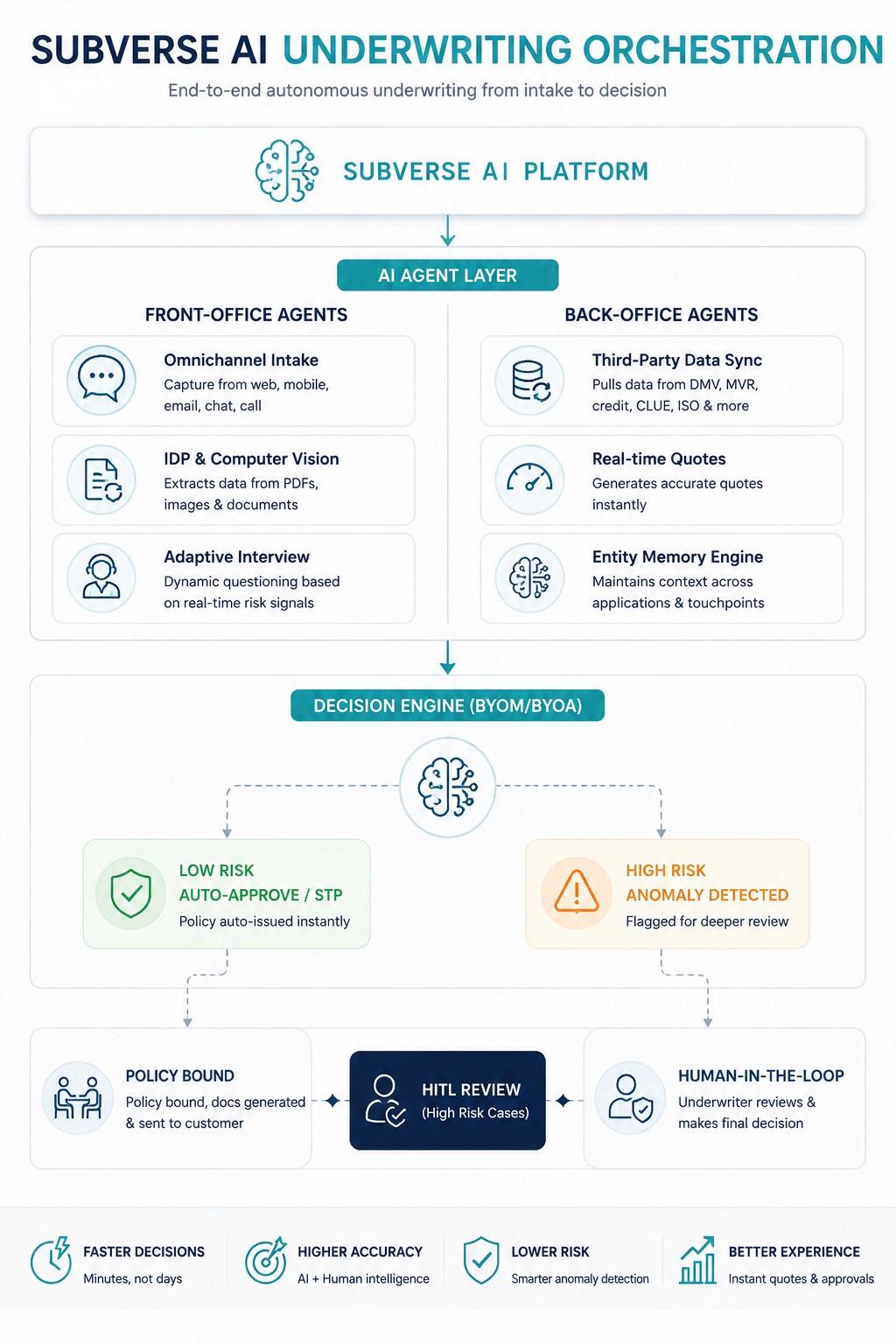
Step 1: Omnichannel Intake & Adaptive Interrogation (Front-Office Agent)
The interaction begins when a prospect initiates an application via Web Chat, WhatsApp, Email, or Interactive Telephony Voice AI. Subverse AI’s Front-Office Agent dynamically adapts the interview flow based on real-time responses. If a driver mentions using their vehicle for ridesharing, the agent immediately requests specific endorsements and additional driver details without forcing the applicant through redundant questions.
Step 2: Intelligent Document & Multimodal Processing (Back-Office IDP Agent)
The applicant uploads driver’s license photos, vehicle registrations, and proof of prior insurance documents. Subverse AI’s Back-Office Vision Agent executes OCR and layout-aware multimodal extraction, validating document authenticity, checking for digital manipulation, and parsing field parameters (e.g., VINs, driver's license numbers, policy expiration dates) directly into structured JSON payloads.
Step 3: Automated Data Enrichment & Verification Webhooks
Once basic identity and vehicle parameters are established, Subverse AI automatically dispatches asynchronous webhook triggers to external verification endpoints:
● State DMV gateways for real-time MVR records (checking suspensions, moving violations, and DUI convictions).
● LexisNexis C.L.U.E. DB for 7-year loss history and claims frequency.
● Credit bureaus for credit-based auto insurance scores.
● NICB (National Insurance Crime Bureau) databases for salvage title flags and theft records.
Step 4: Entity-Level Memory & Cross-Application Profiling
Subverse AI evaluates incoming data against its deep Entity Memory layer. The platform links applicants to persistent entity graphs representing drivers, vehicles, garaging addresses, and prior household policies. Entity Memory flags hidden risk vectors—such as an unlisted high-risk driver residing at the same garaging address or a vehicle previously associated with a fraudulent claim under a different name.
Step 5: Risk Scoring via BYOM Framework & Decision Logic
Enriched data is passed to the carrier's proprietary risk scoring algorithms via Subverse AI’s Bring Your Own Model (BYOM) architecture. The system calculates composite loss ratios, assigns appropriate rating tiers (Preferred, Standard, Non-Standard), and sets precise deductible structures.
Step 6: Human-in-the-Loop (HITL) Exception Routing
If the policy evaluation encounters complex edge cases—such as a major moving violation within the last 12 months, a severe vehicle modification, or a suspected document anomaly—the agent workflow pauses. Subverse AI automatically routes the file to a senior human underwriter via an enterprise dashboard, presenting a pre-digested summary, risk flags, and recommended actions. The underwriter’s decision is captured to retrain agent parameters continuously.
Step 7: Dynamic Quote Presentation & Policy Binding
For standard approved applications, the Front-Office Agent generates a personalized quote option set directly in the conversation channel, processes payment via secure PCI-compliant webhooks, sends e-signature links for policy documents, and updates the core Policy Administration System (PAS) in real time.
What System Integrations & Multimodal Architecture Were Implemented?
To deliver end-to-end automation without forcing a complete tech stack overhaul, Subverse AI integrated directly into Apex National Insurance's existing infrastructure via secure REST/GraphQL APIs, webhooks, and enterprise service buses (ESB).
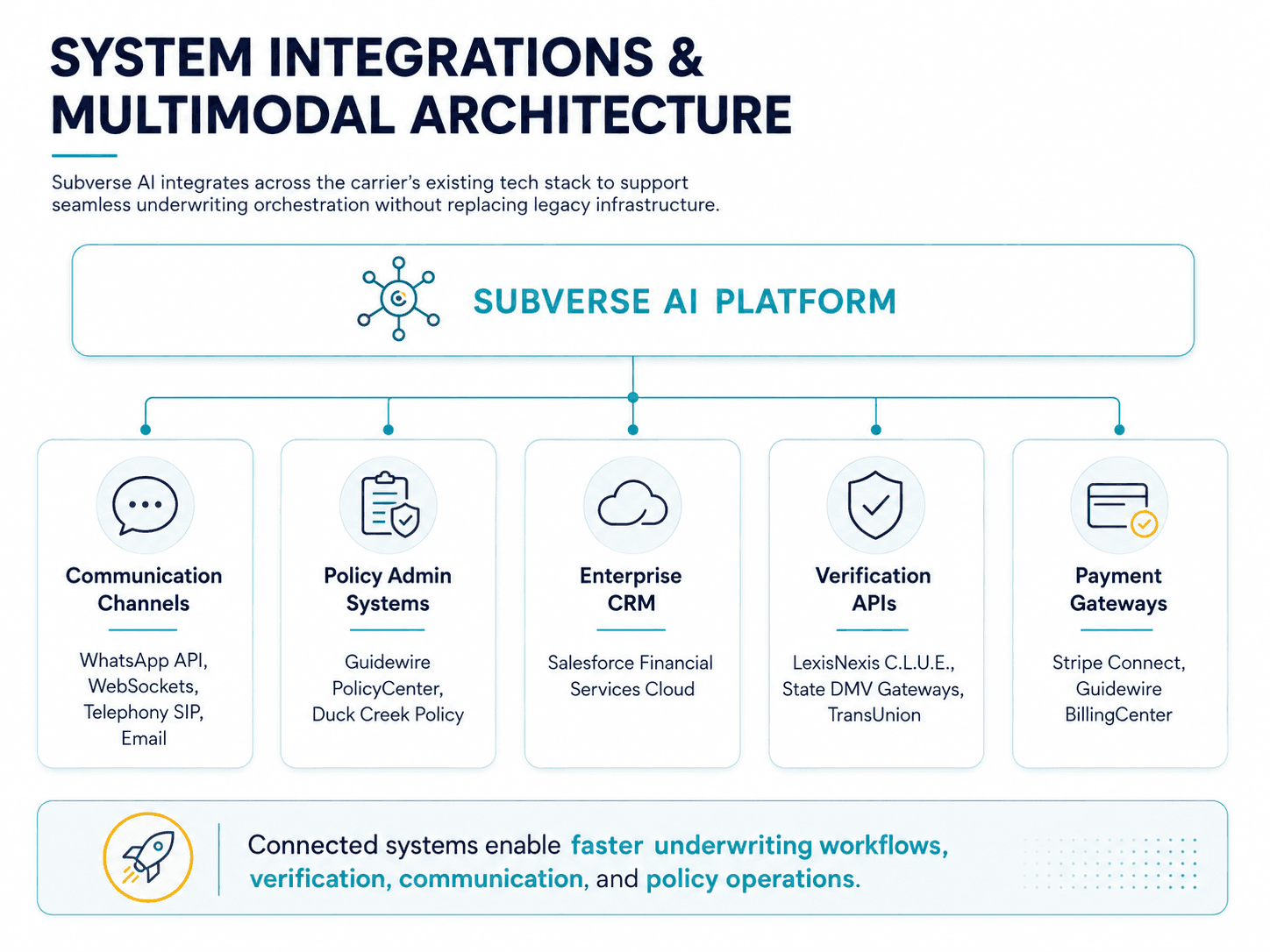
Key Integration Touchpoints:
● Policy Administration Systems (PAS): Native integrations with Guidewire PolicyCenter and Duck Creek Policy for instantaneous policy creation, rating engine calls, and e-policy issuance.
● Customer Relationship Management (CRM): Real-time synchronization with Salesforce Financial Services Cloud, updating lead scores, applicant interactions, and underwriter notes.
● External Verification Services: Bi-directional API connectors to LexisNexis, Verisk, TransUnion, and state DMV databases to fetch MVRs and loss reports within 800 milliseconds.
● Multimodal Data Processing Engine:
○ Computer Vision: Real-time image quality assessment, text identification, and anomaly detection on physical driver's licenses, vehicle registration certificates, and vehicle damage inspection photos.
○ LLM/IDP Document Extractor: Complex PDF parsing capable of extracting multi-page prior policy declarations, recognizing policy limits, liability split structures, and lapsed coverage periods.
○ Voice & Text Conversational AI: Natural Language Understanding (NLU) fine-tuned on insurance terminology across voice telephony, web chat, and WhatsApp channels.
Traditional Approach vs. Subverse Autonomous AI Workflow
Performance Parameter | Traditional / Legacy Underwriting Process | Subverse AI Autonomous Workflow |
Average Processing Time | 3 to 5 business days | 2.5 minutes (End-to-End) |
Straight-Through Processing (STP) | 18% | 78% |
Cost Per Policy Underwritten | $42.00 per policy | $4.80 per policy |
Manual Data Entry Error Rate | 14% | < 0.2% (Automated Extraction) |
Application Abandonment Rate | 34% | 6% |
Fraud Detection Capability | Reactive / Manual sampling | Proactive real-time Entity Memory profiling |
Underwriter Capacity Utilization | 70% time spent on manual data entry | 90% time spent on complex risk review & HITL |
System Scalability | Fixed capacity tied to underwriter headcounts | Scalable to hundreds of quotes per minut |
What Was the Business Impact and KPI Improvement?
Deploying Subverse AI transformed the carrier's underwriting operations from a cost-heavy manual bottleneck into an efficient growth engine.
Cost & Efficiency Metrics
● $6.4M Annual Operational Savings: Drastically cut administrative review labor, manual data re-keying costs, and third-party data query re-runs.
● 88.5% Reduction in Acquisition Cost Per Policy: Lowered underwriter processing costs from $42.00 to $4.80 per bound policy.
● 4.3x Underwriter Productivity Surge: Human underwriters shifted away from routine applications, focusing exclusively on high-value non-standard applications and complex commercial risks.
Speed & SLA Metrics
● 99% Cycle Time Compression: Reduced total elapsed time from initial quote request to bound policy from 96 hours down to 2.5 minutes for standard auto policies.
● 78% Straight-Through Processing (STP): Elevated autonomous approval rates by 60 percentage points, instantly binding nearly four out of five applications.
● 82% Faster HITL Turnarounds: When human intervention was required, underwriters resolved cases in minutes rather than days due to Subverse AI's auto-generated risk synthesis briefs.
Quality & Customer Satisfaction (CSAT) Metrics
● +32 Point NPS Increase: Real-time conversational intake and instant policy binding raised Net Promoter Scores from +28 to +60.
● 82% Reduction in Applicant Drop-Off: Application completion rates surged as underwriting delays were eliminated.
● 41% Decrease in Underwriting Leakage: Precise multimodal verification and entity tracking minimized unrated driver exposure and unverified garaging risk.
Frequently Asked Questions (FAQ)
How does Subverse AI handle high-risk auto insurance applicants?
Subverse AI uses automated risk rules to flag high-risk applicants, such as those with recent DUIs or major moving violations. The platform pauses autonomous processing and routes the application to senior underwriters via a Human-in-the-Loop (HITL) workflow, complete with auto-generated risk summaries.
Can Subverse AI integrate with legacy Policy Administration Systems like Guidewire?
Yes. Subverse AI integrates natively with legacy and modern Policy Administration Systems (PAS) including Guidewire, Duck Creek, and custom backends through REST APIs, webhooks, or secure service buses, enabling real-time data synchronization without replacing core IT infrastructure.
How does the platform maintain regulatory compliance during automated underwriting?
Subverse AI logs every decision, model input, data extraction, and verification output in an immutable audit trail. The platform ensures full compliance with FCRA and state insurance regulations by using explainable AI models and providing clear adverse action reasoning for declined applications.
How does Subverse AI evaluate unstructured documents like vehicle registration images?
Subverse AI uses Back-Office IDP and Computer Vision agents to perform document parsing, OCR, and visual validation. It automatically checks for image tampering, extracts text such as VINs and driver license details, and validates parameters against official database registries.
What is the role of entity memory in auto insurance underwriting workflows?
Subverse AI's Entity Memory tracks context across drivers, vehicles, addresses, and policy histories over time. It identifies non-obvious risk indicators, such as undisclosed household drivers or vehicles linked to prior fraudulent claims, preventing underwriting leakage across channels.
Table of Content
More Insights


