Sep 7, 2026
Deploy an AI-powered credit analyst workforce to orchestrate customer intake, document extraction, financial analysis, and underwriting in minutes.

A Tier-1 commercial and retail financial institution faced operational bottlenecks, taking 7 to 10 days to process loan applications due to manual document extraction, complex financial calculations, and fragmented communication loops. By deploying Subverse AI's multi-agent orchestration platform, the bank transformed its credit underwriting into an autonomous, end-to-end enterprise workflow. Subverse AI orchestrated front-office conversational intake, multimodal IDP back-office agents, financial ratio engines, and risk decisioning agents—reducing loan turnaround time by 85%, cutting processing costs by 62%, and achieving a 92% Straight-Through Processing (STP) rate with Human-in-the-Loop safety checks.
What Operational Challenges Was the Enterprise Facing?
Apex Financial Group (anonymized), a leading regional lender processing over $2.5 billion in annual loan applications, was struggling with scaling its retail and commercial lending operations. As application volumes grew by 40% year-over-year, legacy origination systems and manual workflows created unacceptable operational friction.
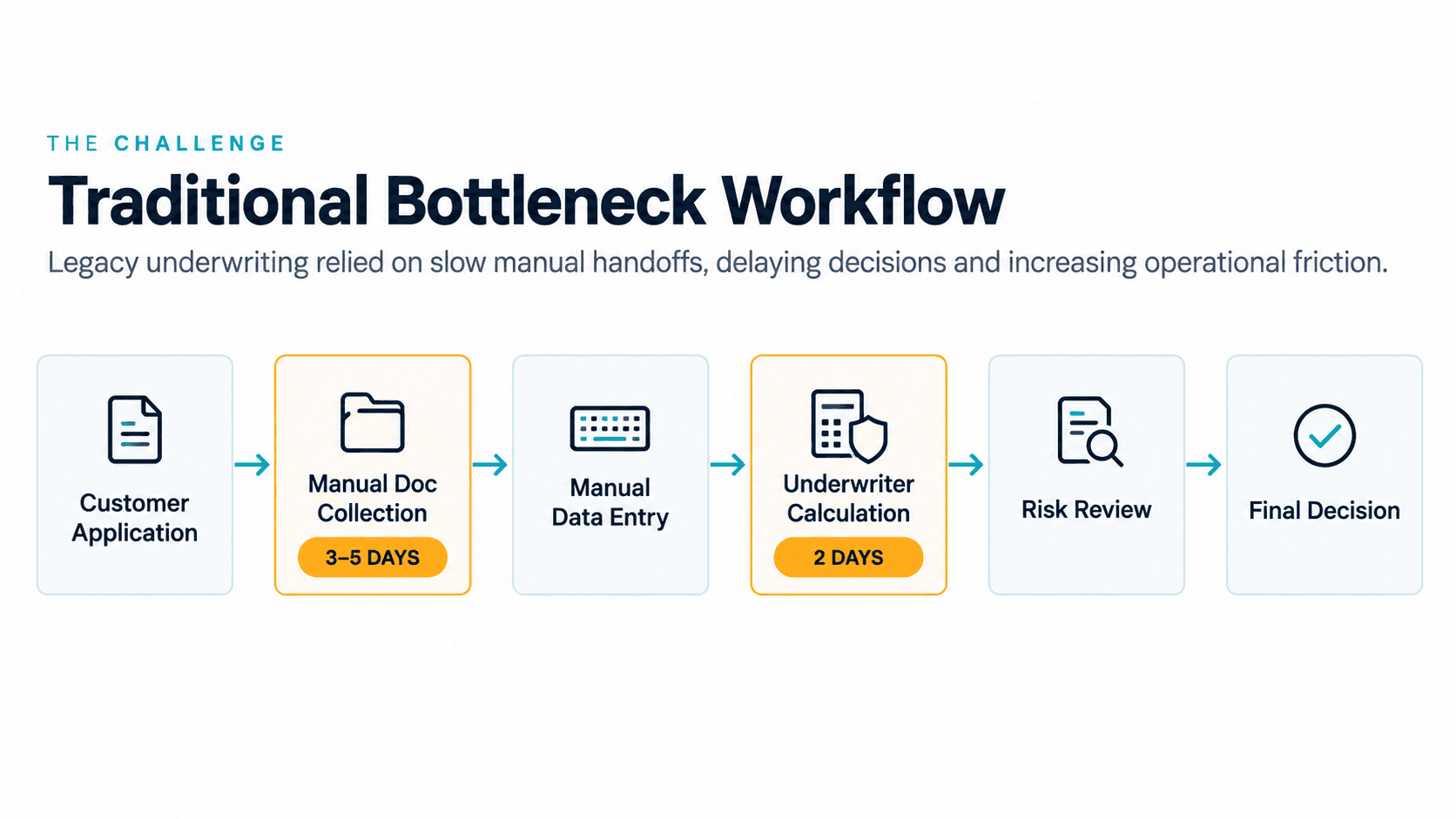
The enterprise identified four primary operational bottlenecks:
1. High Turnaround Times and Severe SLA Delays
Processing a commercial or personal loan required an average of 7 to 10 business days. Manual handoffs between initial customer intake, document verification, credit risk evaluation, and decisioning teams created prolonged idle times during which applicants frequently dropped off or selected competing lenders.
2. Manual Document Extraction and High Error Rates
Credit analysts spent over 60% of their operational hours manually parsing multi-page financial documents, including bank statements, salary slips, GST tax returns, and audited financial statements. Manual data transposition errors led to inaccurate risk scoring and rework cycles.
3. Friction in Missing Document Collection
When applications contained blurry, incomplete, or missing documents, human operations teams initiated manual email or phone follow-ups. This back-and-forth communication extended the origination cycle by an average of 4 business days and resulted in a 38% application abandonment rate.
4. Underwriting Capacity Constraints
Senior credit officers were bogged down by routine administrative tasks—such as calculating Debt-Service Coverage Ratios (DSCR), Debt-to-Income (DTI) metrics, and cash flow trends—limiting their ability to evaluate complex, high-margin commercial loan opportunities.
How Did Subverse AI Solve the Problem?
To solve these challenges, Apex Financial Group implemented Subverse AI, deploying an orchestrated workforce of autonomous front-office and back-office AI agents. Subverse AI allowed the bank to orchestrate complex end-to-end workflows simply by defining operational goals, utilizing custom agent models, and maintaining deep entity-level memory.
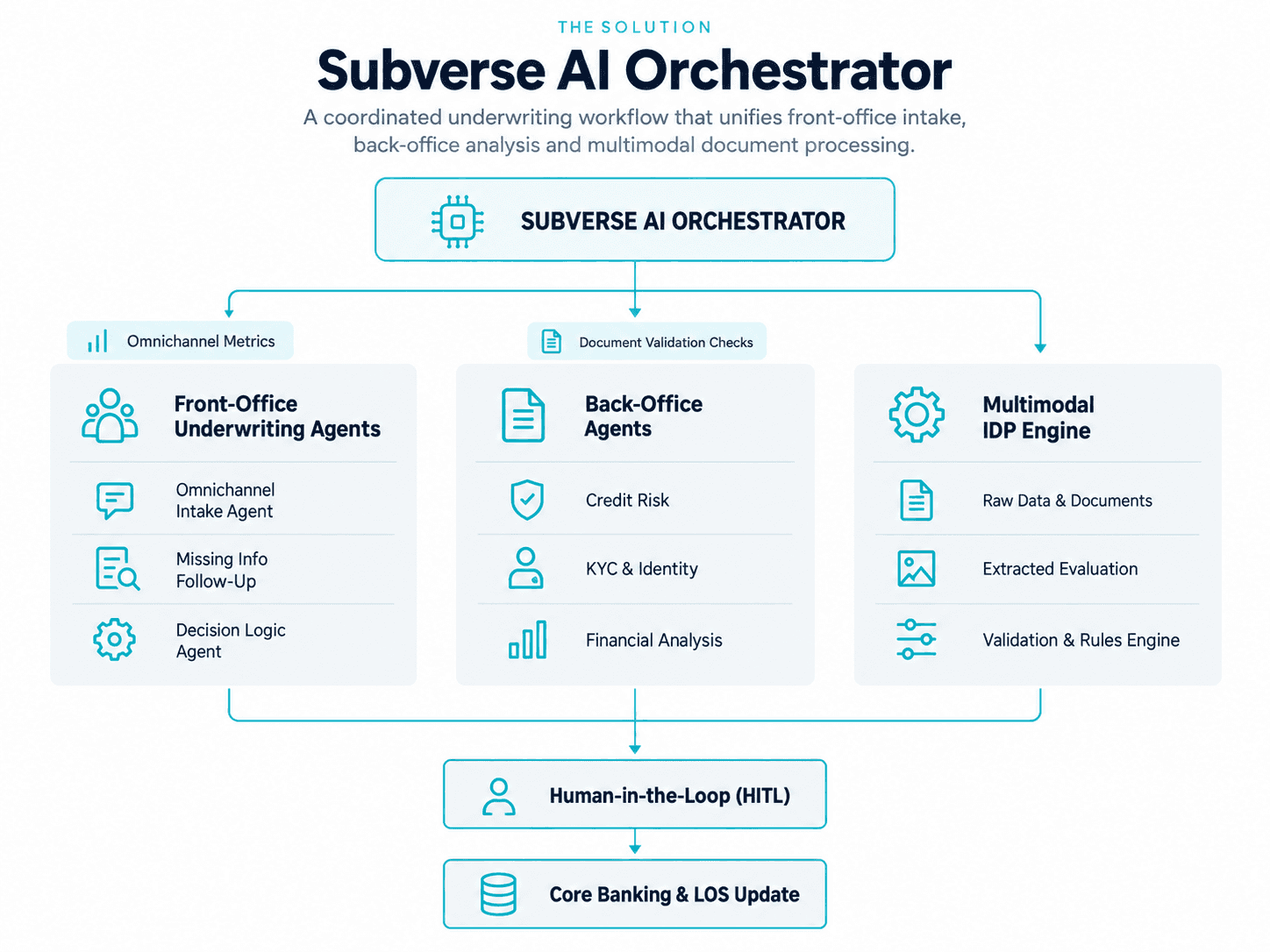
The Autonomous Multi-Agent Workflow
1. Conversational Intake Agent (Front-Office): The intake agent interacts with applicants across Web, WhatsApp, and Mobile App interfaces. It dynamically collects preliminary borrower information, validates stated income, and initiates the loan file.
2. Multimodal Document Processing Agent (Back-Office IDP): Using vision-language models, this agent automatically ingests, classifies, and parses complex uploaded documents—including bank statements, salary slips, GST returns, and tax returns (ITRs)—extracting line-item tabular data with high precision.
3. KYC & Identity Verification Agent (Back-Office): The identity agent runs real-time verification checks against government identity databases, credit bureaus, and AML/PEP sanction lists to validate applicant credentials instantly.
4. Financial Analysis & Ratio Calculation Agent (Back-Office): This agent processes raw extracted financial data to compute debt ratios, cash flow projections, average monthly bank balances, tax compliance indicators, and DSCR metrics in seconds.
5. Credit Risk Assessment Agent (Back-Office): Synthesizing data from credit bureaus, bank statements, and internal scoring models, the risk agent generates an initial risk profile and preliminary loan decision based on configured underwriting policies.
6. Missing Information & Proactive Communication Agent (Front-Office): If a document is missing, low-resolution, or contradictory, this agent proactively contacts the applicant via WhatsApp, Email, or Voice AI to request specific fixes, answering questions and guiding them to completion.
7. Entity Memory & Context Preservation: Subverse AI’s entity memory tracks the context of every applicant over time. Returning customers or multi-product applicants never have to re-upload existing valid documentation or repeat intake steps.
8. Human-in-the-Loop (HITL) Exception Gate: Applications exceeding risk parameters, policy thresholds, or edge-case flags are routed to human credit officers via a unified approval dashboard with pre-summarized risk analysis and supporting evidence.
9. Core Banking / LOS Update & Customer Notification: Upon approval, Subverse AI triggers webhooks to update the Core Banking System and Loan Origination System (LOS), generates loan agreements, and notifies the customer across their preferred channel.
What System Integrations & Multimodal Architecture Were Implemented?
Subverse AI integrated seamlessly with Apex Financial Group’s tech stack without requiring a total overhaul of legacy infrastructure.
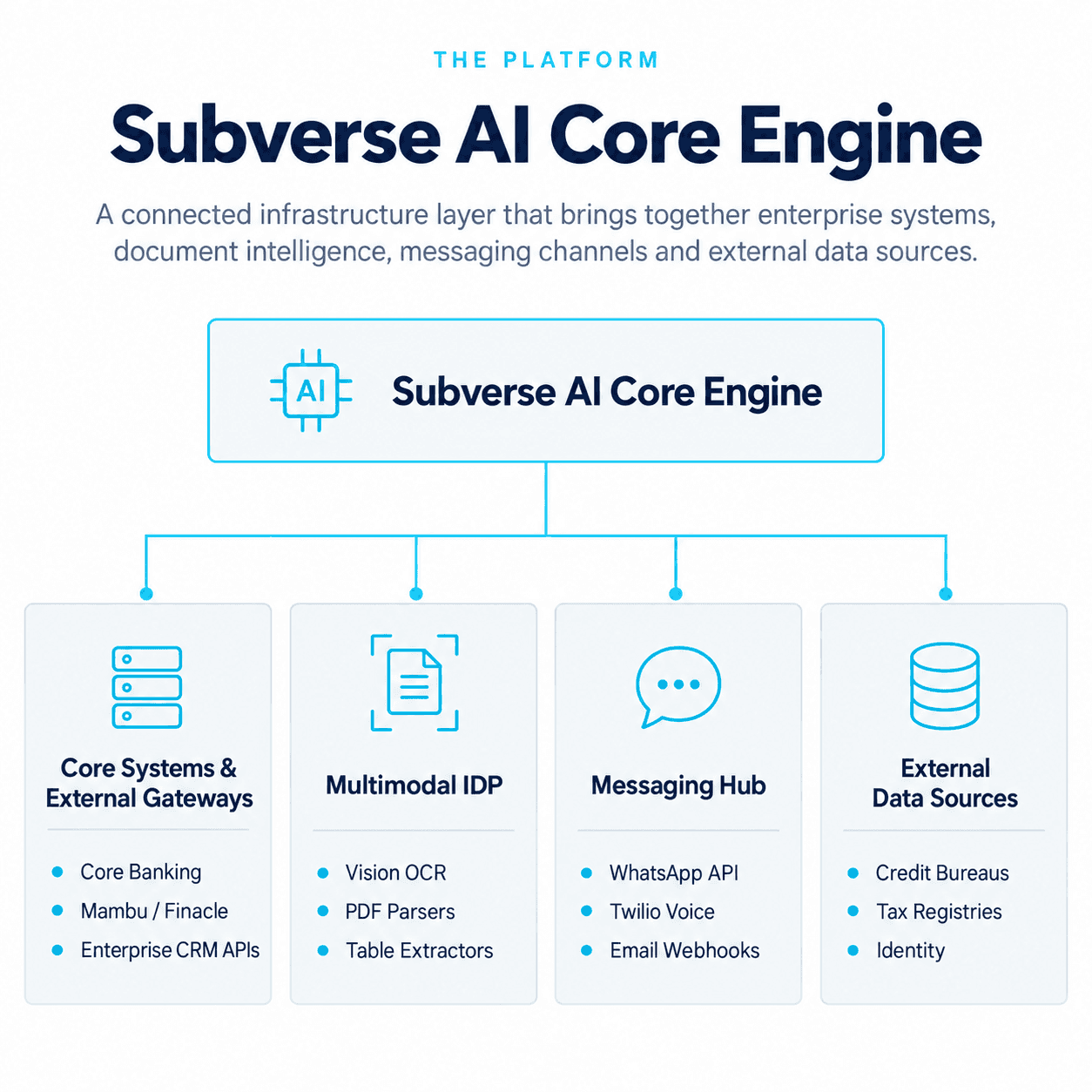
● Core Banking & LOS Integrations: Bi-directional REST API connections to core banking (Finacle, Mambu) and CRMs (Salesforce) to synchronize application statuses, create loan accounts, and push underwriting notes in real time.
● Multimodal Processing Engine: Vision-LLM models capable of scanning structured and unstructured PDFs, hand-signed forms, blurred photo uploads, and complex multi-page financial tables.
● Omnichannel Messaging Hub: Enterprise webhooks connecting WhatsApp Business API, automated Email services, and Voice AI gateways for real-time proactive outreach and status updates.
● Credit Bureau & Verification Gateways: Direct integration with credit registries (Experian, Equifax, TransUnion), government tax portals (GSTIN, IRS), and bank statement aggregator APIs.
Traditional Approach vs. Subverse Autonomous AI Workflow
Performance Parameter | Traditional Manual Workflow | Subverse Autonomous AI Workflow |
Turnaround Time (SLA) | 7 – 10 Business Days | 12 – 15 Minutes (Instant Approval) |
Straight-Through Processing (STP) | 12% | 92% |
Document Verification Cost | $55.00 per application | $3.20 per application |
Data Extraction Accuracy | 81% (Human error-prone) | 99.4% (Multimodal Vision) |
Missing Document Follow-Up | 3 – 5 Days (Manual outreach) | Real-Time (Proactive AI messaging) |
Underwriting Scalability | Linear (Requires hiring analysts) | Infinite Burst Capacity |
Applicant Abandonment Rate | 38% | < 4% |
What Was the Business Impact and KPI Improvement?
By shifting to an autonomous multi-agent underwriting architecture, Apex Financial Group unlocked measurable operational efficiency gains within 90 days of deployment.
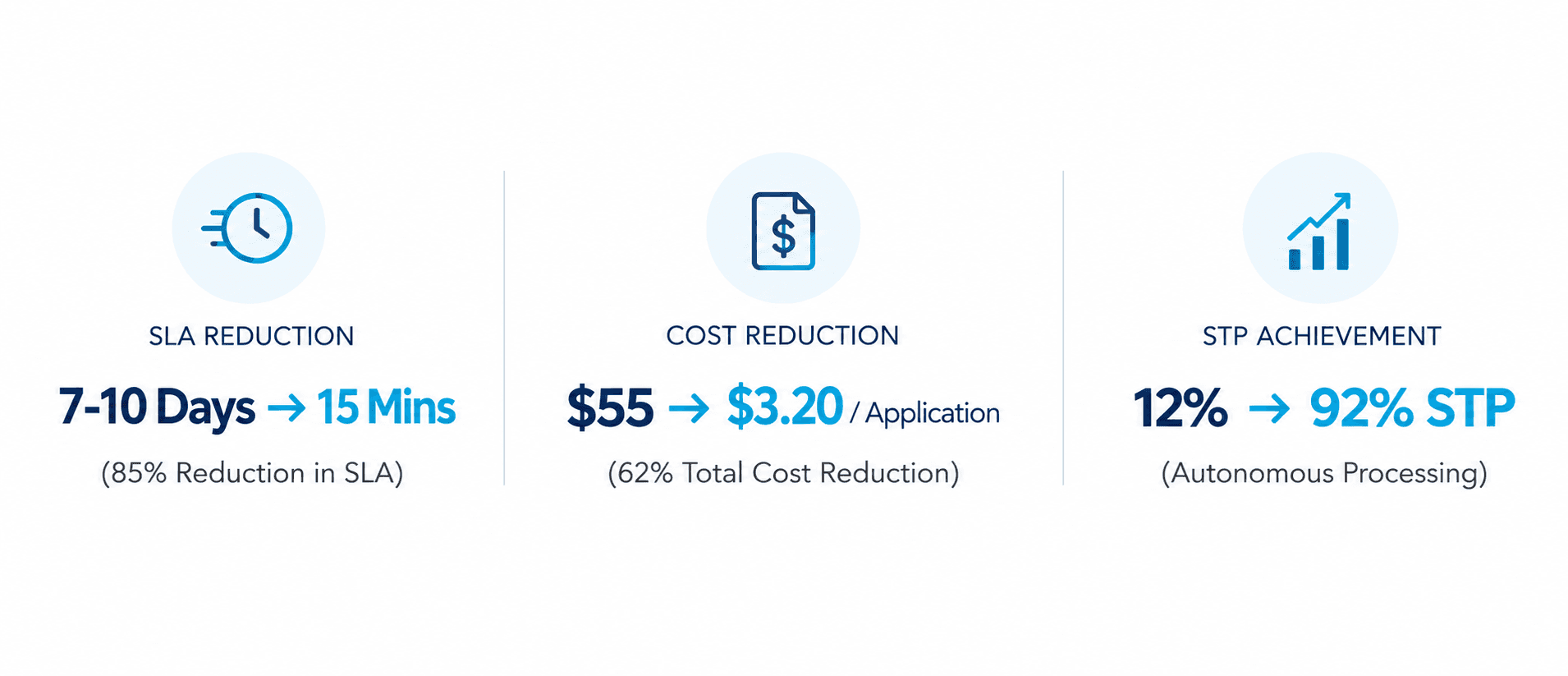
Cost & Efficiency Metrics
● 62% Reduction in Processing Costs: Decreased cost per application from $55.00 to $3.20 through automated data extraction and validation.
● $5.8M Annual Operational Savings: Reallocated over 120,000 hours of manual credit analyst time toward business development and complex commercial underwriting.
● 92% Straight-Through Processing (STP) Rate: Over nine out of ten applications processed end-to-end without requiring human operational manual entry.
Speed & SLA Metrics
● 85% Reduction in Turnaround Time: Decreased overall time-to-decision from 8 days to under 15 minutes for eligible applicants.
● 95% Faster Document Parsing: Reduced document verification and financial ratio calculation time from 24 hours to sub-10 seconds per file.
Quality & CSAT Metrics
● 99.4% Extraction Accuracy: Dramatically reduced underwriting rework and financial miscalculation risks.
● 34% Increase in Conversion Rate: Eliminated application drop-offs by using proactive, real-time follow-ups for missing documents.
● +41 Point Improvement in CSAT: Enhanced borrower satisfaction through instant decisions and multi-channel conversational updates.
Frequently Asked Questions (FAQ)
How does Subverse AI ensure regulatory compliance in credit decisioning?
Subverse AI enforces deterministic rule sets, audit logging, and explainable decision paths. Every automated credit decision generates a compliance report detailing the risk metrics, policy rules evaluated, and source data used, meeting stringent fair lending and banking compliance standards.
What happens when an applicant uploads an unreadable or incomplete document?
The Back-Office IDP Agent detects document issues instantly. It triggers the Front-Office Proactive Communication Agent to contact the borrower via WhatsApp, SMS, or Email, precisely explaining which document is missing or blurry and providing a direct link to re-upload.
Can Subverse AI integrate with legacy core banking and Loan Origination Systems (LOS)?
Yes. Subverse AI features a flexible integration layer supporting REST APIs, webhooks, database connectors, and custom middleware. It seamlessly exchanges data with legacy LOS, core banking engines, and custom enterprise CRMs without requiring underlying code modifications.
How does Human-in-the-Loop (HITL) work in autonomous loan underwriting?
When an application triggers custom threshold alerts—such as elevated credit risk, high loan amounts, or ambiguous tax documents—Subverse AI pauses automated processing. It routes the application to a human underwriter with pre-analyzed summaries, financial ratios, and highlighted risk factors for quick human approval.
Table of Content
More Insights


