Sep 10, 2026
Eliminate customer drop-offs, resolve document mismatches automatically, and guide investors seamlessly from product interest to active portfolio creation.

A leading digital wealthtech platform managing over $2.5B in Fixed Income, Mutual Funds, and Corporate Bonds faced severe applicant drop-offs during Video KYC (VKYC) and customer onboarding. Up to 42% of applicants abandoned the pipeline due to third-party verification delays, document discrepancies (such as Aadhaar-PAN name mismatches or blurred scans), and product complexity friction. By deploying Subverse AI's multi-agent orchestration platform, the enterprise automated proactive VKYC reminders, deployed dual-action conversational agents across Voice AI and WhatsApp, and engineered an autonomous exception-handling engine. The deployment increased VKYC completion rates by 48%, slashed onboarding turnaround time (TAT) from 3 days to 8 minutes, and recovered $3.4M in annual lost transaction volume.
What Operational Challenges Was the Enterprise Facing?
Digital wealth and fixed-income investment platforms rely on rapid, frictionless onboarding to convert high-intent prospective investors. However, multi-step regulatory requirements—specifically Video Know Your Customer (VKYC) and document verification—introduce significant operational friction.
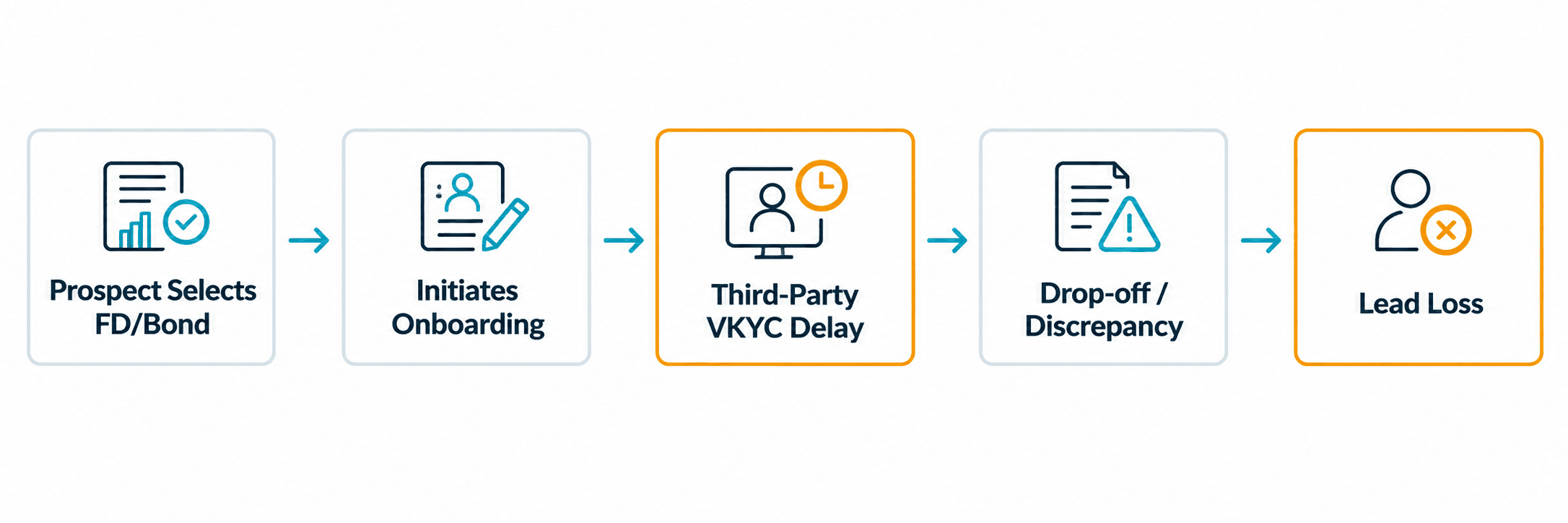
The enterprise struggled with four structural operational bottlenecks across its onboarding funnel:
1. High Abandonment at the VKYC Initiation Stage
The platform relied on third-party verification agencies to execute live VKYC calls. Applicants frequently failed to initiate or complete the VKYC process within the required regulatory time window. Manual telecalling teams lacked the capacity to engage applicants in real time, leading to cold leads and severe drop-offs within 24 hours of application creation.
2. High Support Load Driven by Educational Gaps
When manual agents called applicants to remind them to complete VKYC, customers rarely viewed the interaction as a purely administrative task. Instead, applicants used the outreach to ask complex, consultative questions regarding:
● Fixed Deposit interest payout schedules and premature withdrawal penalties.
● Credit ratings, corporate bond yields, and tax implications (e.g., TDS thresholds).
● Regulatory safety and deposit insurance coverage.
Traditional call center agents, trained primarily for transactional nudges, were unable to provide immediate, compliant financial guidance. This created drop-offs, as hesitant investors refused to complete VKYC without clarity on their investment choices.
3. Document Mismatch & Verification Exception Bottlenecks
Third-party document verification agencies frequently flagged verification failures, including:
● Optical Character Recognition (OCR) discrepancies between Aadhaar and PAN demographic details (e.g., spelling variations in name or date of birth mismatches).
● Unreadable image uploads (e.g., blurred Aadhaar card scans, poor lighting, cropped corners).
● Missing mandatory documentation (e.g., missing PAN card uploads for high-value bond orders).
Without an automated resolution protocol, flagged applications languished in manual compliance queues. By the time a human agent manually reviewed the failure, the applicant's time window had expired, forcing them to drop out.
4. Fragmented Follow-Up Loops and Lead Leakage
When document errors occurred that required a full re-application, the enterprise lacked an intelligent, persistent scheduling mechanism. Leads were routinely marked as "failed" without structured, automated workflows to guide users through re-booking or re-applying, resulting in high customer acquisition cost (CAC) waste.
How Did Subverse AI Solve the Problem?
To solve these interconnected challenges, the enterprise deployed Subverse AI to orchestrate an end-to-end, multi-agent autonomous onboarding architecture. Subverse AI integrated directly with the platform’s core backend, third-party VKYC agencies, and multi-channel messaging endpoints to drive applicants through the funnel.
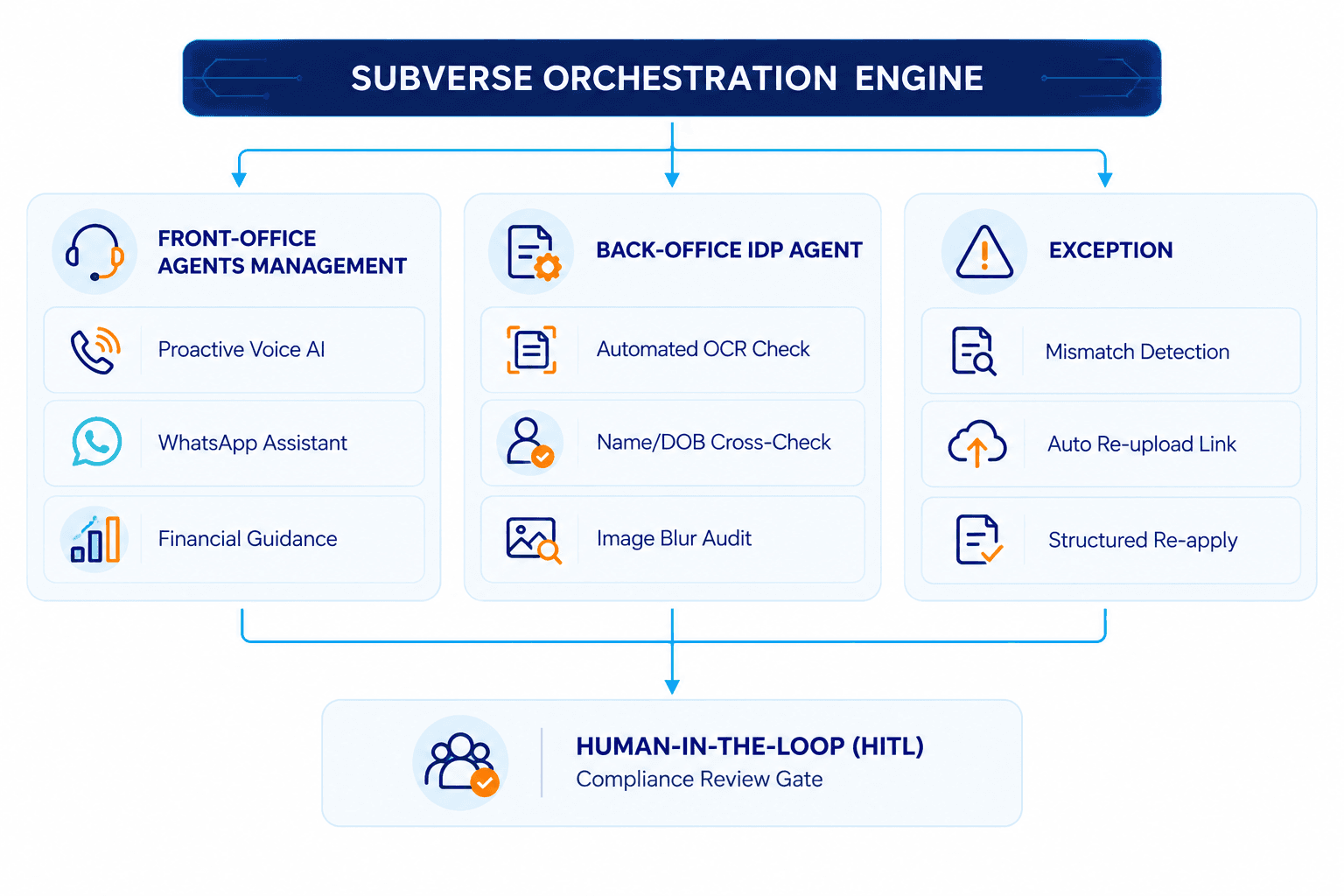
1. Webhook-Driven Proactive Outreach Engine
Subverse AI monitors application state triggers from the core platform. If an applicant creates an order for an FD or bond but fails to initiate VKYC within 15 minutes, Subverse triggers a synchronized multi-channel nudge via WhatsApp and interactive Voice AI.
2. Dual-Capability Front-Office Voice & WhatsApp Agents
Subverse AI deployed conversational front-office Voice and WhatsApp agents powered by domain-specific investment knowledge bases.
● Administrative Nudge: The agent informs the customer of the pending VKYC requirement and provides a direct, one-click link to launch the session with the third-party agency.
● Consultative Educational Support: If the customer asks questions during the call (e.g., "What happens if I break this FD before 12 months?" or "Is the yield on this corporate bond fixed or floating?"), the agent dynamically pivots from administrative reminder mode to an educational consultative mode. It retrieves accurate product parameters instantly and resolves investor doubts in real time.
3. Back-Office IDP & Mismatch Resolution Agent
Subverse AI’s back-office Intelligent Document Processing (IDP) agent receives real-time API payloads from third-party verification agencies. It executes automated verification checks:
● Discrepancy Identification: If the agency returns an error (e.g., name mismatch between Aadhaar and PAN, or blurred Aadhaar scan), Subverse AI parses the raw JSON diagnostic log to pinpoint the exact failure reason.
● Stipulated Timeframe Assessment: The platform evaluates whether the issue can be corrected within the current application window.
○ Fixable Errors (e.g., Blurred Document): Subverse AI automatically generates a personalized WhatsApp workflow requesting a clear re-upload of the specific document, complete with real-time image validation before re-submitting to the agency.
○ Unfixable Errors within Time Window (e.g., Legal Name Mismatch): Subverse AI notifies the user via WhatsApp/Voice, explains the precise reason for failure, and provides a pre-filled link to re-apply or re-book the investment seamlessly.
4. Persistent Entity Memory & Scheduled Re-Engagement
Subverse AI utilizes deep Entity Memory to track every applicant’s journey state, past document errors, product preferences, and previous conversational context across Voice and WhatsApp. If an applicant drops off, Subverse schedules intelligent, non-intrusive follow-up sequences across a 72-hour window, ensuring leads are nurtured until onboarding is fully finalized.
5. Human-in-the-Loop (HITL) Safety Gates
For high-net-worth individual (HNI) investments exceeding threshold limits, or complex compliance flags (e.g., Politically Exposed Person checks), Subverse routes the audit trail to human compliance officers via an internal agent control console.
What System Integrations & Multimodal Architecture Were Implemented?
Subverse AI operated as the central orchestration engine connecting legacy financial backends, verification APIs, and modern customer communication channels.
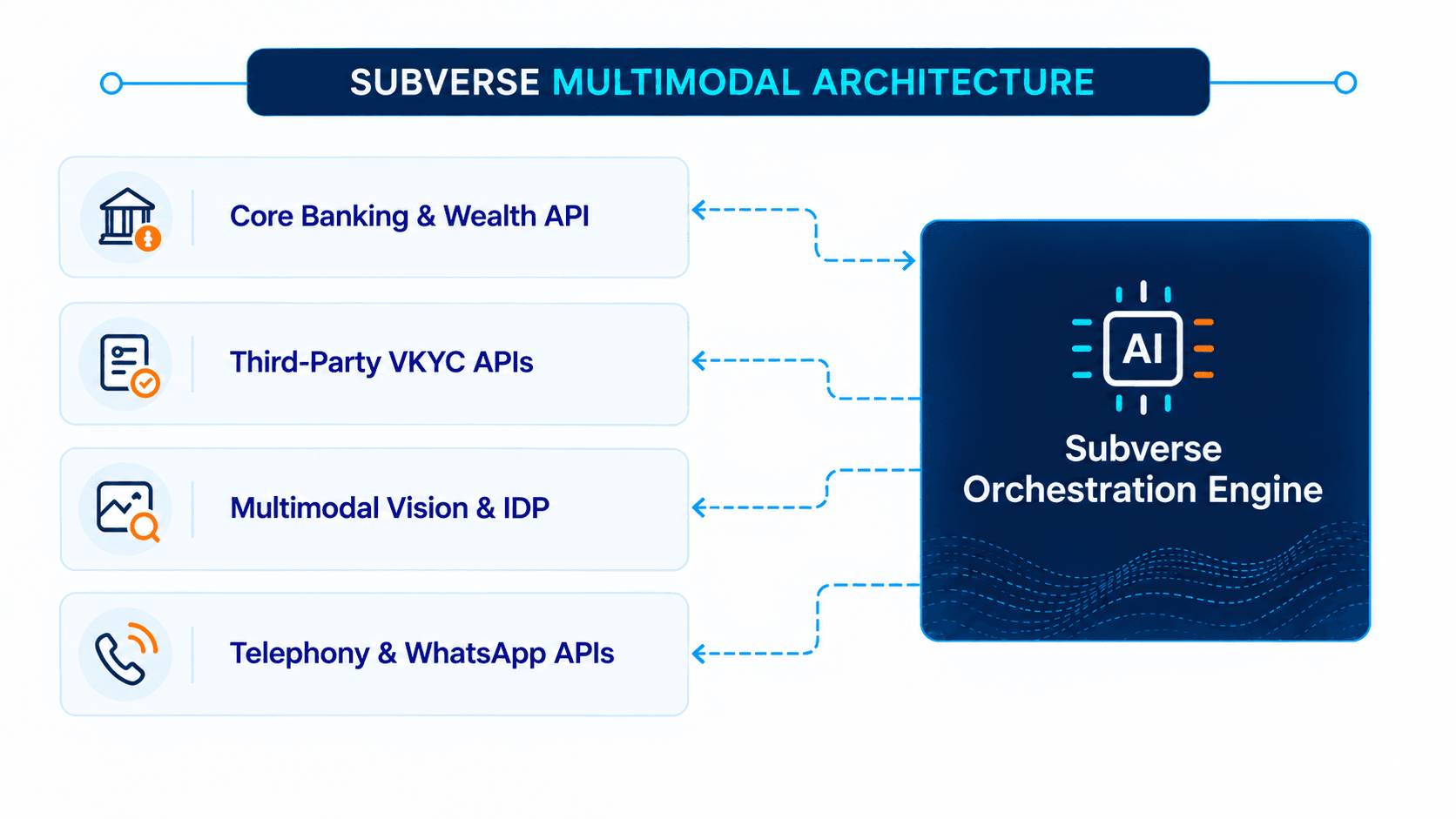
Core Architecture Components
● Core Wealth Platform APIs: Bidirectional integration with core order engines for real-time status updates on Fixed Deposits, bonds, and mutual fund purchases.
● Third-Party KYC & VKYC Webhooks: Real-time event listeners ingesting status payloads from external document verification agencies and video streaming providers.
● Multimodal Vision & IDP Engine: High-precision computer vision models to perform document quality checks, text extraction, blur detection, and cross-document validation across national identity cards (e.g., Aadhaar cards, PAN cards, passport documentation).
● Telephony & WhatsApp Business API Infrastructure: Ultra-low-latency voice synthesis and conversational streaming endpoints capable of handling over 50,000 concurrent multi-lingual interactions.
● Persistent Entity Memory Layer: Centralized state database maintaining contextual continuity across communication channels, preventing redundant questions and preserving application data.
Traditional Approach vs. Subverse Autonomous AI Workflow
Parameter | Traditional Manual & Point-Solution Approach | Subverse Autonomous AI Workflow |
VKYC Initiation SLA | Manual follow-up takes 4–24 hours; high drop-off. | Automated multi-channel nudges within 15 minutes. |
Educational Guidance | Call center agents lack product expertise; high escalation rates. | Dual-mode Voice/WhatsApp agents answer complex yield, tax, and product queries instantly. |
Document Discrepancy Handling | Manual ticket creation; takes 2–3 business days to notify user. | Real-time IDP parses agency errors instantly; issues automated re-upload links within seconds. |
Exception Recovery Rate | Less than 12% of stalled applications are ever recovered. | 41% of document discrepancy drop-offs successfully recovered and completed. |
Onboarding Turnaround Time (TAT) | 48 to 72 hours average turnaround time. | Under 8 minutes for straight-through processing (STP) applications. |
Operational Scalability | Linear scaling cost; requires hiring agents during market spikes. | Infinite elastic scaling with zero incremental operational headcount. |
What Was the Business Impact and KPI Improvement?
By deploying Subverse AI as the primary orchestration layer for VKYC and onboarding, the enterprise transformed its operational efficiency and customer conversion metrics within 90 days.
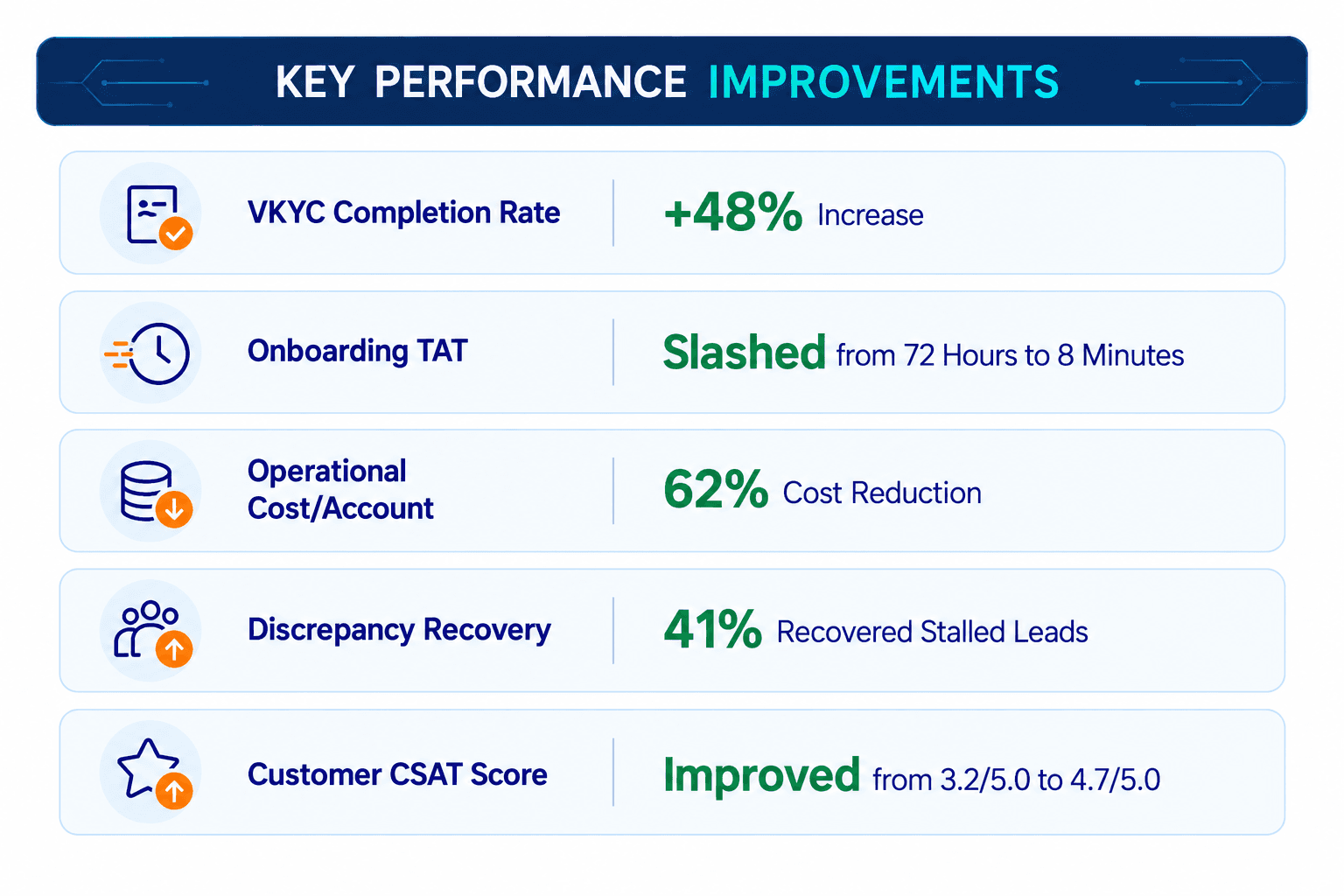
Cost & Efficiency Metrics
● 62% Reduction in Onboarding Operational Cost: Decreased reliance on manual call centers and manual document auditing teams.
● 85% Reduction in Human Touchpoints: Straight-through processing (STP) rate for compliant applications reached 88%.
Speed & SLA Metrics
● 72 Hours to 8 Minutes: Average customer onboarding completion time dropped drastically for error-free applications.
● 54% Boost in 30-Minute Initiation: More than half of all pending applicants initiated VKYC within 30 minutes of receiving the automated Subverse AI nudge.
Quality, Conversion & CSAT Metrics
● 48% Overall Increase in VKYC Completion Rates: Directly translated to higher active investor conversion for fixed income products.
● 41% Drop-Off Recovery Rate: Replaced dead-end application errors with dynamic re-application and re-upload workflows.
● 4.7 / 5.0 CSAT Score: Customer satisfaction scores surged due to instant, accurate educational support during onboarding calls.
Frequently Asked Questions (FAQ)
How does Subverse AI handle customer questions during VKYC follow-up calls?
Subverse AI uses domain-trained conversational models that instantly pivot from administrative reminders to consultative guidance. It answers specific queries regarding yield calculations, lock-in terms, tax deductions, and safety ratings before seamlessly redirecting the applicant back to complete their VKYC session.
What happens when a document mismatch cannot be resolved within the time limit?
When document errors (such as legal name mismatches between PAN and Aadhaar) cannot be fixed instantly, Subverse AI informs the applicant via WhatsApp or Voice, explains the issue clearly, and provides a pre-filled link to easily re-book or re-apply without losing their initial context.
How does Subverse AI integrate with external third-party VKYC agencies?
Subverse AI integrates via webhooks and REST APIs with third-party verification agencies. It listens for real-time status updates, parses error diagnostics from OCR/VKYC payloads, and automatically triggers downstream customer nudges or document re-upload workflows without human intervention.
Can Subverse AI handle multi-lingual customer educational calls?
Yes. Subverse AI supports multi-lingual voice synthesis and natural language understanding across dozens of global languages and regional dialects. It dynamically adapts its spoken language based on user preference or historical communication metadata stored in its Entity Memory.
How does Entity Memory prevent applicant fatigue during onboarding?
Subverse AI’s Entity Memory tracks customer interactions across all channels (Voice, WhatsApp, Web). If a customer asks a question on WhatsApp and later receives a voice call, the Voice AI agent retains that context, ensuring consistent, non-repetitive, and personalized conversations.
Table of Content
More Insights