Jul 10, 2026
How predictive intelligence, industry data, and AI are quietly changing the way insurers understand risk

Ask someone how AI is changing insurance, and the answers are usually predictable. Faster claims. Smarter chatbots. Digital onboarding. Better customer service.
Those developments matter, but they are only part of the story.
Some of the biggest changes are happening where customers never look. AI is quietly reshaping how insurers assess risk, detect fraud, price products, process claims, and develop products for a much broader and more diverse insured population. It is also changing how the industry uses data to identify emerging risks and make better decisions long before customers ever interact with an insurer.
For India, this shift comes at an important time. The country aims to achieve 'Insurance for All by 2047,' a vision that will require insurers to serve millions of first-time policyholders while managing risk at an unprecedented scale. According to the Insurance Regulatory and Development Authority of India, insurance penetration stood at 3.7% in FY24, highlighting both the opportunity and the challenge ahead. As insurers expand their reach, technology will become critical in helping them balance growth with prudent risk management.
Few people have watched this evolution as closely as Dr. (Maj.) Mukund Kulkarni, Chief Business Officer at the Insurance Information Bureau of India (IIB). Over the past two decades, he has worked across insurance medicine, underwriting, global reinsurance, and now India's largest insurance data repository. His perspective offers a useful lens on where AI is creating real impact, and why the industry's biggest transformation is happening behind the scenes.

Insurance Has Always Been a Business of Understanding Uncertainty
Insurance has never been about predicting the future with certainty. It has always been about making the best possible decision with the information available at a given point in time.
Every policy issued is based on a simple question: How likely is this risk, and what is the right price for it?
The answer has traditionally come from actuarial models, medical assessments, historical claims data, and years of underwriting experience. But as risks become more complex and data becomes more abundant, insurers are finding that traditional methods alone are no longer enough.
Dr. Mukund Kulkarni's own career reflects this evolution.
Before entering insurance, he served as a medical officer in the Indian Army during the Kargil conflict, where quick decisions often had to be made with incomplete information. He later moved to Reliance Industries, helping build occupational health systems at the Jamnagar refinery before making what many would consider an unconventional career move into insurance.
Looking back, he does not see those transitions as disconnected.
"It is not a single thread. A lot of people get confused looking at my profile. I would say it's more about opportunities to make a macro-level impact rather than an individual-level career transition."
That search for broader impact led him to a field that was still taking shape in India.
In 2007, insurers had just begun recognising the value of medical expertise in underwriting. Until then, underwriting was largely viewed as a financial and actuarial function. Medical professionals were brought in mainly to interpret health reports and support individual decisions.
Dr. Kulkarni saw a much bigger opportunity.
Instead of applying medical knowledge one patient at a time, insurance medicine offered the chance to influence how entire populations were assessed for risk. That perspective later expanded through regional and global roles with reinsurers and multinational insurers before bringing him to the Insurance Information Bureau of India.
His career also mirrors a larger shift taking place across the industry. Insurance is moving away from relying solely on historical data and static rulebooks. Today, insurers have access to digital health records, wellness data, financial behaviour, claims histories, and other alternative data sources that simply did not exist a decade ago.
The challenge is no longer collecting information. The challenge is making sense of it.
That is where AI is beginning to change the conversation.
As Dr. Kulkarni puts it:
"We all know that data is the new fuel. There are a lot of things which we can do, and we are trying to do a lot at IIB."
That shift in thinking is now shaping how insurers approach underwriting, pricing, claims, and risk management in the age of AI.
Insurance Needed More Than Actuarial Models
Insurance has always been a numbers business, but numbers alone have never told the complete story.
Behind every life insurance application or health policy is a combination of medical history, lifestyle, family background, financial circumstances, and human behaviour. For years, insurers relied heavily on actuarial science to quantify these risks, while medical professionals were brought in only when a case required clinical interpretation.
Dr. Mukund Kulkarni believes that approach overlooked an important reality.
"If you understand the foundational aspects of risk management and insurance, it is a hybrid of actuarial science mixed with medical science and also mixed with business science."
That balance is what makes insurance unique.
Actuarial science estimates the probability of future events using statistical models and historical experience. Medical science helps insurers understand the underlying health risks that those models cannot fully explain. Business strategy determines how much risk an insurer is willing to take, which customer segments it wants to serve, and how products are priced and distributed.
When these three disciplines work together, underwriting becomes more than a checklist. It becomes a structured process for balancing customer access with financial sustainability.
The role of medical experts has also evolved significantly over the last two decades. Earlier, their involvement was largely limited to reviewing laboratory reports or identifying pre-existing conditions. Today, they contribute much earlier in the insurance value chain.
As Dr. Kulkarni explains, medical expertise now plays a role in product design, underwriting, claims management, hospital partnerships, and even the development of predictive technologies.
"Right from day one, when you start designing a product, you need a little bit of medical expertise to create those guardrails or boundaries, which are inputs to the actuarial team to price any product."
The industry is already moving in that direction. According to Deloitte's report, Scaling Gen AI in Insurance, 76% of insurance executives surveyed said their organisations have already implemented generative AI in one or more business functions. More importantly, insurers are no longer limiting AI to customer service or isolated pilot projects. They are embedding it across underwriting, claims, risk management, product development, and operations to improve decision-making at scale.
For Indian insurers, this shift is particularly significant.
The industry is expanding into newer customer segments, including first-time buyers, rural households, and younger digital-first consumers. These groups bring different risk profiles, different behaviours, and different expectations. A one-size-fits-all underwriting approach is becoming increasingly difficult to sustain.
This is also where AI starts becoming relevant, not as a replacement for actuarial or medical expertise, but as a tool that helps connect them. Rather than making decisions independently, AI enables insurers to analyse larger volumes of information, identify patterns that may otherwise go unnoticed, and support experts in making more informed risk assessments.
The future of underwriting is unlikely to be defined by fewer experts. Instead, it will depend on stronger collaboration between human expertise, data, and intelligent systems.
From Rule-Based Underwriting to Predictive Intelligence
For decades, underwriting followed a familiar process. Customers filled out proposal forms, answered medical questionnaires, underwent health tests where required, and waited for an underwriter to assess the risk. The process was thorough, but it was also time-consuming and largely dependent on the information available at that moment.
According to Dr. Mukund Kulkarni, underwriting has always been a balancing act. Insurers cannot ask for unlimited medical tests because every additional requirement increases costs and slows down the customer journey.
"People used to do a very traditional way of medical tests. You can't do an unlimited amount of testing because you have to somewhere have a cap. It was more of a feedback loop. Claims experience would come in, and then we would revise the underwriting practices."
That feedback loop worked well when insurers had access to relatively limited data. Today, the situation is very different.
Customers leave behind digital footprints across healthcare, finance, wellness platforms, wearable devices, and even routine financial transactions. While each source serves a different purpose, together they offer a much richer picture of an individual's risk profile than a single proposal form ever could.
Dr. Kulkarni believes this growing availability of data has fundamentally changed how underwriting is evolving.
"With the expansion of availability of data, with the expansion of variety of data coming in, technology follows very quickly on this."
He points to three developments that are reshaping underwriting.
The first is alternative data. Instead of relying only on medical declarations, insurers are beginning to use broader indicators such as financial behaviour, wellness participation, and health risk scores to better understand long-term risk.
The second is the growth of preventive healthcare and digital wellness ecosystems. Fitness apps, annual health check-ups, telemedicine, and wearable devices are generating continuous health data that was simply unavailable a decade ago. While privacy and consent remain critical, these data sources can help insurers move from one-time assessments to a more dynamic understanding of risk.
The third is the rise of AI-powered predictive models.
Rather than replacing underwriters, these models help them identify patterns that would be difficult to detect manually. AI can analyse thousands of variables simultaneously, flag inconsistencies in applications, identify potential fraud, and estimate future claims probabilities using historical and real-time data.
This is already becoming a priority across the global insurance industry. According to McKinsey & Company's report, The Future of AI in the Insurance Industry, AI has the potential to improve underwriting accuracy, accelerate decision-making, and enable more personalised products by combining structured and unstructured data at scale. The report also notes that insurers creating the most value are redesigning underwriting workflows around AI instead of simply adding AI tools to existing processes.
The impact extends beyond operational efficiency.
As insurers gain access to richer data, underwriting can gradually become more proactive than reactive. Instead of evaluating customers only when they purchase a policy, insurers can identify emerging risks earlier, encourage healthier behaviour through wellness programmes, and design products that reflect changing lifestyles rather than static assumptions.
This shift also supports India's broader insurance ambitions.
As insurers reach first-time buyers across rural and semi-urban markets, scalable underwriting becomes essential. AI cannot replace the judgement of experienced underwriters or medical experts, but it can help them make faster, more consistent decisions across millions of policies.
Dr. Kulkarni sees this as one of AI's biggest strengths.
"We are now able to underwrite in a much better way. We are making the front end much lighter and the back end much heavier so that the customer gets a much better experience of buying."
That distinction captures the industry's direction well. Customers experience a simpler and faster buying journey, while behind the scenes, insurers are investing in increasingly sophisticated intelligence to ensure those decisions remain accurate, responsible, and commercially sustainable.
Data Is Becoming Insurance's Competitive Advantage
If AI is the engine behind modern insurance, data is the fuel that keeps it running.
Every insurer generates enormous volumes of information through policy applications, claims, renewals, customer interactions, and risk assessments. The challenge is that no single insurer has a complete picture. Each company sees only a fraction of a customer's insurance journey, making it difficult to identify broader trends, emerging risks, or fraud patterns across the industry.
This is where the role of the Insurance Information Bureau of India (IIB) becomes significant.
Unlike an individual insurer, IIB brings together data submitted by registered insurers across the country, creating one of India's largest insurance data repositories. According to Dr. Mukund Kulkarni, the organisation is no longer positioning itself as a passive data custodian.
"Since the last three years, we have been transforming a lot. Our strategy has been to move out from a passive data partner to a very active business enabler or risk enabler."
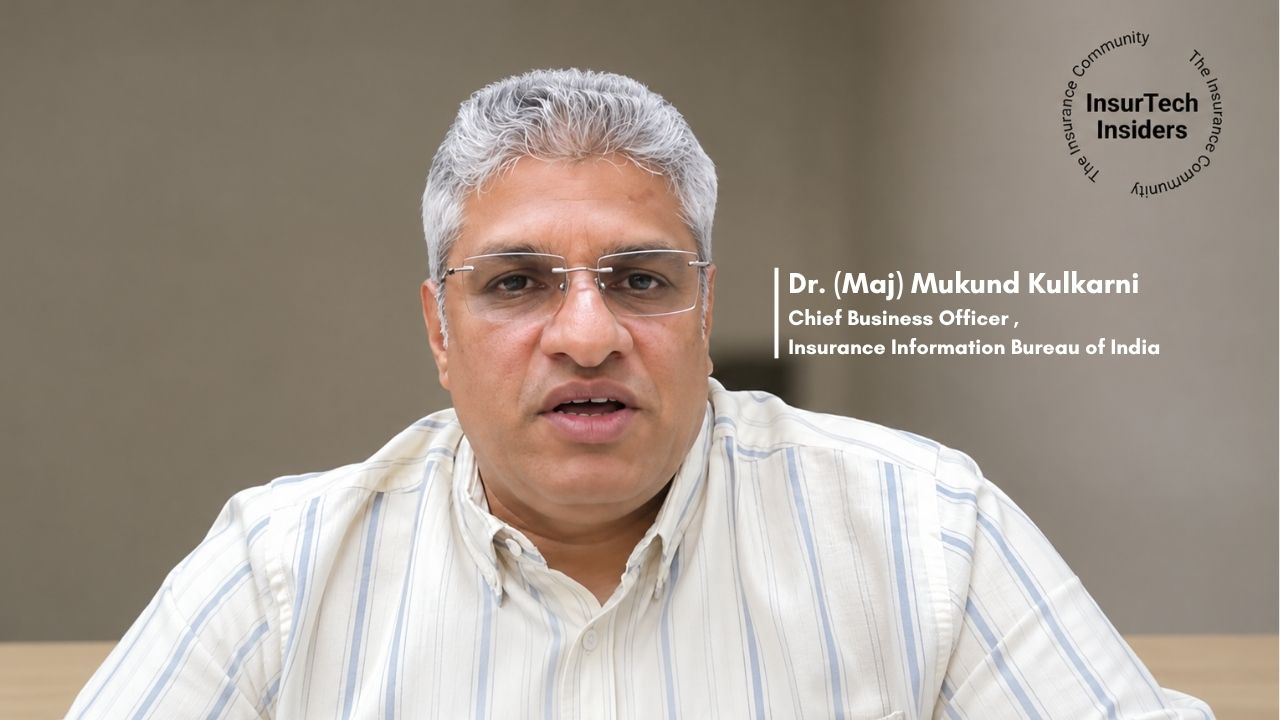
Dr. (Maj.) Mukund Kulkarni discussing how IIB is evolving from a data repository into a business enabler.
That transformation is happening across three levels.
The first is transactional intelligence.
Insurers can access customer-level information, including longitudinal policy histories and claims records, to support underwriting and claims decisions in real time. Instead of relying only on the information collected during policy issuance, insurers gain a broader view of an applicant's insurance history.
The second is predictive intelligence.
By combining information from multiple datasets, IIB develops predictive models that help insurers assess fraud risk, claims behaviour, and policy persistence. Rather than replacing insurers' own models, these insights complement internal risk assessments by adding an industry-wide perspective.
"We have built a lot of predictive models and this is where we are utilising AI and advanced technologies. We bring predictive models from multiple-source intelligence, but our models work in tandem with insurers' own models."
The third is scientific intelligence.
IIB also publishes mortality and morbidity studies that help insurers develop actuarially sound products. These studies, endorsed by the regulator, provide common benchmarks so insurers can price products using broader industry experience instead of relying solely on their own historical data.
"Everybody has to price scientifically, and that science is provided centrally from IIB."
This approach reflects a larger shift happening across the insurance industry. According to the IBM Institute for Business Value's Insurance in the AI Era report, insurers are using AI not just to automate workflows but to improve decision-making across operations. The report notes that 40% of insurers' AI spending is allocated to operational efficiency and cost reduction, while 75% of surveyed executives believe AI will improve personalisation and customer experience. It also highlights that AI delivers the greatest value when insurers can combine information from multiple systems instead of working with isolated datasets.
The same principle applies in India.
As insurance expands to millions of new customers, insurers will need more than faster technology. They will need reliable industry-wide intelligence that helps distinguish genuine risk from unnecessary friction while supporting more consistent underwriting decisions across the market.
This is perhaps the most overlooked way AI is reshaping insurance.
Customers may never see the predictive models running behind the scenes or the datasets being analysed in real time. But those systems influence everything from underwriting decisions and fraud detection to product pricing and claims outcomes.
For insurers, competitive advantage is no longer determined only by how much data they collect. It increasingly depends on how effectively they combine data, AI, and domain expertise to make better decisions.
AI Is Redefining Claims, Not Just Speeding Them Up
Claims are often described as the "moment of truth" in insurance. A customer may spend years paying premiums, but it is the claims experience that ultimately shapes their trust in an insurer.
That is why claims have become one of the biggest focus areas for AI adoption.
Many insurers have already automated parts of the claims journey, from document collection and verification to fraud detection and settlement. But Dr. Mukund Kulkarni believes the bigger shift is happening behind the scenes, where AI is helping insurers make faster decisions without compromising on risk controls.
"There are certain areas where straight-through processing of claims is happening today without human intervention at all."

He points to health insurance as one example. For standard treatments at trusted hospital networks and within defined claim limits, some insurers are already processing claims automatically. These decisions are supported by fraud detection models, hospital performance data, and predefined risk controls rather than manual intervention.
If everything meets the required thresholds, the claim can move from submission to settlement without an employee reviewing each step.
The same thinking is beginning to appear in life insurance.
"I know a couple of insurers who experimented on the principles of claims guarantee. When you buy a policy, you actually get a guarantee that your claim will never be declined."
While such models are still limited to specific products and underwriting conditions, they represent an important shift. Instead of asking customers to prove their claim years later, insurers are investing more effort at the underwriting stage so claims can be settled with greater confidence.
This also changes the role of AI.
Most discussions focus on automation, but automation alone cannot improve claims outcomes. Insurance claims involve medical records, policy conditions, historical claims data, fraud indicators, and information from multiple stakeholders including hospitals, surveyors, and third-party administrators. AI helps connect fragmented sources of data and identify patterns that would be difficult to detect through manual review alone.
As Dr. Kulkarni explains:
"We still need aggregate-level intelligence. IIB gets data from almost ten different sources and creates predictive models on claims, persistence and fraud. That is impossible from a human angle."
Industry research supports this direction. According to Capgemini's World Property and Casualty Insurance Report 2025, insurers are increasingly using AI to automate routine claims, detect fraud earlier, and improve decision-making rather than simply reduce processing time. The report notes that AI is helping insurers shift claims teams towards handling more complex cases while routine claims are processed with greater speed and consistency.
That distinction matters.
The future of claims is unlikely to be completely human-free. Complex claims involving litigation, catastrophic losses, or medical disputes will continue to require human judgement. What AI changes is the volume of routine work that can be completed accurately before a claim ever reaches a claims manager.
For customers, the difference is simple. Less paperwork. Faster settlements. Better visibility into claim status.
For insurers, the benefits are much broader. Lower operational costs, improved fraud detection, more consistent decisions, and higher customer trust.
As India's insurance market expands, these efficiencies will become increasingly important. Processing millions of additional claims using traditional workflows alone will not be practical. AI is making that scale possible, one decision at a time.
Technology Can Scale Insurance. Trust Will Decide Its Future.
For all the progress AI has made, technology alone will not determine whether India's insurance ambitions succeed.
The bigger challenge is trust.
India has set an ambitious goal of achieving Insurance for All by 2047, but expanding coverage is not simply about building better technology or introducing more digital products. It also requires people to believe that insurance is worth buying and that insurers will stand by them when they need support the most.
Dr. Mukund Kulkarni believes this remains one of the industry's biggest hurdles.
"The major barrier is whether insurance still becomes a product which people would like to buy."
He argues that affordability is only one part of the equation. Even among people who can afford insurance, adoption remains lower than expected. One reason is the sheer complexity of products available today.
"If you really see the variety of products, I would say there are more than 50 variations in health insurance products today. Even the best educated people, including you and me, would get confused."
AI also has the potential to simplify that experience. Intelligent recommendation engines can help customers compare policies based on their needs rather than forcing them to navigate dozens of product variants. AI-powered advisors can explain policy terms in plain language, answer questions in regional languages, and recommend appropriate coverage instead of overwhelming customers with options.
However, making insurance easier to understand also requires responsible use of customer data.
Insurance depends heavily on personal information, including medical records, financial history, identity documents, and claims data. As insurers adopt AI across underwriting, pricing, and claims, protecting that information becomes just as important as using it effectively.
Dr. Kulkarni sees India's Digital Personal Data Protection (DPDP) Act as a necessary step in that direction.
"Insurance cannot work without personal data. With the DPDP compliance coming in, a lot of restructuring and re-engineering will happen."
For insurers, compliance is not just a regulatory exercise. It will require investments in data governance, consent management, cybersecurity, and AI systems that are transparent and accountable. Companies that build these capabilities early are likely to be better positioned as AI adoption accelerates across the industry.
This reflects a broader global conversation around responsible AI adoption. The World Economic Forum's 2025 report, Blueprint for Intelligent Economies, argues that building successful AI ecosystems requires more than technological capability. It identifies responsible data governance, collaboration across stakeholders, and public trust as essential pillars for scaling AI across industries. As organisations become increasingly data-driven, long-term success will depend not only on innovation but also on how securely and transparently customer data is managed.
Dr. Kulkarni believes trust must extend beyond individual insurers.
"This is not one operator's job. The entire ecosystem has to come together, put the citizens at the centre and align their services towards one common goal, which is trust."
That observation perhaps captures the industry's next challenge better than any discussion around algorithms or automation.
AI can improve underwriting, accelerate claims, strengthen fraud detection, and support better decision-making across the insurance value chain.
But whether more Indians choose to buy insurance, renew their policies, and recommend insurers to others will ultimately depend on something that cannot be automated.
Trust.
The Future of Insurance Is Bigger Than AI
AI is undoubtedly changing insurance, but not in the way most people imagine.
While customer-facing experiences will continue to improve, the industry's biggest transformation is happening behind the scenes. From underwriting and fraud detection to claims processing and actuarial modelling, AI is helping insurers make faster, smarter, and more consistent decisions at scale.
As India moves towards its vision of Insurance for All by 2047, technology alone will not be enough. Success will depend on combining AI with trusted data, domain expertise, responsible governance, and customer confidence.
The insurers that create lasting value will not simply automate processes. They will use AI to build a more resilient, accessible, and trusted insurance ecosystem, one where technology supports people rather than replaces them.
About InsurTech Insiders
This article draws on insights from an InsurTech Insiders conversation with Dr. (Maj.) Mukund Kulkarni, Chief Business Officer, Insurance Information Bureau of India (IIB). To explore more conversations on AI and the future of insurance, join the InsurTech Insiders- The Insurance AI Community by SubVerse AI on Linkedin.
Table of Content
More Insights