May 21, 2026
Introduction: The LLM’s Short Term Memory Problem
Large Language Models (LLMs) are brilliant at generating language but terrible at remembering it. This is their biggest Achilles' heel. Just like a call center virtual assistant that forgets what a customer said 2 minutes ago, an LLM without memory breaks the flow, shatters trust, and creates robotic conversations.
The culprit?
The context window. Once a conversation exceeds this window, details vanish names, past purchases, issue history, preferences, everything.
For real time agent assist, contact center automation, and voice AI, forgetting is not just inconvenient it destroys the experience.
This is exactly where the Memory Layer comes in: the external, persistent brain that transforms an LLM from a clever text generator into a truly intelligent call center or customer service agent.
What Exactly Is the Memory Layer? The LLM’s External Brain 🧠
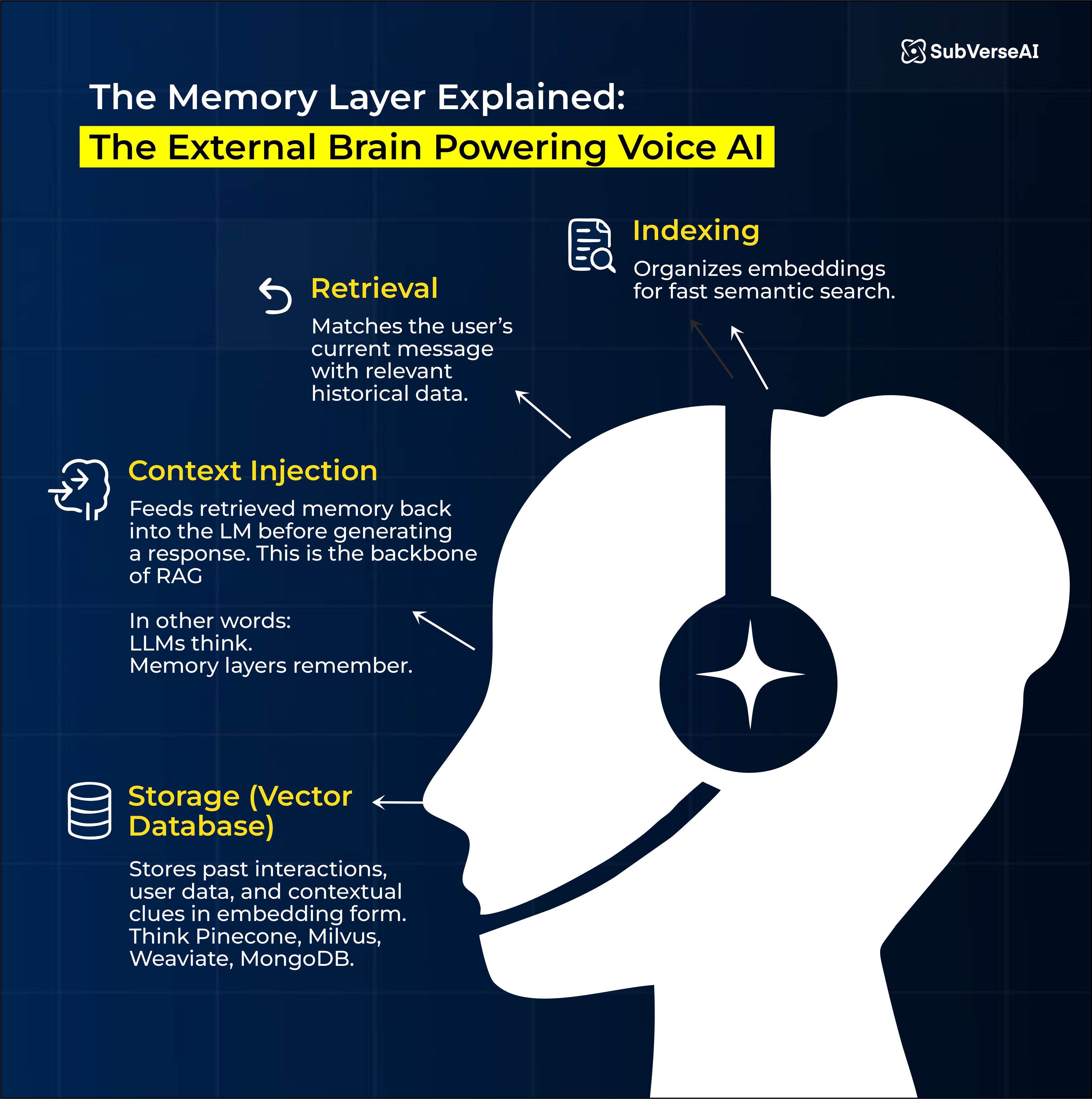
A Memory Layer is a structured system that gives an LLM long term recall, something it fundamentally lacks.
It typically includes:
1. Storage (Vector Database)
Stores past interactions, user data, and contextual clues in embedding form.
Think Pinecone, Milvus, Weaviate, MongoDB.
2. Indexing
Organizes embeddings for fast semantic search.
3. Retrieval
Matches the user’s current message with relevant historical data.
4. Context Injection
Feeds retrieved memory back into the LLM before generating a response.
This is the backbone of Retrieval Augmented Generation (RAG).
In other words:
➡️ LLMs think.
➡️ Memory layers remember.
This is the foundation of knowledge AI, conversation intelligence, and intelligent call center systems that actually feel human.
Why the Memory Layer Is Non Negotiable for Voice Agents 📞
Voice agents operate in one of the toughest environments:
Zero latency
Continuous turn-taking
High expectation of personalization
No patience from the user
Here’s why memory is essential:
1. Continuity Across Calls
Customers expect a contact center virtual assistant to remember their previous issue or open ticket - not restart from zero.
2. Personalized Response
Voice AI in industries like financial services, insurance, and healthcare needs contextual awareness to offer relevant advice.
3. Ultra-Low Latency Requirements
Text chat can afford a pause.
Voice cannot.
Even a 1 second delay breaks the illusion.
This makes memory the foundation of modern contact center automation tools and AI customer experience in financial services.
The Latency Trap: Why Mid Conversation Retrieval Fails ⚡
Traditional memory systems fetch context during the conversation.
Great for chatbots.
A disaster for voice.
Mid-call querying means:
❌ LLM pauses
❌ Vector DB query
❌ Embedding search
❌ Context re-injection
❌ Long awkward silence
This is unacceptable for real time agent assist or any phone-based workflow.
SubVerse AI Breakthrough: Proactive Context Passing
To meet the demands of AI-powered contact centers, SubVerse AI developed a new strategy:
Pre-load all context before the call begins.
✔ Post-Call Summaries
Each call generates a structured call analysis.
✔ Rolling User History Profile
We compress and refine history into a concise, always-up-to-date user profile.
✔ Pre-Call Injection
When a call starts, we pass the profile into the system prompt.
The agent begins speaking already aware of:
customer identity
previous issues
preferences
tone
past resolutions
This eliminates mid-call latency entirely.
It's the difference between a robotic script reader and a truly intelligent call center experience.
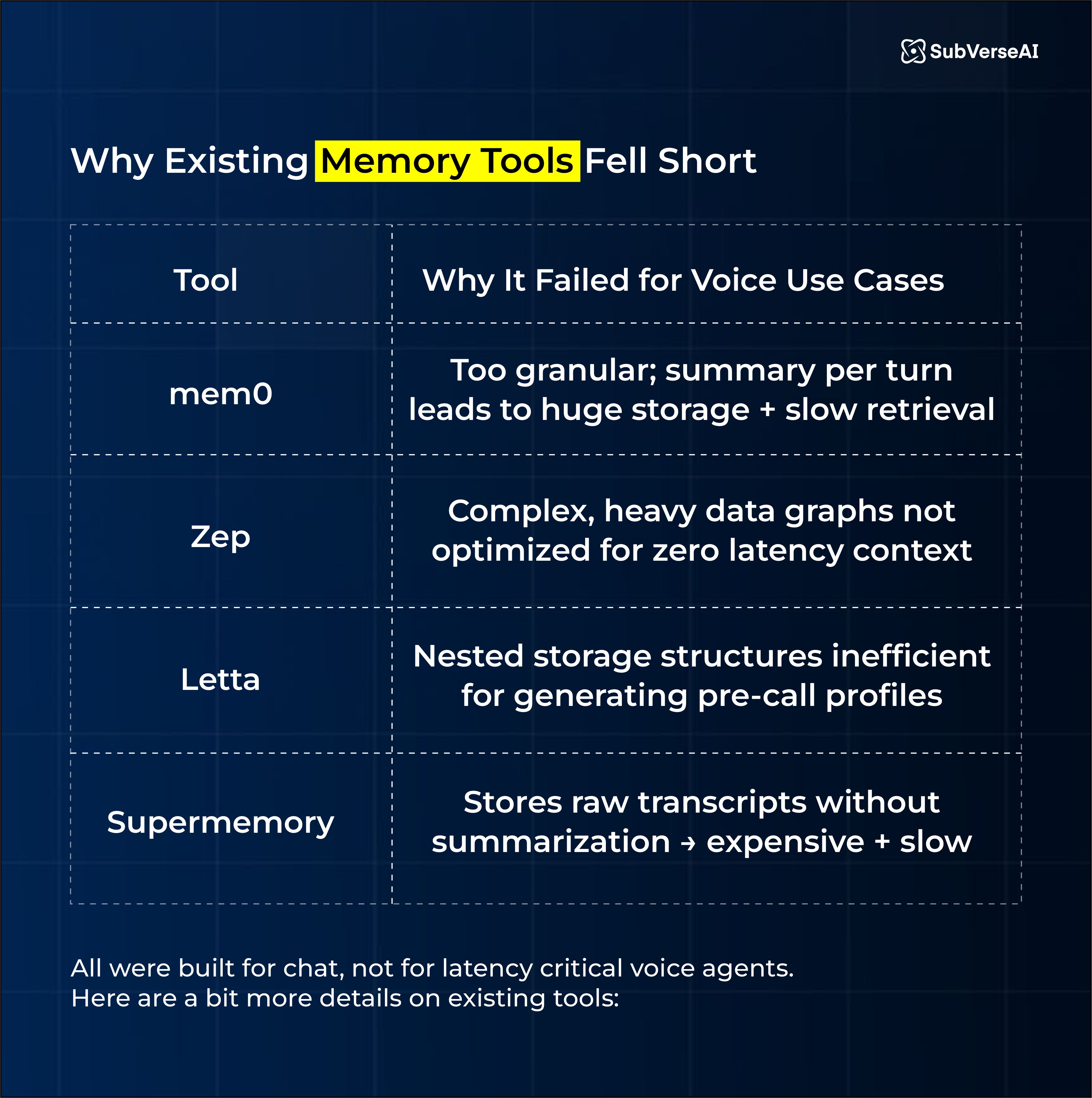
Why Existing Memory Tools Fell Short (mem0, Zep, Letta, Supermemory)
The Future of Context-Aware AI: From Memory to Mastery 🚀
As voice AI becomes embedded in banking, insurance, e-commerce, and healthcare, the next frontier includes:
1. Adaptive Memory Retrieval
Dynamic switching between proactive and real-time based on latency budgets.
2. Knowledge Graph Integration
Understanding relationships, not just storing text - essential for enterprise reasoning.
3. Intelligent Forgetting
Smarter compression so systems only store the most useful facts.
This is the evolution from basic voicebots to true conversation intelligence platforms.
Table of Content
More Insights


